

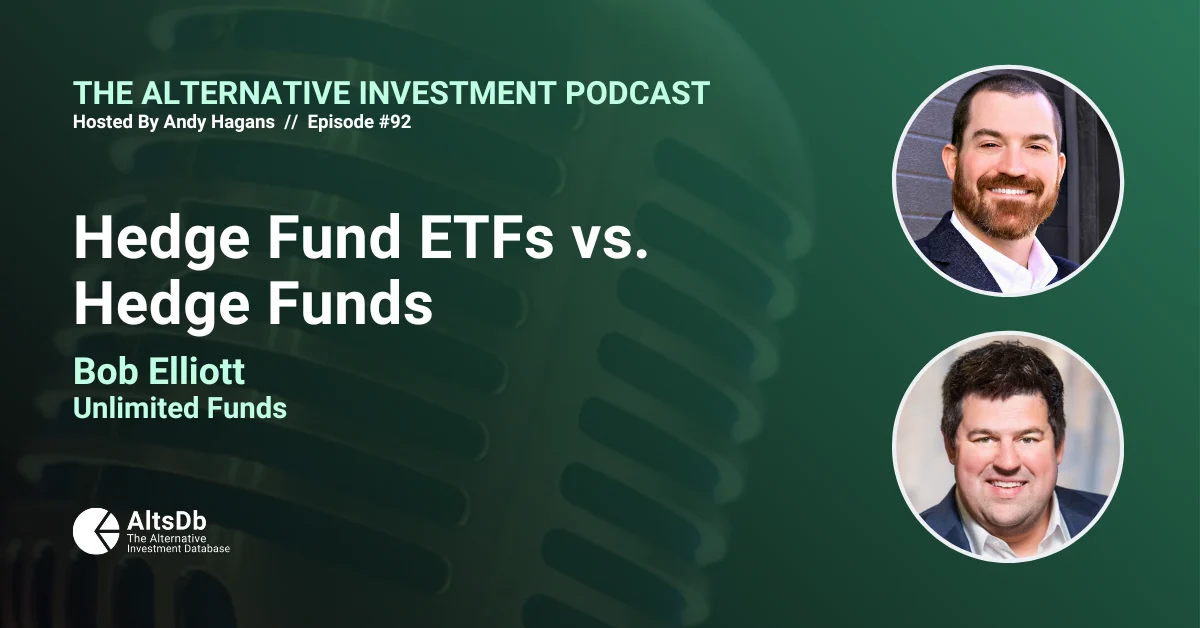
Leading hedge funds have long been recognized for their potential to generate substantial investor returns through active management, but this performance often comes with a significant price tag. Bob Elliott, CEO of Unlimited Funds, recently sat down with The Alternative Investment Podcast to discuss his firm’s innovative approach with the HFND ETF, arguing that alternative Exchange Traded Funds (ETFs) can indeed outperform traditional hedge funds, even after accounting for fees. This conversation delves into the intricate world of hedge fund strategies, the challenges faced by investors seeking access, and how technology, particularly machine learning, is reshaping the landscape of alternative investments.
The Allure and Accessibility of Hedge Funds
The term "hedge fund" often conjures images of exclusive, high-stakes investment arenas. For many outside the industry, it remains a somewhat opaque concept, perceived as a "secret club" where only the most sophisticated investors gain entry. However, the underlying strategies employed by hedge funds aim to provide diverse return streams, often uncorrelated to traditional markets, and to manage risk more effectively, especially during periods of market stress.
Bob Elliott’s career journey offers a unique perspective on this world. He began his career at Bridgewater Associates, a firm renowned for its systematic approach to macro investing. "Bridgewater’s real innovation…was bringing the sort of rigorous and systematic approaches…into the macro space," Elliott explained. Over his nearly 15 years at the firm, he developed a deep understanding of macroeconomic drivers and the construction of systematic investment strategies, many of which were instrumental in Bridgewater’s flagship Pure Alpha fund. This foundational experience provided him with a comprehensive grasp of various asset classes, investment strategies, and the power of systematic approaches to gain an edge in investing.
Elliott’s academic background in the pure sciences, specifically botany, highlights an unconventional path into finance. Recognizing that a career in scientific research wasn’t his ultimate goal, he turned his innate interest in investing and the macroeconomy towards finance. His initial intention was to gain a temporary, hands-on education, but this evolved into a nearly 15-year tenure, witnessing Bridgewater’s transformation from a challenger to an established player.
Deconstructing Macroeconomic Investing
The understanding of how the macroeconomy functions is a central theme in Elliott’s expertise. He posits that the real-world macroeconomy operates quite differently from theoretical models taught in academic settings. "A big part of developing that understanding was sort of understanding and thinking about the intuitive cause-effect drivers of the macroeconomy in asset classes," he stated. This involves identifying linkages, such as the expected rise in bond yields when inflation exceeds expectations, and then quantifying these relationships.
Systematization, in this context, is the process of quantifying these intuitions and applying them in a disciplined, repeatable manner. "The biggest benefit of systemization is quantification and discipline," Elliott emphasized. Discretionary investors can often be swayed by incremental news, leading to overreactions or underreactions. Systematic approaches, however, offer discipline, synthesize diverse information, and execute strategies as designed.
The success of macro investing, even for the best practitioners, is not about perfect prediction but about a statistical edge. Elliott illustrated this by noting that even top macro investors are wrong about 45% of the time in any given month. However, by consistently applying a strategy with a slight probabilistic advantage (e.g., a 55/45 win ratio) across multiple markets, significant long-term gains can be achieved. This is akin to a skilled blackjack player who, by understanding odds and making strategic decisions, can consistently outperform the house over time.
The Complexity of Market Reactions and Predictive Modeling
The interconnectedness of economic events and policy responses presents a formidable challenge for investors. As Elliott noted, observing a linkage like rising inflation leading to higher bond yields is only the first step. The subsequent reactions from central banks, policy changes, and market pricing add layers of complexity. "There has to be like an order of magnitude less certainty in the reaction to the reaction," Andy Hagans, the podcast host, observed.
Elliott clarified that the goal of systematic macro investing isn’t to achieve perfect foresight but to gain an edge in predicting the actions of market participants. This involves understanding their motivations and constraints. For instance, the Federal Reserve’s actions are often driven by incoming data and a relatively constrained set of decision rules. By analyzing core inputs like growth and inflation, and understanding the central bank’s response function, one can predict their behavior. This perspective suggests that central bankers, while not literal robots, operate within a framework that can be systematically analyzed and anticipated.
Differentiating Alternative Assets and Strategies
Within the broad umbrella of "alternative investments," a key distinction exists between alternative assets and alternative strategies. Hedge funds, and by extension hedge fund ETFs, primarily fall under the category of alternative strategies. These strategies often involve complex instruments and market-neutral approaches designed to generate returns independent of broad market movements.
Elliott’s passion for alternative strategies stems from his fascination with understanding complex systems. He likens markets and economies to intricate biological systems, wherein understanding the interplay of various elements is crucial. "What investment strategies are, are ways in which you can express your understanding relative to how the rest of the market understands the world," he explained. This means identifying mispricings or opportunities where one’s own analytical framework diverges from the collective market consensus.
The inherent uncertainty in investing provides a constant learning opportunity. With a 55/45 success rate, investors are wrong 45% of the time, offering continuous chances to refine their understanding and strategies. This ongoing intellectual challenge is what keeps many seasoned investors engaged, even into their later careers.
The Nuances of "Bets" in Financial Markets
The term "bet" is an apt description for trades in financial markets, according to Elliott. It emphasizes the inherent uncertainty and the need to consider both potential payoffs and losses. Crucially, trading is not merely about knowing the probability of an event but about understanding that probability relative to what is already priced into the market. If the market incorrectly prices an event, an opportunity arises for those who accurately assess the odds. This can involve identifying situations where "Browns fans are betting with their heart, not with their head," leading to a market mispricing of a particular probability.
Execution of Hedge Fund Strategies
Hedge funds employ a wide array of financial instruments to express their investment views. These can include futures, swaps, options, and the direct buying and selling or shorting of cash securities. The flexibility to operate across diverse asset classes and to take both long and short positions provides hedge funds with a powerful toolkit to navigate complex market conditions.
Accessibility and the Bifurcation of the Hedge Fund Industry
Historically, hedge funds were primarily accessible to large institutional investors like pension funds and sovereign wealth funds. However, over the past two decades, platforms like iCapital have increased accessibility for smaller-scale investors. Despite this broader reach, Elliott points to a significant bifurcation in the industry. The most successful and sophisticated funds often limit their investor base to institutions, not due to exclusivity but to manage capacity effectively. This can lead to a situation where individual investors, or even smaller institutions, may be relegated to a "negative selection" of funds that are less desirable or still carry high fees and complex structures.
Hedge Fund Performance in 2022: A Year of Resilience
The year 2022 presented a challenging macroeconomic environment, with traditional 60/40 portfolios experiencing significant drawdowns. In this context, alternative investments, in general, demonstrated resilience. Managed futures, for example, posted impressive gains of around 20%.
Regarding hedge funds specifically, Elliott’s analysis indicates that the industry, in aggregate, performed commendably. While the exact figures vary depending on the methodology, the hedge fund industry as a whole was broadly flat to slightly down, a stark contrast to the double-digit losses seen in many traditional asset classes. "The hedge fund industry in aggregate, did pretty well in a challenging market environment," Elliott stated. He further elaborated that even strategies like equity long-short, which might have underperformed relative to cash, still delivered significant alpha compared to passive equity benchmarks, thereby preserving capital effectively.
The ability of hedge funds to "play defense" in difficult markets by reducing risk, lowering beta exposure, and identifying value opportunities is a key differentiator. This strong performance, even before considering fees, underscores the inherent value of the strategies employed.
The HFND ETF: A New Paradigm for Accessing Hedge Fund Strategies
Recognizing the pain points associated with traditional hedge fund investments – high fees, tax inefficiencies, limited diversification, and cumbersome paperwork – Unlimited Funds developed the HFND ETF. This actively managed ETF aims to replicate the gross-of-fees return characteristics of the hedge fund industry. "The fund seeks to create a portfolio with return characteristics similar to the hedge fund industry’s gross of fees returns, and believes the fund may outperform the hedge fund industry net of fees returns by charging comparatively lower expenses," the fund’s objective states.
Elliott detailed the multiple challenges investors face with traditional hedge funds:
- High Fees: Typically ranging from 300 to 400 basis points annually, these fees can erode the benefits of even strong underlying strategies.
- Tax Inefficiencies: Traditional Limited Partnership (LP) structures often result in annual distributions taxed at marginal income rates, which can be disadvantageous for investors.
- Diversification Limitations: Small-scale investors often struggle to achieve adequate diversification across multiple hedge funds due to minimum investment requirements or by incurring additional fees through fund-of-funds structures.
- Paperwork Burden: The extensive documentation and administrative overhead associated with alternative investments can be a significant hurdle for both investors and financial advisors.
The HFND ETF addresses these issues by leveraging technology, including modern machine learning techniques, to replicate hedge fund strategies. This approach allows Unlimited Funds to "look over the shoulder of the hedge fund managers, see what they’re doing in close to real-time," and translate that understanding into long and short positions in various index products.
Machine Learning Revolutionizing Alternative Investments
The integration of machine learning is a transformative element of the HFND ETF’s strategy. This technology enables a more cost-efficient and effective replication of complex hedge fund exposures. "By using technology, our replication of these strategies is imperfect because it’s naturally… you know, because we can’t perfectly replicate investing in 5,000 hedge funds," Elliott acknowledged. However, with decades of combined experience in developing proprietary hedge fund strategies, his team possesses the expertise to accurately replicate the underlying exposures and risk positions taken by hedge fund managers.
The resulting ETF offers liquidity, no minimum investment, and a significantly lower cost structure compared to traditional hedge funds. Its tax efficiency is also enhanced due to its ETF wrapper. Elliott likens this approach to offering the "Costco of long-short" strategies, making sophisticated investment approaches accessible to a broader audience.
The Evolving Landscape of Actively Managed ETFs
The emergence of actively managed ETFs, particularly in the alternative strategies space, represents a significant evolution in the investment product landscape. While early iterations of actively managed ETFs faced skepticism, the market appears to be increasingly receptive to these sophisticated offerings. The HFND ETF’s rapid fundraising success, securing $70 million within its first three months, signals strong investor demand.
Regulatory changes in recent years have also facilitated the development of more complex strategies within the ETF wrapper, provided that robust, institutional-quality risk controls are implemented. This regulatory evolution, coupled with investor demand for more investor-friendly structures, is driving a shift towards ETFs for a wider range of investment strategies. The inherent benefits of the ETF structure – liquidity, transparency, tax efficiency, and ease of execution – make it an attractive vehicle for both sophisticated strategies and everyday investors.
The Future of Hedge Fund ETFs and Traditional Hedge Funds
Looking ahead, Elliott anticipates a rationalization of fees across the investment management industry. In an era of historically low interest rates and readily available capital, high fees were often overlooked. However, the current macroeconomic environment, characterized by the end of "cheap money," suggests a future of potentially lower returns, making the cost of investing a critical factor.
This environment will likely lead to a bifurcation in the hedge fund industry. Highly skilled managers generating unique alpha will continue to command their fees, but access to these top-tier funds will likely remain exclusive to the largest institutional investors. For the broader market, a reckoning is expected for hedge funds whose fees are not justified by their performance.
In this context, hedge fund ETFs and other sophisticated replication strategies, offered at significantly lower costs and with greater tax efficiency, are poised to gain considerable ground. Investors who are not among the world’s largest institutions will increasingly opt for these more accessible and cost-effective alternatives. This shift will not only benefit investors by providing access to sophisticated strategies but also drive innovation and efficiency throughout the investment management industry.
The proliferation of these products ultimately benefits investors by increasing choice and putting pressure on all asset managers to deliver maximum value within their respective sectors.
For those interested in learning more about Unlimited Funds and the HFND ETF, the company’s website, unlimitedfunds.com, offers detailed information and regular commentary. Bob Elliott also maintains an active presence on Twitter (@BobEUnlimited), where he shares insights on macroeconomics and investment topics.
