

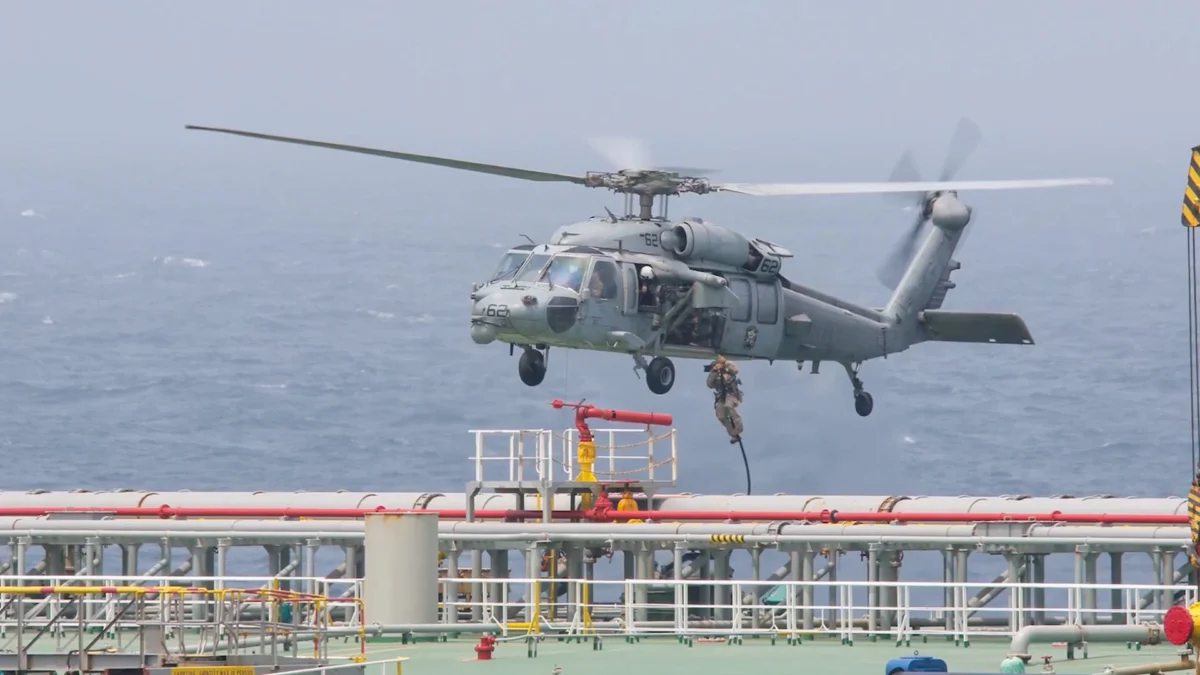
In a significant maritime operation underscoring escalating tensions in the critical Gulf of Oman, United States Marines from the 11th Marine Expeditionary Unit (MEU) successfully boarded the commercial tanker M/T Wen Yao on July 17, 2026. The boarding, captured in video footage released by the U.S. military, was executed as part of an ongoing naval blockade against Iran, intensifying the international community’s focus on the strategic waterway and the broader geopolitical standoff. This incident marks a direct enforcement action in a region already fraught with complex security challenges and serves as a stark reminder of the United States’ commitment to its "maximum pressure" campaign against Tehran.
The Operation: Interdiction in a Strategic Chokepoint
The M/T Wen Yao, a motor tanker whose registration details and cargo manifest were not immediately disclosed by U.S. officials, was intercepted within the international waters of the Gulf of Oman, a vital maritime corridor linking the Arabian Sea to the Strait of Hormuz. The released video depicts heavily armed Marines, identifiable by their tactical gear and unit insignia, utilizing fast-roping techniques from helicopters or boarding ladders from rigid hull inflatable boats (RHIBs) to gain control of the vessel. The precision and speed of the operation highlight the advanced capabilities of the 11th MEU, a highly adaptable crisis response force routinely deployed within the U.S. Central Command (CENTCOM) area of responsibility.
While the specific intelligence leading to the targeting of the M/T Wen Yao remains classified, such interdictions are typically predicated on suspicions of violating international sanctions, smuggling illicit goods, or engaging in activities deemed destabilizing to regional security. The U.S. has long maintained a robust naval presence in the region, primarily through the U.S. Fifth Fleet, headquartered in Bahrain, tasked with ensuring freedom of navigation and enforcing international maritime law. This particular operation, however, signals a more direct and assertive posture in the enforcement of sanctions against Iran, potentially targeting the illicit oil trade or the transport of materials related to Iran’s contested nuclear and missile programs.
Chronology of Escalation: A Decade of Tensions
The boarding of the M/T Wen Yao did not occur in a vacuum but is rather a culmination of years of persistent friction and sporadic flare-ups between the United States and Iran.
- 2015: The Joint Comprehensive Plan of Action (JCPOA), commonly known as the Iran nuclear deal, is signed, lifting international sanctions in exchange for limitations on Iran’s nuclear program.
- 2018: The U.S. unilaterally withdraws from the JCPOA under the Trump administration, re-imposing a comprehensive array of sanctions aimed at crippling Iran’s economy, particularly its oil exports. This marks the beginning of the "maximum pressure" campaign.
- 2019: A series of attacks on oil tankers in the Gulf of Oman and the Strait of Hormuz, attributed by the U.S. to Iran, significantly heighten maritime security concerns. Iran also shoots down a U.S. surveillance drone. The U.S. begins increasing its military presence in the region.
- 2020: Tensions reach a critical peak with the U.S. drone strike that kills Iranian Quds Force commander Qassem Soleimani in Baghdad, followed by Iranian retaliatory missile strikes on U.S. bases in Iraq.
- 2021-2025: Persistent diplomatic efforts to revive the JCPOA repeatedly falter, leading to a steady deterioration of relations. Iran continues to expand its nuclear program beyond JCPOA limits, prompting further international condemnation and tightening of sanctions. Reports of Iranian support for regional proxy groups and illicit maritime activities persist. The U.S. and its allies conduct regular naval exercises and surveillance operations in the Gulf to counter perceived Iranian threats. The term "naval blockade," while not officially declared as an act of war by the U.S., increasingly reflects a more aggressive posture of interdiction and enforcement of sanctions.
- Early 2026: Increased intelligence sharing among coalition partners suggests Iran is attempting to circumvent sanctions more aggressively, leading to a potential surge in illicit maritime trade. The U.S. Fifth Fleet reportedly intensifies its monitoring and interdiction capabilities.
- July 17, 2026: The M/T Wen Yao is boarded by the 11th MEU, publicly confirming the proactive enforcement of the "naval blockade" against Iran.
Supporting Data and Context: The Gulf’s Vital Role
The Gulf of Oman and the adjacent Strait of Hormuz are among the world’s most critical maritime chokepoints. Approximately one-fifth of the world’s total petroleum liquids consumption, or about 21 million barrels per day, passes through the Strait of Hormuz. This includes crude oil, refined petroleum products, and liquefied natural gas (LNG) from Saudi Arabia, Iran, Iraq, Kuwait, Qatar, and the United Arab Emirates. Any disruption in this flow can have immediate and severe repercussions on global energy markets, leading to spikes in oil prices and increased shipping insurance premiums.
The concept of a "naval blockade," while used in the U.S. military’s public statement, is a term with significant legal and political implications under international law. Traditionally, a full-fledged naval blockade is an act of war, requiring specific declarations and adherence to principles of proportionality and neutrality under the UN Charter and customary international law, including the San Remo Manual on International Law Applicable to Armed Conflicts at Sea. The U.S. operations are more accurately described as "maritime interdiction operations" aimed at enforcing UN Security Council resolutions and unilateral sanctions, rather than a full-scale blockade which implies preventing all maritime access to a belligerent nation. However, the use of the term "naval blockade" by the military signals a highly assertive and perhaps unprecedented level of enforcement.
The 11th MEU, operating as part of a larger naval force, is trained for a wide range of missions, including amphibious assaults, counter-terrorism, and maritime interdiction. Their involvement underscores the perceived high-risk nature of the operation and the potential for resistance. Such operations require extensive intelligence gathering, legal review, and coordination to ensure compliance with international law and rules of engagement.
Official Responses and Diplomatic Fallout
The boarding of the M/T Wen Yao immediately triggered a cascade of anticipated reactions from various international actors.
United States:
A spokesperson for U.S. Central Command (CENTCOM) confirmed the operation, stating, "U.S. Marines from the 11th Marine Expeditionary Unit conducted a lawful maritime interdiction of the M/T Wen Yao in the Gulf of Oman on July 17, 2026. This action is part of ongoing efforts to enforce international sanctions against Iran and ensure the free flow of commerce in this vital waterway. We will continue to deter destabilizing activities and uphold international law in cooperation with our partners."
The U.S. State Department issued a statement emphasizing its commitment to a diplomatic resolution with Iran but reiterated that "Tehran’s continued defiance of international norms and its proliferation activities necessitate robust enforcement measures. The United States remains steadfast in preventing Iran from acquiring a nuclear weapon and curbing its destabilizing influence in the region."
Iran:
Iranian state media, citing an unnamed official from the Islamic Revolutionary Guard Corps (IRGC), swiftly condemned the U.S. action as "an act of piracy and a blatant violation of international law." The official warned of "severe consequences for any aggression against Iranian interests or freedom of navigation in regional waters."
The Iranian Foreign Ministry summoned the Swiss Ambassador, who represents U.S. interests in Tehran, to deliver a formal protest, denouncing the boarding as "an unlawful interference with commercial shipping" and demanding the immediate release of the vessel and its crew. "Such provocative actions only serve to escalate tensions and undermine any prospects for constructive dialogue," a Foreign Ministry spokesperson stated.
International Shipping Community:
The International Maritime Organization (IMO) expressed concern over the incident, reiterating calls for "de-escalation and respect for the safety and security of international shipping."
Major shipping associations warned their members to exercise extreme caution when transiting the Gulf of Oman and the Strait of Hormuz, advising enhanced security measures and updated risk assessments. Insurance premiums for vessels operating in the region were expected to rise further.
Flag State of M/T Wen Yao (Inferred):
Assuming the M/T Wen Yao is flagged to a third-party nation (e.g., Liberia, Panama, Marshall Islands, or a country with a less direct stake in the U.S.-Iran conflict), its government would likely issue a statement seeking clarification from the U.S. regarding the legal basis for the boarding, the welfare of its crew, and the status of the vessel and its cargo. This nation would emphasize its commitment to international law and the rights of commercial vessels.
Broader Impact and Implications
The boarding of the M/T Wen Yao carries profound implications across geopolitical, economic, and legal spheres.
Geopolitical Implications:
This direct action by U.S. forces significantly raises the stakes in the ongoing U.S.-Iran confrontation. It demonstrates a willingness by Washington to move beyond rhetoric and financial sanctions to direct physical interdiction, risking potential military confrontation. The incident could provoke a retaliatory response from Iran, possibly targeting commercial shipping, U.S. assets, or regional allies, further destabilizing an already volatile region. It also sends a strong signal to other nations and entities that might be assisting Iran in circumventing sanctions, potentially forcing them to reconsider their involvement. Regional allies of the U.S. may welcome the assertive posture, while others, particularly those reliant on Iranian oil or trade, might express concerns about increased instability.
Economic Implications:
The immediate economic impact is likely to be felt in global oil markets, with potential for increased volatility and price surges as traders factor in heightened supply risks from the Gulf. Shipping costs will inevitably rise due to increased insurance premiums and the need for enhanced security measures, impacting global supply chains. The incident could deter some commercial vessels from transiting the region, leading to longer and more expensive alternative routes. For Iran, such interdictions directly undermine its efforts to generate revenue, exacerbating its economic woes and increasing pressure on its leadership.
Legal and Precedent-Setting Implications:
The U.S. characterization of its actions as part of a "naval blockade" against Iran, even if technically a maritime interdiction operation, is a potent statement. It pushes the boundaries of peacetime enforcement actions and could set precedents for how nations address sanctions evasion in international waters. Legal scholars will scrutinize the justifications under international law, particularly concerning the sovereignty of the vessel’s flag state and the rights of innocent passage. While the U.S. would cite UN Security Council resolutions and self-defense under international law, Iran and its allies would argue violations of sovereignty and international maritime conventions, potentially bringing the matter to international tribunals or forums. The transparency of the operation, evidenced by the released video, might be an attempt by the U.S. to preemptively establish legitimacy and accountability for its actions.
Future of U.S.-Iran Relations:
The M/T Wen Yao incident further complicates any prospects for renewed diplomatic engagement between Washington and Tehran. It hardens positions on both sides, making de-escalation more challenging. Iran may feel compelled to demonstrate its capability to counter such actions, potentially through its own interdictions or naval maneuvers. The incident underscores the deeply entrenched mistrust and the high-stakes nature of the conflict, suggesting that a return to the status quo ante or a swift diplomatic breakthrough is increasingly improbable in the near term. The world watches with bated breath, as the Gulf of Oman once again becomes a focal point of global geopolitical struggle.
