

American manufacturing leaders expressed a notable uptick in confidence during June, a significant shift driven by robust order books, a receding sense of impending recession, and expanded access to new markets. Despite these positive indicators, persistent challenges such as escalating cost pressures and the pervasive shadow of geopolitical uncertainty continued to temper the sector’s overall outlook. This dynamic paints a complex picture of an industry navigating a landscape of both burgeoning opportunity and enduring headwinds.
Since the dawn of the year, chief executive officers within the manufacturing sector have consistently articulated a dual narrative: one characterized by immediate, tangible pressures and another steeped in a cautious, forward-looking optimism. The June data from Chief Executive‘s CEO Confidence Index suggests that this perceived gap between near-term realities and future aspirations began to contract, signaling a potential turning point.
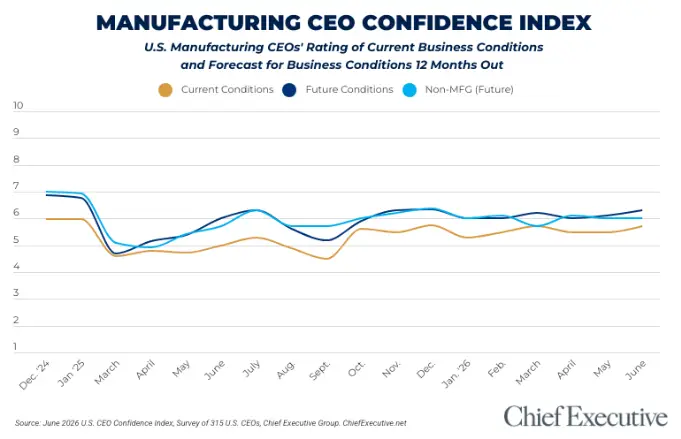
The latest survey, conducted on June 2-3 among 315 U.S. CEOs, revealed that manufacturers rated their current business conditions at an average of 5.7 out of 10, with 1 representing "Poor" and 10 signifying "Excellent." This score represents a 4 percent increase from May and marks the first improvement in manufacturers’ assessment of current conditions since March. This positive movement indicates that some of the pressures that weighed heavily on sentiment during the spring months may be starting to dissipate.
Beyond the present, manufacturing CEOs are also projecting a more optimistic trajectory for the next twelve months. The outlook for business conditions a year from now stands at 6.3 out of 10, an increase from 6.0 in May. This marks the first occasion in recent months where manufacturers have simultaneously demonstrated greater positivity regarding both their current operational standing and their future prospects. This dual improvement is a significant indicator of shifting sentiment within the sector.
Furthermore, manufacturers have consistently exhibited a more optimistic outlook than their non-manufacturing counterparts since April, a trend that widened further in June. While non-manufacturing CEOs maintained their 12-month outlook steady at 6.0 out of 10, the manufacturing sector’s forecast saw a 5 percent increase. This divergence underscores the growing confidence within manufacturing, even amidst ongoing economic and geopolitical ambiguities.
Drivers of Enhanced Sentiment
The uptick in confidence among manufacturing CEOs is attributed to several key factors. A significant driver is the observable improvement in demand, coupled with healthier order books. Many leaders also pointed to signs of increased stability within their own businesses and the end markets they serve.
Jason Stanczyk, CEO of Equipment Development Company, a small, family-owned industrial manufacturing firm, shared his perspective: "Orders are up over 12 months ago. The industries we serve are predicting growth over the next 24 months. We continually find the right talent for the fair market salaries we pay." This sentiment reflects a tangible improvement in the pipeline of future business and a stable operational environment.
Peter Ensch, CEO of Sani-Matic, a mid-sized industrial goods manufacturer, echoed this sentiment, describing a transition from uncertainty to decisive action. "I believe manufacturing is entering a phase of stability as business leaders have grown accustomed to the constant chaos of the current administration combined with pent-up demand, leading to projects being released," Ensch stated. This suggests that businesses are adapting to prevailing economic and political conditions and that pent-up demand is beginning to translate into concrete projects and orders.
Persistent Challenges and Uneven Recovery
However, the recovery in manufacturing confidence is not uniformly distributed. For a substantial segment of manufacturers, persistent cost pressures, the lingering uncertainty surrounding tariffs, regulatory burdens, and ongoing supply chain disruptions continue to exert downward pressure on profit margins and dampen customer demand.
Katie Malnight Meisinger, president of RELY Contract Manufacturing, highlighted these ongoing concerns: "Geopolitics [is] driving up fuel and raw material prices which is eating into margins, dampening demand and/or causing customers to push out timelines." This statement encapsulates the dual impact of rising input costs and their knock-on effect on order fulfillment and customer behavior.
Manufacturers with significant exposure to government contracts also voiced concerns regarding policy uncertainty and regulatory frameworks. Specific challenges mentioned include the unpredictable nature of "government research funding policies" and "constant supply chain disruptions," which complicate strategic planning and investment decisions. These external factors create an environment of unpredictability that can hinder long-term growth strategies.
Economic Outlook Brightens, Recession Fears Subside
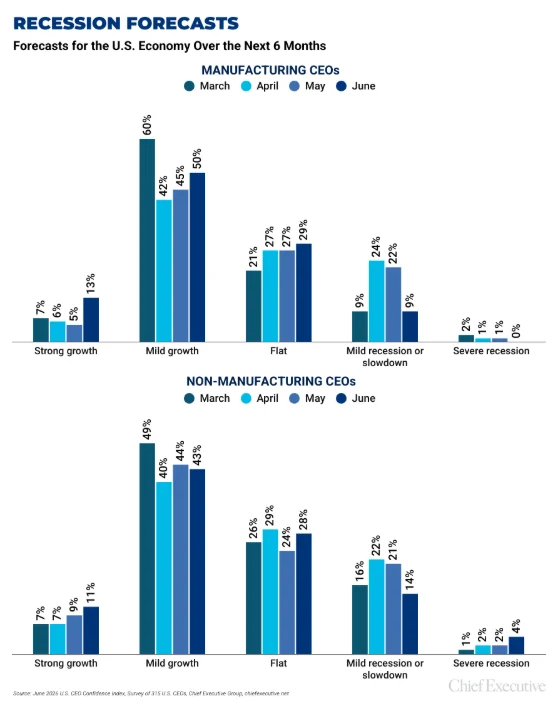
The broader economic outlook for the manufacturing sector experienced a sharp improvement in June, effectively reversing much of the decline observed earlier in the spring. After reaching a peak in March, when 67 percent of manufacturers anticipated U.S. economic growth by year-end, this figure had dipped to 48 percent in April and 50 percent in May. In June, however, the sentiment rebounded significantly, with 63 percent of manufacturers forecasting some form of economic expansion before the end of the year.
This optimistic forecast places manufacturers ahead of their non-manufacturing peers, among whom only 54 percent expect the U.S. economy to grow over the same period. This divergence may be indicative of several factors, including the aforementioned improvements in demand, as well as a renewed interest in reshoring initiatives and domestic capacity expansion. These trends are gaining traction amidst continued uncertainty surrounding international trade policies and regulatory landscapes.
Recession fears, a dominant concern for much of the past year, also appear to be diminishing within the manufacturing sector. While the proportion of non-manufacturing CEOs forecasting a severe recession within the next six months has steadily increased since March, reaching 4 percent in June, notably, no manufacturing respondents reported such a forecast in the current survey. This absence of recessionary predictions among manufacturing leaders is a significant indicator of their growing confidence in the sector’s resilience.
Diversification as a Cornerstone of Future Growth
While improved demand is a primary catalyst for the enhanced outlook, manufacturing CEOs are also strategically leveraging diversification and market expansion as crucial avenues for growth in a volatile global environment. The survey data reveals a proactive approach to business development: nearly three-quarters of manufacturing CEOs reported that their companies have entered new sectors, engaged with different customer categories, explored new geographic markets, or identified novel applications for their products and services over the past five years.
This strategic diversification is projected to remain a cornerstone of competitiveness. Looking ahead to the next three to five years, an overwhelming 82 percent of manufacturers consider diversification to be either critical or important to their company’s ability to grow and maintain a competitive edge. Only a minuscule 1 percent of respondents indicated that diversification is not a priority, underscoring its central role in long-term strategic planning within the sector. This commitment to adaptability and expansion positions manufacturers to better weather future economic shifts and capitalize on emerging opportunities.

Corporate Forecasts Signal Cautious Expansion
Despite the overall improvement in confidence, corporate forecasts from manufacturing CEOs present a more nuanced picture, suggesting a degree of caution regarding the translation of heightened sentiment into aggressive growth plans. While optimism is on the rise, many leaders appear to be adopting a measured approach to scaling operations and making significant capital investments.
The survey did not provide specific comparative data points for corporate forecasts from May to June in the provided text, but the implication is that while sentiment has improved, concrete plans for significant increases in areas such as capital expenditures, hiring, and inventory levels may be more tempered. This suggests a strategic balance between capitalizing on current opportunities and maintaining a prudent stance in the face of lingering uncertainties. CEOs are likely evaluating the sustainability of current positive trends before committing to substantial expansions.
Methodology and Background of the CEO Confidence Index
The CEO Confidence Index, compiled by Chief Executive Group since 2002, serves as a vital barometer of business sentiment among U.S. corporate leaders. The index surveys hundreds of CEOs across organizations of all types and sizes, tracking their confidence in both current and future business environments. This is achieved through assessments of various economic and business components, providing valuable insights into the prevailing mood and strategic outlook of the nation’s top executives. For more detailed information and historical data, readers are directed to ChiefExecutive.net/category/CEO-Confidence-Index/.
The recurring nature of this survey allows for the identification of trends and shifts in confidence, offering a valuable perspective on the health and direction of the U.S. economy and its key sectors, such as manufacturing. The June 2024 data, in particular, highlights a pivotal moment where a confluence of positive developments is beginning to outweigh some of the persistent challenges, offering a cautiously optimistic outlook for the American manufacturing landscape.
