

The proposal by leading artificial intelligence firm OpenAI to grant the U.S. government a 5% equity stake in the company has been met with significant skepticism in prediction markets, even as the Trump administration actively pursues similar investments in other critical technology sectors like quantum computing, semiconductors, and drone manufacturing. While the innovative offer from OpenAI CEO Sam Altman, first floated to the Trump administration in 2025, aims to address mounting political and regulatory scrutiny surrounding the rapid ascent of AI, traders on the Kalshi prediction market platform currently assign less than a 30% probability that such a deal will materialize for OpenAI or its competitor Anthropic within 2026. This contrasts sharply with the much higher odds — exceeding 60% — seen for government stakes in quantum computing pioneers Rigetti Computing and D-Wave Quantum, as well as semiconductor giant GlobalFoundries, reflecting a discerning market view on the practicalities and political appetite for direct government ownership in different segments of the tech industry.
The prospect of the U.S. government taking equity stakes in private technology companies marks a significant departure from traditional American industrial policy, signaling a potential new era of state intervention in strategically vital sectors. This shift is primarily driven by escalating geopolitical competition, particularly with China, and a growing recognition of technology’s indispensable role in national security, economic competitiveness, and future global leadership. The discussions surrounding OpenAI come at a time when the AI industry is experiencing unprecedented growth, coupled with intense debate over its ethical implications, regulatory oversight, and potential for monopolistic power.
OpenAI’s Strategic Overture: Addressing the AI Governance Conundrum
The genesis of OpenAI’s proposal can be traced back to the burgeoning concerns surrounding artificial general intelligence (AGI) and the broader implications of powerful AI systems. OpenAI, initially founded as a non-profit with a mission to ensure AGI benefits all of humanity, transitioned to a "capped-profit" model to attract the vast capital required for advanced AI research and development. However, this hybrid structure, combined with its rapid commercial success through products like ChatGPT, has drawn considerable attention from policymakers globally. The "political blowback" cited as a motivation for the stake offer likely encompasses a spectrum of issues: antitrust scrutiny, data privacy concerns, national security implications of dual-use AI technologies, and the existential risks associated with powerful AI.
Sam Altman, a prominent figure in the AI world, reportedly initiated discussions with the Trump administration regarding a government stake as early as 2025. This early engagement suggests a proactive strategy by OpenAI to align its interests with national priorities and potentially pre-empt more stringent regulatory measures. A government stake, even a minority one, could offer several benefits to OpenAI: it could lend legitimacy and stability in a volatile regulatory environment, potentially facilitate access to government contracts or research funding, and signal a commitment to national interests. However, it also raises questions about corporate autonomy, the potential for political influence over research directions, and the perception of a blurring line between private innovation and state control.
The specific proposal, reported by the Financial Times in late June 2026, outlined a 5% stake for the U.S. government. While the exact terms — whether it would be a direct equity purchase, a grant-based stake, or a warrants-based arrangement — remain undisclosed, the core idea is to establish a direct financial and strategic link between one of the world’s most influential AI developers and the federal government. This is a bold move in an industry traditionally characterized by venture capital funding and fierce independence.
Kalshi’s Verdict: Market Skepticism on AI vs. Concrete Tech
Kalshi, an online prediction market, offers a unique lens into market sentiment regarding the likelihood of these government interventions. Unlike traditional polling, Kalshi users bet real money on future events, creating a collective wisdom that often proves insightful. The low odds (below 30%) assigned to the U.S. government taking a stake in OpenAI or Anthropic by 2026 suggest several underlying market perceptions.
One primary factor could be the sheer valuation and complexity of these leading AI companies. OpenAI, despite its unique structure, commands an estimated multi-billion dollar valuation, making a 5% stake a substantial financial commitment. The political and regulatory hurdles for such a direct investment in a high-profile, rapidly evolving, and often controversial sector like generative AI might also be perceived as significantly higher than in more defined, hardware-centric industries. Furthermore, the inherent open-ended nature of AI development, with its broad societal implications and potential for rapid technological shifts, might make a direct equity stake less appealing or harder to justify politically compared to investments in specific, tangible hardware capabilities.
In stark contrast, Kalshi traders see odds exceeding 60% for government stakes in quantum computing firms Rigetti Computing and D-Wave Quantum, as well as semiconductor manufacturer GlobalFoundries. This disparity highlights a perceived difference in strategic urgency, clarity of national security implications, and the established frameworks for government support in these sectors. Quantum computing and advanced semiconductor manufacturing are universally recognized as foundational technologies for future economic and military power, with clear supply chain vulnerabilities and significant capital expenditure requirements that often necessitate government support.
A New Era of Industrial Policy: The Trump Administration’s Tech Strategy
President Donald Trump’s past rhetoric and actions suggest a strong inclination towards leveraging government power to secure national interests in critical industries. During a CNBC interview in early July 2026, Trump notably sidestepped a direct question about the proposed OpenAI stake. Instead, he referenced a precedent set just last summer (2025) when his administration secured a 10% equity stake in Intel. "Intel came in. They had a problem," Trump recounted. "I said, ‘I can solve your problem, but I want 10% of the company.’"
This anecdote underscores a transactional and assertive approach to industrial policy. The Intel deal, while not fully detailed in the original context, likely falls under the umbrella of the CHIPS and Science Act of 2022, a bipartisan legislative effort to boost domestic semiconductor manufacturing and research. The Act authorizes billions in grants, loans, and loan guarantees, and explicitly allows the Commerce Department to take equity stakes or warrants as a condition for certain awards, particularly for projects deemed critical for national security or economic competitiveness. The Intel stake, therefore, serves as a tangible example of the administration’s willingness to use government funding as leverage for direct ownership in strategic companies.
This approach is not isolated to semiconductors. The U.S. Commerce Department announced in May 2026 that it would award $2 billion in grants to nine firms in the quantum computing space, with the National Institute of Standards and Technology (NIST) taking a minority, non-controlling stake in each company. Rigetti Computing, D-Wave Quantum, and GlobalFoundries were explicitly named among the recipients. This move demonstrates a clear commitment to fostering a domestic quantum industry, recognizing its potential for breakthroughs in computing, cryptography, and materials science, all with profound defense and economic implications.
Similarly, a Wall Street Journal report in May 2026, citing familiar sources, indicated that the Trump administration was exploring deals with several private-sector drone companies, including Performance Drone Works and Neros Technologies, some of which could also entail equity stakes. This initiative is part of a broader push to reduce reliance on foreign-made drones, particularly from adversaries, and to bolster domestic manufacturing capabilities for critical defense and surveillance technologies. Kalshi traders see just over a 50% likelihood of a government stake in Performance Drone Works, but less than 40% for Neros Technologies, again reflecting nuanced market assessments of individual company prospects and policy priorities.
Chronology of Government-Tech Engagement: A Developing Timeline
The period from 2025 to mid-2026 has witnessed a rapid acceleration in the dialogue and concrete actions surrounding government involvement in critical technology sectors:
- 2025: Sam Altman, CEO of OpenAI, first discusses the idea of offering the U.S. government an equity stake in OpenAI with the Trump administration. This initial outreach likely aimed to establish a collaborative relationship amidst growing regulatory scrutiny and the rapid advancement of AI capabilities. Concurrently, the Trump administration secured a 10% equity stake in Intel, setting a significant precedent for direct government ownership in a major tech firm, likely tied to incentives under the CHIPS and Science Act to boost domestic semiconductor production.
- May 2026: The U.S. Commerce Department announces a landmark initiative to award $2 billion in grants to nine quantum computing firms. As part of this program, the National Institute of Standards and Technology (NIST) confirms it will acquire minority, non-controlling equity stakes in each recipient company, including Rigetti Computing, D-Wave Quantum, and GlobalFoundries. This move solidifies the government’s commitment to securing leadership in the nascent but strategically vital quantum sector. In the same month, the Wall Street Journal reports on ongoing discussions within the Trump administration to establish deals, potentially including equity stakes, with domestic drone manufacturers such as Performance Drone Works and Neros Technologies, signaling a focused effort to bolster national security and supply chain resilience in unmanned aerial systems.
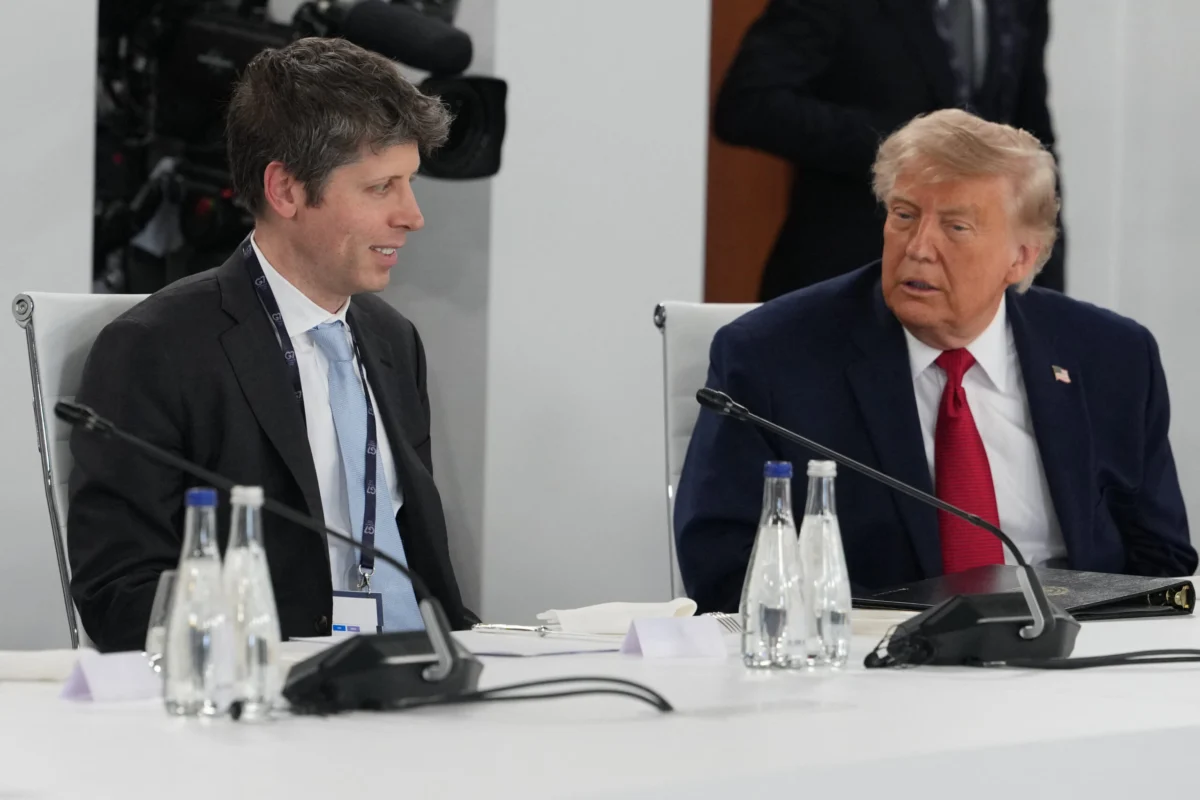
- June 15-17, 2026: The G7 Summit takes place in Evian-les-Bains, France. Artificial intelligence is a central theme, with discussions among G7 leaders, partner countries, and AI business leaders focusing on global governance frameworks, ethical AI development, and international cooperation. A notable working lunch meeting on June 17 sees U.S. President Donald Trump and OpenAI CEO Sam Altman in attendance, captured in a photograph, highlighting the high-level engagement on AI policy at the global stage. This meeting likely provided a platform for further discussion on OpenAI’s proposal and the broader role of governments in AI.
- Late June/Early July 2026: The Financial Times reports on OpenAI’s formal proposal to grant the U.S. government a 5% stake. This public disclosure intensifies debate on the merits and implications of such a deal. In a subsequent interview, President Trump notably avoids a direct answer when questioned by CNBC about the OpenAI stake, instead pivoting to discuss the Intel precedent, reinforcing his administration’s willingness to pursue such arrangements. Simultaneously, the Kalshi prediction market opens contracts on which companies the U.S. government will take stakes in this year, revealing the aforementioned market skepticism towards AI companies compared to quantum and semiconductor firms.
Broader Implications: A Shifting Landscape for Tech and Governance
The trend of the U.S. government seeking equity stakes in private tech companies carries profound implications for the future of American industrial policy, corporate governance, and global technological leadership.
For Technology Companies: While government investment can provide crucial capital, stability, and access to strategic partnerships or contracts, it also introduces a new layer of complexity. Companies might face increased scrutiny, potential influence over product roadmaps or research priorities, and a shift in their governance structures. For rapidly innovating sectors like AI, this could either accelerate development by aligning with national goals or stifle agility through bureaucratic oversight. The "non-controlling" nature of these minority stakes is key, but the influence of the largest shareholder, especially a sovereign one, can extend beyond mere voting rights.
For the U.S. Government: Direct equity stakes offer a mechanism for governments to gain insight, influence, and potentially financial returns from critical technologies deemed vital for national security or economic prosperity. It represents a more active, hands-on approach than traditional grants or procurement. However, it also raises questions about market distortion, potential conflicts of interest, and the government’s role in picking winners and losers in a dynamic, competitive market. The long-term success of such an approach hinges on the government’s ability to act as a savvy, non-interfering investor while still achieving its strategic objectives.
For the Broader Market and Economy: This emerging industrial policy could reshape investor sentiment and capital allocation in the tech sector. Venture capitalists might view government-backed companies differently, potentially valuing the stability but also considering the added regulatory burden or perceived loss of independence. It could also signal a departure from the traditional free-market ethos that has long defined Silicon Valley, potentially leading to a more state-guided innovation ecosystem, reminiscent of models seen in other nations.
Global Competitiveness and National Security: At its core, this policy shift is driven by a desire to maintain the U.S.’s technological edge against rivals, particularly China, which employs a comprehensive state-backed strategy for tech development. By taking stakes in critical areas like AI, quantum computing, semiconductors, and drones, the U.S. aims to ensure domestic control over foundational technologies, mitigate supply chain risks, and accelerate innovation in areas with dual-use military and civilian applications.
The debate over government equity stakes in companies like OpenAI underscores a pivotal moment in the relationship between technology, economy, and state power. As AI continues its transformative trajectory and geopolitical tensions persist, the lines between public and private sectors in the pursuit of technological supremacy are becoming increasingly blurred. While prediction markets currently show skepticism for a government stake in leading AI firms, the broader trend suggests that direct government investment in strategic technologies is not merely a passing phase but a foundational element of a new industrial policy. The ultimate success and implications of this strategy will unfold in the coming years, shaping not only the future of technology but also the very structure of the global economy and power dynamics.
Disclosure: CNBC and Kalshi have a commercial relationship that includes customer acquisition and a minority investment.
