

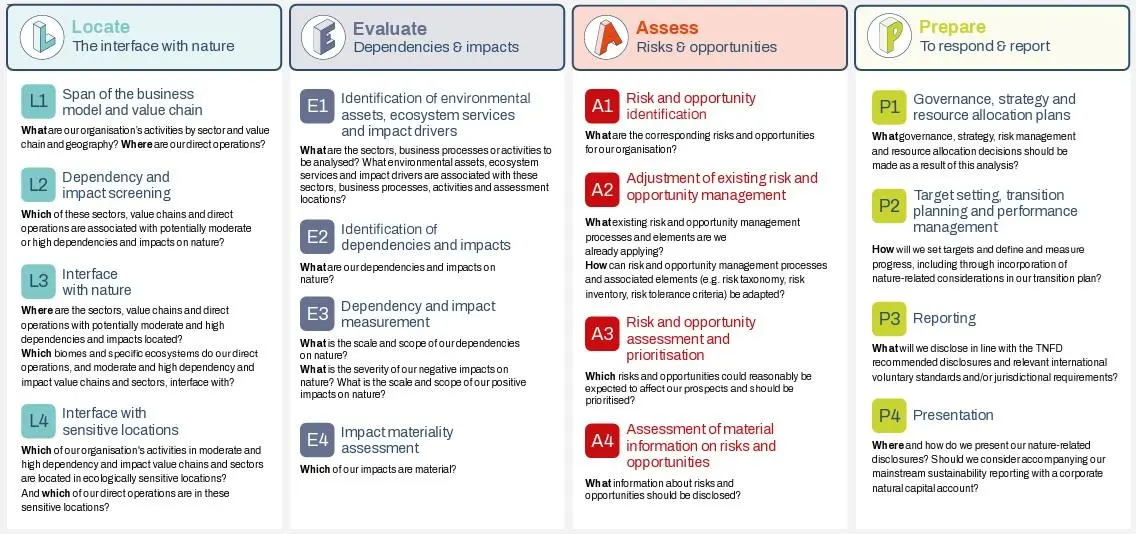
The Taskforce on Nature-related Financial Disclosures (TNFD) has officially announced the release of LEAP 2.0, representing the first comprehensive upgrade to its core assessment approach and technical guidance designed to assist corporations in identifying, assessing, and reporting on nature-related dependencies, impacts, risks, and opportunities. This milestone update reflects the evolving landscape of environmental accounting and the increasing pressure from global regulators and investors for transparent disclosures regarding biological diversity and ecosystem services. As the private sector grapples with the accelerating degradation of natural capital, the LEAP 2.0 framework provides a more robust, data-driven methodology for integrating nature into corporate governance and financial decision-making.
The release comes at a critical juncture for global environmental policy, as the international community prepares for the COP 17 UN Biodiversity Conference. The updated framework is designed to bridge the gap between high-level sustainability goals and the granular operational data required for meaningful financial reporting. By refining the "Locate, Evaluate, Assess, and Prepare" (LEAP) methodology, the TNFD aims to standardize how organizations across diverse sectors—from agriculture and mining to finance and consumer goods—quantify their relationship with the natural world.
The Evolution of Nature-Related Financial Disclosures: A Chronology
The journey toward a standardized nature reporting framework began in earnest in June 2021 with the formal launch of the TNFD. Modeled after the successful Task Force on Climate-related Financial Disclosures (TCFD), the TNFD was established to address the "nature-blindness" of traditional financial reporting. While climate change has long been a fixture of ESG (Environmental, Social, and Governance) discussions, nature and biodiversity loss were often relegated to the periphery despite their systemic importance to the global economy.
Following two years of intensive consultation and pilot testing involving hundreds of organizations, the TNFD published its final recommendations in September 2023. This release included the initial version of the LEAP approach, which provided a voluntary but highly influential roadmap for disclosure. Since that time, the adoption of TNFD recommendations has seen exponential growth. To date, more than 1,000 organizations spanning 56 countries—representing trillions of dollars in assets under management—have committed to publishing disclosures aligned with the TNFD framework.
The transition to LEAP 2.0 marks one of the final major technical milestones for the Taskforce. In late 2025, the TNFD announced plans to wind down its primary technical work program by late 2026. This sunsetting is a strategic move intended to hand over the baton to the IFRS Foundation’s International Sustainability Standards Board (ISSB). The ISSB has signaled its intention to begin formal standard-setting for nature-related disclosures, and it has explicitly stated that its future requirements will draw heavily from the foundations laid by the TNFD and the LEAP 2.0 approach.
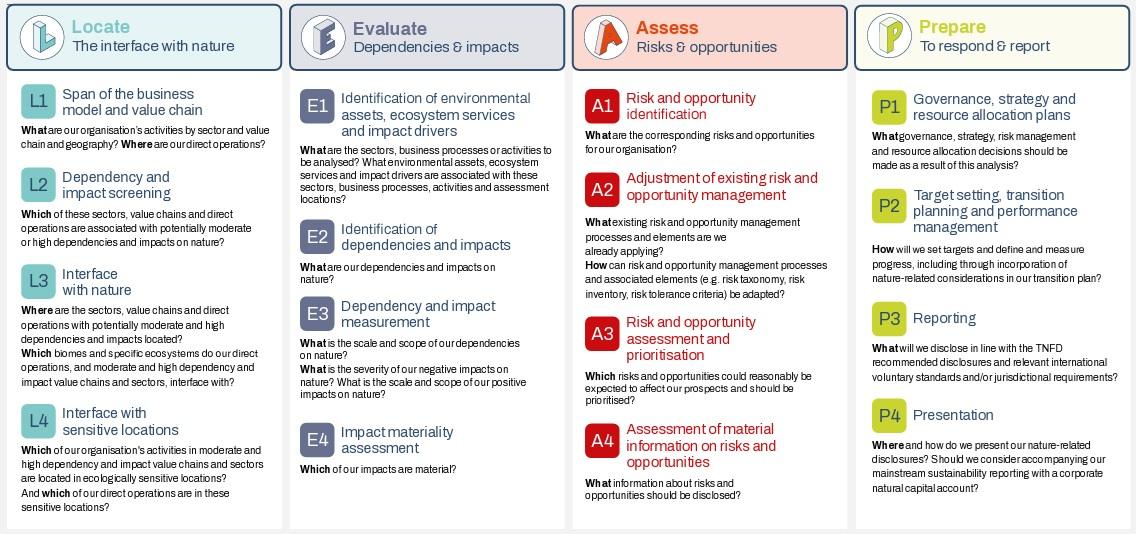
Decoding LEAP 2.0: Key Enhancements and Technical Updates
The LEAP 2.0 update is not merely a cosmetic revision; it integrates substantial technical improvements based on extensive market feedback and real-world implementation challenges. The framework retains its four-phase core—Locate (interface with nature), Evaluate (dependencies and impacts), Assess (risks and opportunities), and Prepare (reporting)—but adds layers of specificity that were previously absent.
One of the most significant additions in LEAP 2.0 is the enhanced guidance for financial institutions. Banks, insurers, and asset managers face unique challenges in nature reporting because their primary impacts and risks are "financed" rather than direct. The updated guidance provides specialized metrics for assessing portfolios, allowing financial entities to map how their lending and investment activities interact with sensitive biomes and ecosystems.
Furthermore, LEAP 2.0 introduces groundbreaking considerations for environmental crime and invasive alien species. Recognizing that illegal logging, unregulated fishing, and wildlife trafficking pose significant legal and reputational risks to supply chains, the framework now includes prompts for organizations to evaluate their exposure to these activities. Similarly, the measurement of invasive alien species has been prioritized, acknowledging their role as a primary driver of biodiversity loss and operational disruption in sectors like forestry and infrastructure.
The update also integrates the "State of Nature Indicators and Metrics," a new set of benchmarks released by the Nature Positive Initiative (NPI). These indicators allow companies to measure the health of the ecosystems they rely upon with greater precision, moving beyond simple footprint metrics to more sophisticated assessments of ecosystem resilience and functionality.
The Economic Rationale for Nature-Positive Reporting
The drive toward LEAP 2.0 is underpinned by a stark economic reality. According to data from the World Economic Forum, more than half of the world’s total GDP—approximately $44 trillion—is moderately or highly dependent on nature and its services. From the pollination of crops to the filtration of water and the provision of raw materials, the global economy is effectively a subsidiary of the natural environment.
As biodiversity declines at rates unprecedented in human history, the risks to business operations become material. Supply chain disruptions, regulatory penalties, and shifting consumer preferences are no longer theoretical. By adopting LEAP 2.0, companies can transition from a reactive posture to a proactive strategy. The framework encourages the identification of "nature-related opportunities," such as the development of regenerative agriculture practices, the expansion of circular economy models, and the creation of new markets for ecosystem services.

The alignment of LEAP 2.0 with the Science Based Targets Network (SBTN) further strengthens this economic case. While the TNFD focuses on risk management and disclosure, the SBTN provides the methodology for setting rigorous, science-based targets for nature. Together, these frameworks allow a corporation to say not only "here is our risk" but also "here is our plan to operate within planetary boundaries."
Global Harmonization and the Role of International Standards
A primary goal of the LEAP 2.0 release is to facilitate global harmonization in sustainability reporting. The fragmentation of ESG standards has long been a complaint of the corporate sector, leading to "reporting fatigue" and inconsistent data. The TNFD has worked closely with the International Organization for Standardization (ISO) to ensure that LEAP 2.0 can serve as the basis for a future ISO standard on nature-related assessments.
This move toward standardization is particularly important for multinational corporations operating across different jurisdictions. As the European Union implements the Corporate Sustainability Reporting Directive (CSRD) and other regions develop their own green taxonomies, the LEAP 2.0 approach provides a common language that satisfies multiple regulatory requirements simultaneously.
The ISSB’s involvement is the linchpin of this harmonization strategy. By integrating TNFD’s work into the global baseline for sustainability disclosures, the IFRS Foundation ensures that nature reporting will eventually carry the same weight and rigor as financial accounting. This "institutionalization" of nature risk is expected to drive significant shifts in capital allocation over the coming decade.
Official Responses and Market Implications
The release of LEAP 2.0 has been met with positive reactions from both the public and private sectors. Tony Goldner, CEO of the TNFD, emphasized the practical necessity of the update, stating, "The market has moved quickly in recent years, with thousands of organisations now working to understand and respond to their nature-related issues. As implementation accelerates, it is essential that assessment, target-setting and reporting approaches work together in a practical and mutually reinforcing way."
Environmental advocacy groups and scientific bodies have also welcomed the update, particularly the inclusion of transition planning. Nature-related transition planning involves outlining how a company intends to align its business model with a "nature-positive" future—one where biodiversity is increasing rather than declining. This aligns corporate strategy with the Kunming-Montreal Global Biodiversity Framework (GBF), which aims to protect 30% of the planet’s land and seas by 2030.

However, challenges remain. The primary hurdle for many organizations is the availability of high-quality, location-specific data. Nature is inherently local; a company’s impact on a watershed in Brazil cannot be measured using the same metrics as its impact on a forest in Scandinavia. LEAP 2.0 addresses this by providing better guidance on data collection and the use of secondary data sources, but the "data gap" will likely persist as a significant barrier for smaller enterprises.
Conclusion: A New Era of Corporate Accountability
The release of LEAP 2.0 signifies that nature-related reporting has moved from the "early adopter" phase into the mainstream of corporate governance. By providing a clear, technical, and scientifically grounded methodology, the TNFD has equipped the global market with the tools necessary to confront the biodiversity crisis.
As the TNFD prepares to hand over its technical legacy to the ISSB and ISO, the focus for corporations will shift from "how to report" to "how to act." The insights generated through the LEAP 2.0 process are intended to drive internal transformation, encouraging companies to rethink their supply chains, investment strategies, and long-term viability in a world where natural capital is increasingly scarce.
For investors, the updated framework offers a more transparent view of the hidden risks within their portfolios. For regulators, it provides a blueprint for future mandatory disclosure requirements. For the planet, it represents a vital step toward an economic system that values the biological foundations upon which all human prosperity is built. The successful implementation of LEAP 2.0 will be measured not just by the number of reports published, but by the tangible protection and restoration of the world’s ecosystems.
