

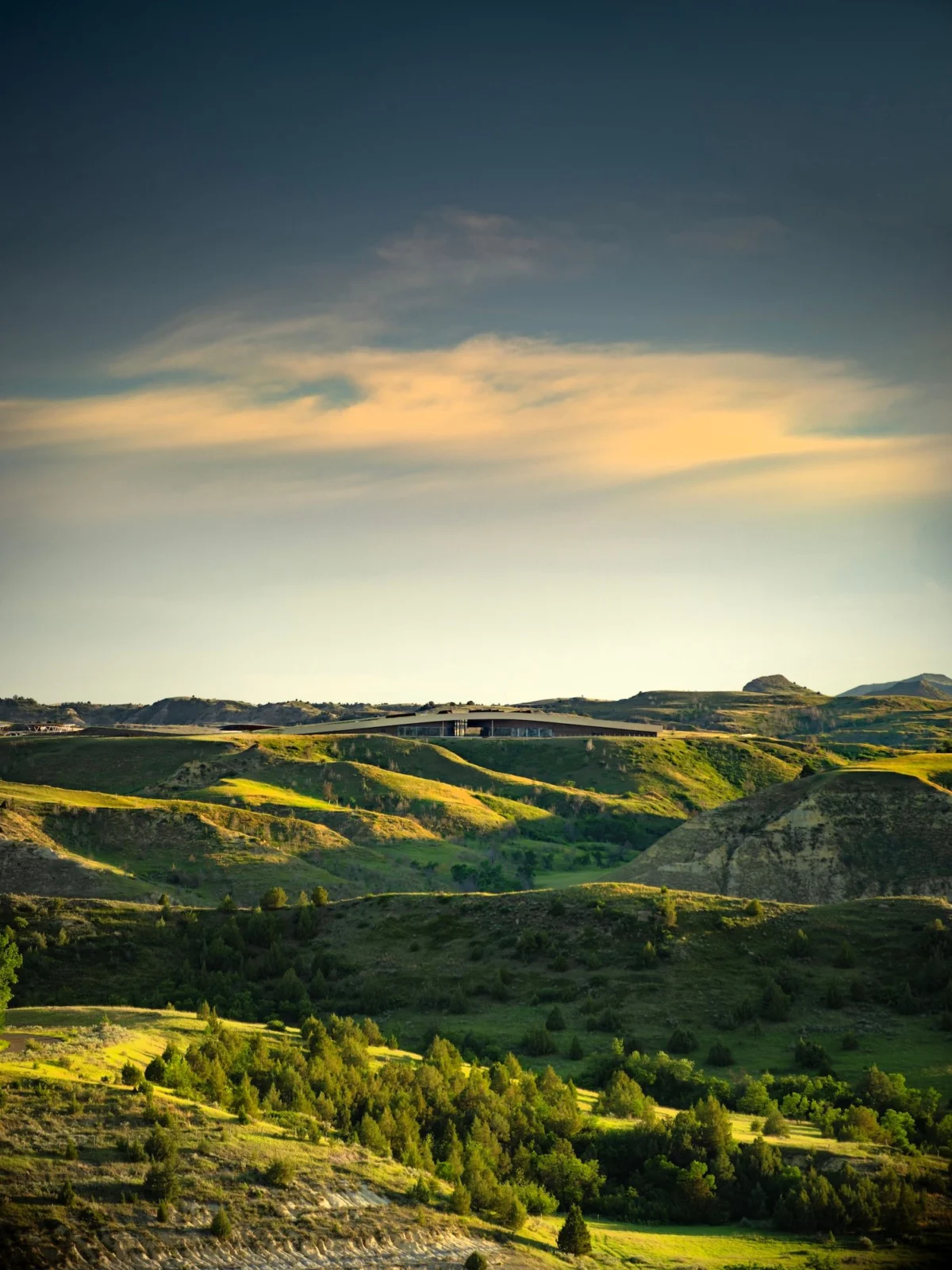
As one climbs the butte above remote Medora, North Dakota, a curved roof comes slowly into view, featuring the distant silhouettes of hikers traversing its peak. Turn a corner and the structure disappears again, blending seamlessly into the rugged Badlands from which it emerges. This is the new Theodore Roosevelt Presidential Library, a 96,000-square-foot facility that functions as a museum, an education center, and a digital archive of the 26th president’s life and legacy. Scheduled to open its doors on July 4, the project represents a departure from traditional presidential monuments, favoring an ecological integration that mirrors the conservationist ideals of its namesake.
The library was built on the very land that catalyzed a transformative period in Roosevelt’s life. In 1884, following the tragic deaths of his mother and his wife on the same day, the future president retreated to the North Dakota prairie to grieve and reinvent himself. It was here, amid the harsh beauty of the Little Missouri River valley, that Roosevelt developed the deep appreciation for untamed nature that would later define his presidency. During his time in office, Roosevelt established the United States Forest Service and signed the Antiquities Act, ultimately protecting approximately 230 million acres of public land.

Matthew McMahon, a director of landscape architecture at Snøhetta—the international firm tasked with the project’s design—notes that the building’s form is a direct response to this history. According to McMahon, while most presidential libraries serve as static monuments, the face of this building is the land itself. By prioritizing the landscape over the architecture, the design team aimed to create a facility that is as dynamic and resilient as the ecosystem Roosevelt fought to preserve.
Historical Chronology: From Grieving Rancher to Conservationist President
To understand the architectural choices made for the library, one must look at the timeline of Theodore Roosevelt’s connection to the North Dakota Badlands. Roosevelt first arrived in the region in 1883 as a 24-year-old looking to hunt bison. At the time, he was a New York Assemblyman with a burgeoning political career. However, the events of February 14, 1884, fundamentally altered his trajectory. After losing both his mother, Mittie, and his wife, Alice Lee, within hours of each other, Roosevelt left his infant daughter in the care of his sister and headed west to "find himself."
In Medora, Roosevelt established the Elkhorn Ranch, which he referred to as his "home ranch." The physical and mental rigors of ranching in the Badlands—dealing with extreme weather, cattle rustlers, and the isolation of the frontier—hardened his resolve and shaped his philosophy of the "strenuous life." By the time he returned to New York and eventually ascended to the presidency in 1901, his identity was inextricably linked to the American West.

The library’s location in Medora serves as a bookend to this narrative. It is the place where Roosevelt began his healing process and formulated the path that would lead to his conservation legacy. The project, designed by Snøhetta in collaboration with local architect of record JLG Architects, seeks to honor this transformation by ensuring the building does not dominate the landscape but rather emerges from it.
Architectural Innovation and Materiality
The design of the Theodore Roosevelt Presidential Library is defined by its 39-foot-tall sloping green roof. The roof is not merely an aesthetic choice; it is a functional extension of the surrounding trails, allowing visitors to hike directly onto the building to gain 360-degree views of the Theodore Roosevelt National Park and the Little Missouri River valley. Craig Dykers, founding partner of Snøhetta, explained that the goal was to "hide" the building within the beauty of the surrounding environment, treating the structure as an extension of the world around it rather than a delineated property.
The construction materials were selected based on their environmental impact and their ability to regulate temperature in the extreme North Dakota climate. Key features include:

- Mass Timber: The primary structural system utilizes mass timber, a sustainable alternative to steel and concrete that sequesters carbon within the building’s frame.
- Low-Carbon Concrete: Where concrete was necessary, low-carbon mixtures were utilized to minimize the project’s total carbon footprint.
- Rammed Earth Walls: Constructed using locally sourced sediment and custom pigments, these walls provide significant thermal mass. This allows the building to buffer the intense temperature swings of the Badlands, reducing the energy required for heating and cooling.
- Geothermal and Solar Energy: The facility is designed to be self-sufficient. It utilizes geothermal wells and solar panels to generate power. According to Snøhetta director Aaron Dorf, the building generates 25% of its required renewable energy on-site, with the remaining 75% sourced from off-site solar arrays.
The interior of the building houses a café, classrooms, a digital archive, and various gallery spaces. These galleries feature exhibitions designed by firms such as Local Projects, Dimensional Innovations, and the Future of StoryTelling. The exhibits focus on Roosevelt’s curiosity for nature, his life at Elkhorn Ranch, and the national conservation standards he established. A 300-seat auditorium features a large picture window behind the stage, ensuring that even during indoor presentations, the landscape remains the focal point.
The Working Landscape and the Native Plant Project
A central pillar of the project is the "Native Plant Project," a restorative initiative conducted in partnership with North Dakota State University. Local volunteers collected 400,000 native seedlings, which were then grown and replanted across the library grounds. This effort aims to regenerate the immediate grasslands, providing a biological benefit to the adjacent public parkland.
The grounds are managed as a "working landscape." This involves adaptive management techniques such as controlled burns and modified grazing by local livestock. These practices are designed to replicate the historic grazing patterns of bison, which are essential for maintaining the health of the prairie ecosystem.

The importance of this regenerative approach was highlighted during a wildfire that swept through the site in 2021, shortly after construction work had begun. Michelle Delk, a partner and landscape architect at Snøhetta, noted that the rapid reemergence of plant life following the fire served as a turning point for the design team. It reinforced the idea that the site itself is the primary "library," and that the architecture must support the landscape’s natural cycles of destruction and rebirth.
Sustainability Metrics and Environmental Impact
The Theodore Roosevelt Presidential Library aims to achieve a "carbon sink" status, meaning it is designed to sequester more carbon over its lifespan than was embodied in its construction. This is a high bar for a 96,000-square-foot facility, but the project’s environmental design, overseen by the studio Atelier Ten, utilizes several strategies to reach this goal:
- Zero Emissions and Waste: The project targets zero carbon emissions and zero waste through its integrated energy systems and waste management protocols.
- Thermodynamic Efficiency: By pairing radiant flooring and a central fireplace with high-thermal-mass rammed earth walls, the building minimizes its reliance on traditional HVAC systems.
- Minimal Land Disruption: The library was strategically positioned to take advantage of existing National Park infrastructure, minimizing the need for new roads or utility lines that would further fragment the habitat.
Broader Implications for Presidential Libraries and Regional Tourism
The opening of the Theodore Roosevelt Presidential Library is expected to have a significant impact on both the field of presidential history and the local economy of North Dakota. Traditionally, presidential libraries are located in urban or suburban settings close to the president’s birthplace or political stronghold. By placing this library in a remote, rural setting, the organizers are betting on "destination tourism."

The site is designed to be accessible via various modes of transport, reflecting Roosevelt’s own appreciation for outdoor activity. Visitors can arrive by car, but they are also encouraged to visit via mountain bike, on foot, or on horseback. A hitching post is provided for those arriving by horse, and a one-mile undulating boardwalk allows visitors to experience the grounds without ever entering the physical building.
This multi-modal, outdoor-centric approach aligns the library with the growing trend of "eco-tourism." For the town of Medora, which already serves as a gateway to the Theodore Roosevelt National Park, the library provides a year-round cultural anchor that could extend the traditional summer tourist season.
Ultimately, the Theodore Roosevelt Presidential Library serves as a case study in how architecture can honor a historical figure not through statues or grand facades, but through the preservation and restoration of the environment that shaped them. By looking a century into the future—much as Roosevelt did when he established the first federal bird reserve or national forest—the library’s design seeks to ensure that the Badlands remain a place of healing and discovery for generations to come.
