

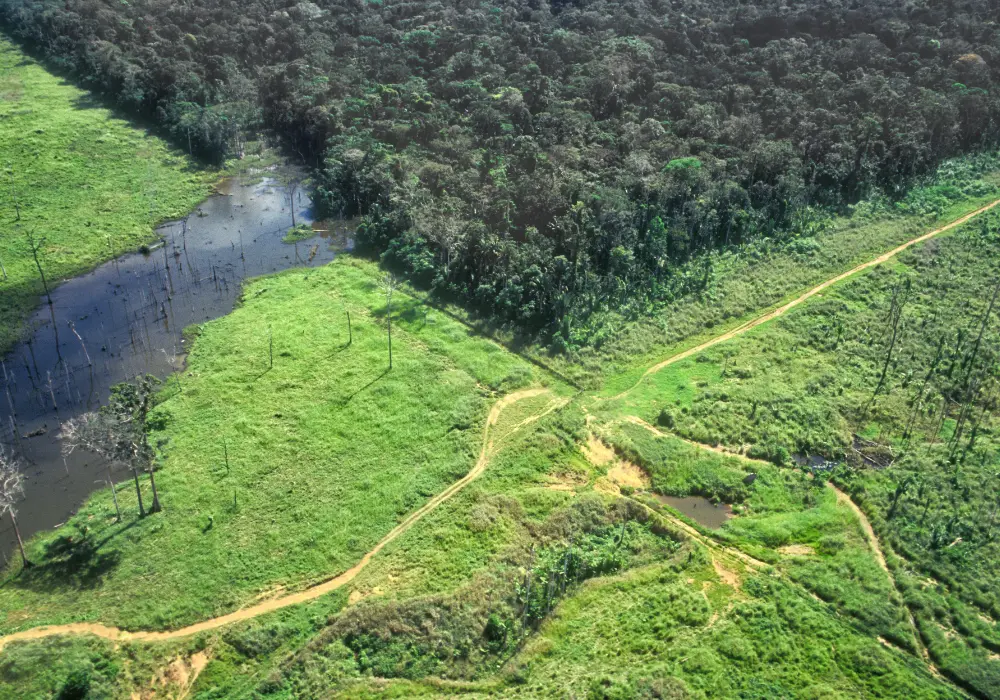
Spanning 6.4 million hectares along the rugged Pacific coast of British Columbia, the Great Bear Rainforest represents one of the most significant ecological fortifications against global climate change. This vast expanse of fjords, ancient cedars, and sprawling river systems is more than a scenic wilderness; it is one of the world’s largest and most efficient carbon sinks. According to data from Great Bear Carbon, an Indigenous-led initiative, these old- and second-growth forests sequester more carbon per hectare than even the tropical Amazon rainforest. As the largest project of its kind in Canada, the Great Bear Carbon initiative has emerged as a rare success story within the global carbon-credit market—a sector frequently besieged by allegations of "greenwashing" and lack of transparency.
Managed by an alliance of nine Coastal First Nations, the project generates approximately one million carbon credits annually. These credits serve as a vital economic engine, funding large-scale conservation efforts and essential community infrastructure. The credits are purchased by corporations through two primary channels: a voluntary market, where companies seek to meet internal sustainability goals, and a compliance market established by the British Columbia provincial government. In the compliance market, large-scale industrial emitters are legally required to purchase credits if their emissions exceed government-mandated caps.
The Mechanics and Challenges of the Carbon-Credit System
In its most fundamental form, a carbon credit represents a simple mathematical exchange: one credit equals one metric ton of carbon dioxide prevented from entering or removed from the atmosphere. However, the practical application of this system is fraught with complexity. Economists and climate scientists warn that the efficacy of carbon markets depends entirely on the integrity of the "caps" set by regulatory bodies.
Dave Sawyer, principal economist at the Canadian Climate Institute, notes that if governments set emission caps too high, an oversupply of credits is created. This saturation drives down prices and removes the financial pressure on corporations to innovate or reduce their actual carbon footprint. "When there is too much supply, there’s no incentive to reduce emissions," Sawyer explains. For a carbon market to function as a tool for decarbonization, the scarcity of credits must reflect a genuine necessity for atmospheric improvement.
Beyond market supply, the "quality" of a credit is determined by two critical factors: verification and additionality. Verification involves rigorous auditing by third-party organizations to ensure that the claimed carbon sequestration is actually occurring. The importance of this was highlighted in 2023 when an investigation into Verra, the world’s leading certifier of carbon credits, revealed that more than 90% of its rainforest-related credits provided no real climate benefit. Such failures have led to widespread skepticism regarding the validity of forest-based offsets.
Defining Additionality in the Great Bear Rainforest
The second pillar of credit integrity is "additionality"—the requirement that the carbon-sequestering activity would not have occurred without the financial incentive provided by the credit sale. Joseph Pallant, CEO of Great Bear Carbon, asserts that their project meets the highest standards of additionality.
In the context of the Great Bear Rainforest, additionality is rooted in the suspension of industrial logging. Historically, the region was a primary target for the forestry industry. Without the revenue generated from carbon credits, the Coastal First Nations would have faced immense economic pressure to continue large-scale timber extraction to support their communities. By choosing to preserve the forest rather than harvest it, the Nations created a measurable "additional" carbon benefit that would not exist under a "business-as-usual" economic model.
"If the project would have happened anyway, then it’s not additional and you don’t get offsets," Pallant explains. "In the case of Great Bear Carbon, the project is very additional because it represents a fundamental shift in land use that was made possible through this specific funding model."
A Chronology of Conservation: From Conflict to Agreement
The current carbon project is the culmination of decades of environmental activism and legal battles often referred to as the "War in the Woods." During the 1990s and early 2000s, the British Columbia coast was a flashpoint for protests as environmentalists and Indigenous groups fought to stop clear-cut logging in pristine valleys.
The turning point occurred in 2009 with the landmark Great Bear Rainforest Agreements. This series of historic deals between the provincial government and the Coastal First Nations established a new framework for "ecosystem-based management." Under these agreements, 85% of the forest was placed under permanent protection from industrial logging. Crucially, the agreements recognized the right of the First Nations to manage the land and to issue carbon credits based on the carbon stored in the protected areas.
This transition from an extraction-based economy to a conservation-based economy has yielded significant financial returns. By 2026, the funding generated through the carbon market is projected to reach $85 million. These funds are not merely profit but are reinvested directly into the stewardship of the land and the well-being of the people who inhabit it.
The Indigenous Guardians and Community Reinvestment
A primary beneficiary of the carbon-credit revenue is the Indigenous Guardians program. Described by Pallant as the "eyes and ears on the landscape," the Guardians are trained professionals from the local Nations who manage the territory. Their responsibilities are diverse, ranging from monitoring migratory wildlife and protecting salmon spawning grounds to conducting search-and-rescue operations in the remote coastal wilderness.
The impact of this funding extends deep into the social fabric of the communities. In Haida Gwaii, carbon-credit revenue has contributed to the construction of a new healthcare unit, providing vital services to a remote population. It also funds specialized scientific research, such as studies on the northern goshawk, an endangered raptor that relies on the old-growth canopy. This model demonstrates how environmental conservation can be inextricably linked to social equity and Indigenous self-determination.
Managing Environmental Risks: Wildfires and Pests
One of the most persistent criticisms of forest-based carbon projects is their vulnerability to natural disasters. If a protected forest burns down or is decimated by a pest infestation, the carbon stored in those trees is released back into the atmosphere, effectively canceling out the offset.
To mitigate this risk, Great Bear Carbon employs a "buffer pool" strategy. Each year, 10% of the credits that would otherwise be available for sale are set aside as insurance. If a portion of the forest is lost to fire, a corresponding number of credits from the buffer pool are "retired" or canceled to account for the loss. This ensures that the total number of credits circulating in the market always reflects the actual carbon sequestered on the ground.
Pallant notes that despite the increasing frequency of wildfires in Western Canada, Great Bear Carbon has not yet had to cancel an offset from its buffer pool. The coastal temperate rainforest’s high humidity and high rainfall provide a natural defense against the mega-fires seen in the province’s drier interior. This ecological resilience puts the project in a "good position" to maintain long-term stability in a changing climate.
Audits and Accountability: An Outlier in the Industry
The credibility of Great Bear Carbon is further bolstered by external audits. In a 2023 report by the verifier Standard Carbon, the project received several "sufficient" scores for its processes and transparency. This stands in stark contrast to other regional projects. For example, an audit of the BigCoast Forest Climate Initiative, another B.C.-based carbon project, resulted in a zero score due to a lack of transparency and a failure to prove additionality.
The success of the Great Bear model suggests that Indigenous-led governance may be a key factor in project integrity. Because the First Nations have a multi-generational stake in the health of the land, their management practices tend to prioritize long-term ecological stability over short-term financial gain.
Broader Implications and the Future of Conservation
As Great Bear Carbon enters the 15th year of its initial 25-year carbon-credit issuance agreement, the project serves as a global blueprint for how carbon markets can be harnessed for the benefit of both the planet and Indigenous peoples. The initiative proves that with rigorous verification, genuine additionality, and local leadership, carbon credits can be more than just a corporate accounting tool—they can be a catalyst for systemic change.
The implications of this model are significant for international climate policy. As nations strive to meet the targets of the Paris Agreement, the preservation of existing carbon-dense ecosystems like the Great Bear Rainforest is as critical as the transition to renewable energy.
"In our case, the credits will be protecting land through 25 years, and surely way into the future," says Pallant. "We haven’t run out of land to protect." The continued success of the project suggests that the "Great Bear" will remain a cornerstone of Canada’s climate strategy, proving that the most effective way to protect the environment is to empower the people who have served as its stewards for millennia.
