

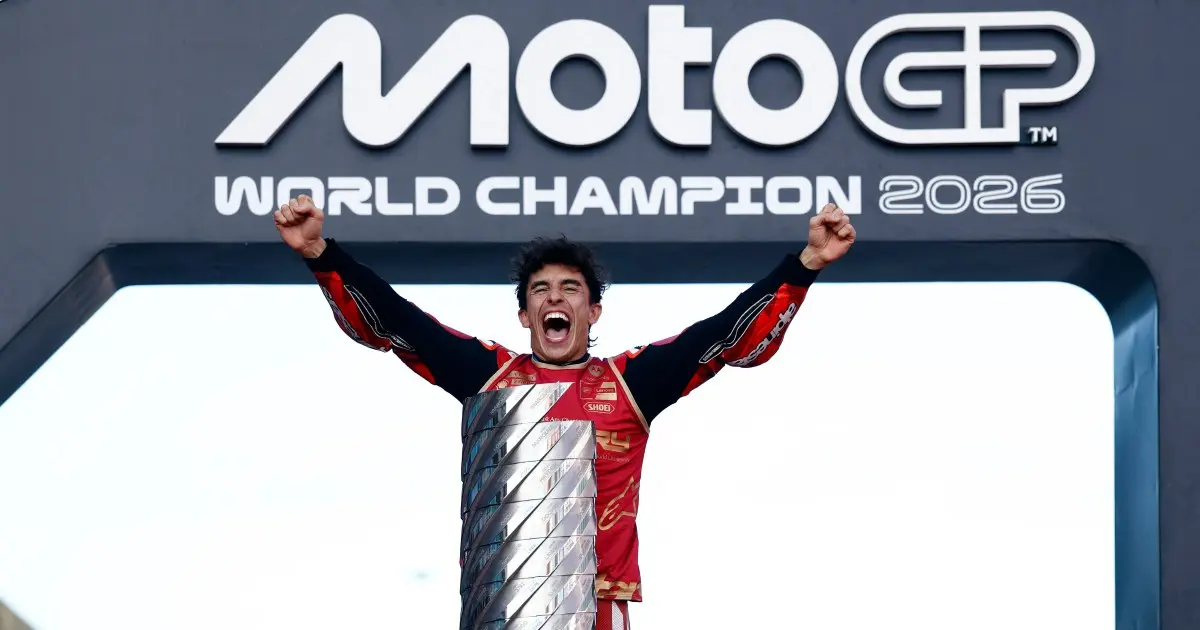
The atmosphere in southern Portugal was electric as the season reached its penultimate climax. While the race victory belonged to Italian rider Marco Bezzecchi, who delivered a flawless performance for Aprilia, the day’s narrative was firmly centered on the "Ant of Cervera." Upon crossing the finish line, an overcome Marquez abandoned his bike to celebrate with his team and the thousands of fans who had traveled to witness what many considered an impossible comeback following years of career-threatening injuries.
A Tactical Masterclass in Portimão
The Portuguese Grand Prix was less about outright speed for Marquez and more about calculated risk management. Having entered the weekend with a comfortable but not insurmountable lead over his nearest rivals, Jorge Martin and Marco Bezzecchi, Marquez knew that a top-nine finish would be enough to secure the trophy, regardless of what his competitors achieved.
The race began under clear skies, with Bezzecchi taking an early lead that he would never relinquish. Marquez, starting from a cautious position on the grid following a crash in Saturday’s sprint race, opted for a conservative tire strategy. He avoided the early skirmishes between the mid-pack riders, maintaining a steady pace that kept him within the points-paying positions. As Bezzecchi and Martin battled at the front, Marquez focused on maintaining his eighth-place standing, eventually crossing the line to a deafening roar from the grandstands.
The post-race celebrations were steeped in symbolism. Marquez was greeted on the track by Giacomo Agostini, the man whose record he had just equaled. In a passing-of-the-torch moment, Agostini presented Marquez with a golden commemorative helmet. The Spaniard then ascended a specially constructed staircase, flanked by digital displays showing the silhouette of a goat—a reference to the "Greatest of All Time" acronym—before placing his nameplate on the permanent Tower of Champions.

The Long Road to Recovery: A Season of Two Halves
Marquez’s 2026 triumph is widely regarded by analysts as the most significant of his career due to the immense adversity he faced. The season did not begin with the dominance usually associated with the eight-time champion. Instead, the first quarter of the year was a series of setbacks that led many pundits to suggest his era had finally come to an end.
The season-opener in Thailand saw Marquez suffer a catastrophic flat tire while leading, resulting in a zero-point finish. This was followed by a low-side crash at the Spanish Grand Prix in Jerez and a high-speed tumble at Le Mans in France. The French GP accident was particularly damaging, as Marquez sustained a foot fracture that forced him to undergo surgery and withdraw from the subsequent Catalan Grand Prix.
By early June, the championship standings told a grim story. Marquez trailed the championship leader, Marco Bezzecchi, by a staggering 102 points. Having undergone both foot surgery and a corrective procedure on a lingering shoulder issue within the same month, his title aspirations seemed mathematically and physically improbable.
However, the Hungarian Grand Prix on June 7 marked a pivotal turning point. Marquez secured his 100th career win in a masterclass of wet-weather riding, igniting a momentum shift that would define the rest of the summer. From June through October, Marquez embarked on a relentless campaign, securing seven Grand Prix victories and ten sprint race wins. This "summer of dominance" allowed him to erase the 102-point deficit and take control of the standings heading into the flyaway races.
Comparative Analysis: Marquez, Agostini, and Rossi
With this eighth premier-class title, Marquez has solidified his place in the pantheon of motorcycling greats. He now stands equal with Giacomo Agostini, who secured his eight titles between 1966 and 1975 during an era of significantly different mechanical and safety standards.

While Agostini remains the overall leader in total world titles across all classes (15), Marquez has now surpassed his modern-era rival, Valentino Rossi, in premier-class championships. Rossi, who retired with seven MotoGP titles, still holds a slight edge in individual race wins in the top category (89 to Marquez’s 80), but Marquez’s 10 titles across 125cc, Moto2, and MotoGP place him in a rarefied atmosphere of versatility and longevity.
Statistically, Marquez’s 2026 season was a testament to efficiency. While he won 11 Grands Prix during his 2025 campaign—his first year with Ducati—the 2026 title required a higher level of psychological resilience. His ability to maintain a total of 439 points despite missing a race and suffering three DNFs (Did Not Finish) underscores the high ceiling of his performance when the bike is operational.
Technical Synergy: The Ducati Lenovo Partnership
The shift from Honda to Ducati, which began as a gamble in late 2024, has paid dividends beyond expectations. For over a decade, Marquez was synonymous with the Honda RC213V, a bike known for being notoriously difficult to ride. His transition to the Ducati Desmosedici provided him with a platform that rewarded his aggressive braking style while offering the stability and aerodynamic advantages that Honda currently lacks.
Ducati’s engineering team, led by Gigi Dall’Igna, has praised Marquez’s feedback and adaptability. "To see a rider of Marc’s caliber integrate so seamlessly into our philosophy is a dream," Dall’Igna stated in a post-race interview in the paddock. "He pushed the development of the GP26 in directions we hadn’t explored, particularly in mid-corner rotation. This title belongs as much to his engineers as it does to his right wrist."
The synergy between the rider and the Italian manufacturer has shifted the power dynamic of the paddock. With Jorge Martin (396 points) and Marco Bezzecchi (394 points) also performing at elite levels on European machinery, the 2026 season confirmed the total eclipse of Japanese manufacturers Yamaha and Honda in the current technical regulations.

Official Reactions and Future Implications
The emotional weight of the victory was evident in Marquez’s post-race comments. "We need to be happy. I know that we are here celebrating a historic moment. I know how I suffered," he told reporters while draped in the Spanish flag. "I know that in the middle of the season, the fans believed more than I did. My people believed more than I did. But I kept pushing; I kept doing my best."
His rivals were quick to offer praise. Jorge Martin, who secured second in the championship, acknowledged the difficulty of competing against a rejuvenated Marquez. "Marc is on another level when the pressure is at its highest. We pushed him to the limit, but his ability to recover from the injuries he had in May is something I have never seen before."
The 2026 MotoGP season will conclude next weekend in Valencia, Spain. While the championship is decided, the race will serve as a homecoming celebration for Marquez and a final opportunity for Bezzecchi and Martin to settle the battle for second place.
Looking ahead to 2027, the primary question for the sport is whether anyone can prevent Marquez from claiming a ninth premier-class title to become the undisputed record-holder. With his physical health seemingly restored and his mastery of the Ducati platform complete, the "Marquez era," once thought to be over in 2020, appears to be in a vibrant second act.
The implications for the sport’s commercial appeal are equally significant. MotoGP has seen a surge in viewership and attendance throughout 2026, largely driven by the narrative of Marquez’s comeback. As he chases the elusive ninth title, the sport finds itself in a golden era of competition, balancing the raw talent of established legends with a hungry generation of young Italian and Spanish riders. For now, however, the spotlight remains firmly on the man from Cervera, who proved that even in a sport defined by speed, endurance and mental fortitude are the ultimate paths to history.
