

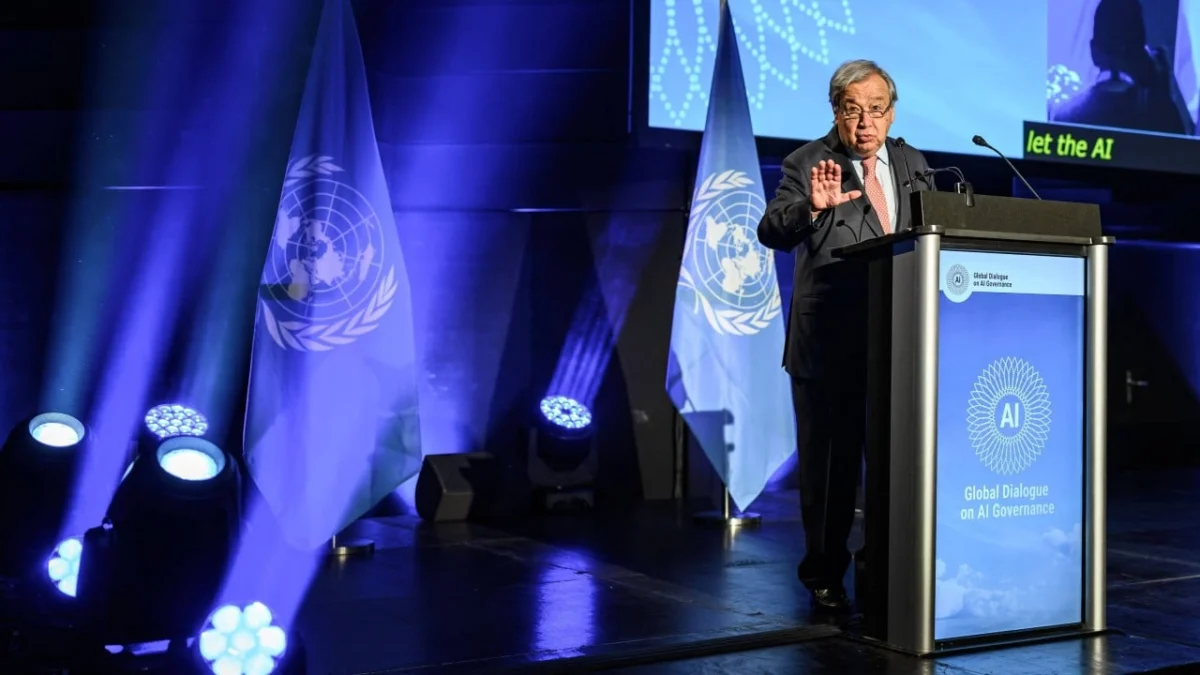
The global competition for dominance in artificial intelligence has evolved beyond a mere commercial or scientific rivalry, transforming into a fundamental contest over the future of the international order. As of mid-2024, two distinct architectural visions for AI governance and deployment have emerged, led respectively by the United States and China. In June, the United States convened the second summit under the "Pax Silica" framework, a 24-economy coalition focused on securing supply chains, building AI infrastructure, and fostering trusted technology partnerships. This was followed closely in July by a meeting of all 193 United Nations member states in Geneva for the inaugural Global Dialogue on AI Governance. Only days after the UN assembly, 29 countries gathered in Shanghai to sign an agreement establishing the World Artificial Intelligence Cooperation Organization (WAICO). These rapid-fire developments signal a tri-polar structure in the global tech landscape: an American-led model of secured diffusion, a Chinese model of developmental multilateralism, and a fragmented functional track governed by international institutions and middle powers.
The American Pathway: Control of the Technological Frontier
The United States has anchored its strategy in the dominance of the technological frontier. Currently, American firms maintain a commanding lead across the entire AI value chain, from advanced semiconductor design and cloud computing platforms to proprietary large language models (LLMs) and the software ecosystems used to train them. Companies such as NVIDIA, Microsoft, Alphabet, and OpenAI represent the core of this "full-stack" dominance.
The American "Pax Silica" framework is not merely a trade agreement but a comprehensive security and economic architecture. It organizes these technological assets through a combination of export packages, public financing via the CHIPS and Science Act, and deep-seated cybersecurity networks. The primary objective of this pathway is "secured diffusion." This involves widening access to high-performance technology among a circle of "trusted partners" while ensuring that the most consequential capabilities—particularly those with military or dual-use applications—remain subject to strict oversight and restrictions.
For partner nations, the American system offers significant advantages, including access to mature financial markets, cutting-edge hardware, and the world’s most advanced AI models. However, this access comes with inherent strings. Participation in the US-led ecosystem creates a multi-layered dependence on American licenses, proprietary cloud services, and continuous model updates. Furthermore, it requires alignment with US policy continuity and export control regimes managed by the Bureau of Industry and Security (BIS). Consequently, American influence in the AI era rests as much on the conditions of access as it does on the intrinsic quality of the technology itself.
The Chinese Architecture: Developmental Multilateralism and WAICO
In contrast to the American focus on frontier control and security-gated access, China is constructing an alternative architecture rooted in "developmental multilateralism." This strategy is designed to appeal to the Global South and nations seeking to build domestic AI capabilities without the stringent alliance-based conditions imposed by Washington.
The Chinese pathway integrates several key components: lower-cost hardware, open-weight models, telecommunications infrastructure, and massive data-center projects. By promoting "open-weight" models—such as Alibaba’s Qwen series—Beijing offers a middle ground between completely closed proprietary systems and fully open-source software, allowing partner states to fine-tune models on local data while remaining within a Chinese-influenced technical ecosystem.
The establishment of the World Artificial Intelligence Cooperation Organization (WAICO) in Shanghai marks a significant step in institutionalizing this vision. With 29 founding member states, WAICO serves as a permanent platform for international cooperation and global governance. The organization’s charter emphasizes "safe, fair, and inclusive" development, explicitly linking AI advancement to capacity-building in developing economies. By positioning itself as the champion of the Global South, Beijing seeks to frame the AI race not as a quest for hegemony, but as a collective effort to address "historical injustices" in technological access.
However, the Chinese model introduces its own form of path dependency. While models may be operated locally, the underlying hardware, technical standards, and maintenance requirements often remain tied to Chinese suppliers. The long-term influence of WAICO will depend on its ability to move beyond diplomatic declarations and establish a stable budget, a functioning secretariat, and tangible projects that provide a credible alternative to the Western tech stack.
Chronology of the 2024 AI Governance Pivot
The summer of 2024 has proven to be a watershed moment for the formalization of these competing blocs. The following timeline illustrates the accelerating pace of global AI diplomacy:
- June 2024: The Second Pax Silica Summit. The United States hosted representatives from 24 economies to solidify "trusted" supply chains. The discussions focused on preventing the leakage of dual-use AI technologies to "adversarial" states and coordinating investment in domestic semiconductor manufacturing.
- Early July 2024: UN Global Dialogue on AI Governance (Geneva). All 193 UN member states met to discuss a unified framework for AI safety. This meeting highlighted the "functional track" of AI governance, where international bodies attempt to find common ground on ethics and risk management despite geopolitical tensions.
- Mid-July 2024: The Shanghai WAICO Agreement. Twenty-nine countries signed the founding documents for the World Artificial Intelligence Cooperation Organization. This event was synchronized with the World AI Conference (WAIC) in Shanghai, where Chinese leadership emphasized the need for a more "equitable" global distribution of AI computing power.
- Late July 2024: Implementation of New Export Controls. Following the summits, the US Department of Commerce signaled further refinements to export controls on advanced HBM (High Bandwidth Memory) chips, tightening the "secured diffusion" model.
Supporting Data: The Economic and Technical Divide
The divergence between the US and Chinese strategies is reflected in the underlying economic data. According to industry reports from 2023 and early 2024, the United States still accounts for approximately 60% of global private investment in AI, driven largely by venture capital in Silicon Valley. In contrast, China leads in the volume of AI patent applications and the deployment of "embodied AI" (robotics and industrial automation), reflecting its focus on integrating AI into its massive manufacturing sector.
Data from the International Monetary Fund (IMF) suggests that AI could affect almost 40% of global employment, with advanced economies seeing a higher impact (60%) compared to emerging markets (26%). This disparity explains the different diplomatic pitches: the US focuses on "frontier" safety and economic productivity in advanced economies, while China focuses on "capacity building" and infrastructure for the remaining 74% of the global workforce located in developing nations.
Furthermore, the "open-weight" movement led by Chinese firms has gained significant traction. In early 2024, Chinese models began topping various open-source benchmarks, providing a viable alternative for nations that cannot afford or are restricted from accessing the top-tier proprietary models from US-based firms.
Official Responses and Strategic Perspectives
The reactions from global leaders underscore the high stakes of this institutional competition. During the Geneva dialogue, UN Secretary-General António Guterres warned against a "Great Fracture" in technology, stating that a world with two different sets of AI standards and infrastructures would be inefficient and dangerous.
From the American perspective, US Secretary of Commerce Gina Raimondo has consistently emphasized that "national security is the North Star" of the US AI strategy. The American view is that AI is a transformative technology that requires a "high fence around a small yard"—protecting the most advanced chips while collaborating with democratic allies.
Conversely, Chinese President Xi Jinping has warned against the creation of "new historical injustices" in the AI era. Beijing’s rhetoric focuses on "technological sovereignty," suggesting that the US-led model is a form of "digital colonialism" that keeps the Global South dependent on Western software and values. By establishing WAICO, China aims to provide an "inclusive" alternative that respects the diverse political systems of its member states.
Middle powers, such as the European Union, Singapore, and the United Arab Emirates, are attempting to navigate between these two poles. The EU’s AI Act represents a third way—a "regulatory track"—that focuses on human rights and risk-based classifications, though the EU remains largely dependent on American hardware for its implementation.
Broader Impact and Implications for the International Order
The emergence of these competing AI architectures suggests several long-term implications for the international order. First, the world is moving toward a "splinternet" of AI, where technical standards, data practices, and hardware compatibility are no longer universal. A country that builds its national AI infrastructure on the WAICO/Chinese stack may find it prohibitively expensive or technically impossible to switch to the Pax Silica/US stack later, and vice versa.
Second, the "functional track" led by the UN and other international institutions faces an uphill battle. While there is broad consensus on the need for "safe" AI, there is no shared definition of what "safety" or "fairness" means in practice. For the US, safety often involves preventing the use of AI by authoritarian regimes for surveillance; for China, safety involves preventing AI from being used to destabilize social order or undermine state sovereignty.
Third, the role of middle powers will be crucial. Nations like the UAE and Saudi Arabia are investing billions into AI and are currently attempting to maintain partnerships with both sides—buying American chips while collaborating with Chinese researchers. However, as the US tightens its "trusted partner" requirements, these "swing states" may eventually be forced to choose a side, further solidifying the bipolar nature of the global tech landscape.
Ultimately, the global AI race is not just about who has the fastest processor or the most sophisticated chatbot. It is a struggle to define the rules, norms, and physical infrastructure that will govern human society in the 21st century. Whether the future is one of "secured diffusion" or "developmental multilateralism," the decisions made in the summer of 2024 have set the stage for a decades-long competition over the technological foundations of power.
