

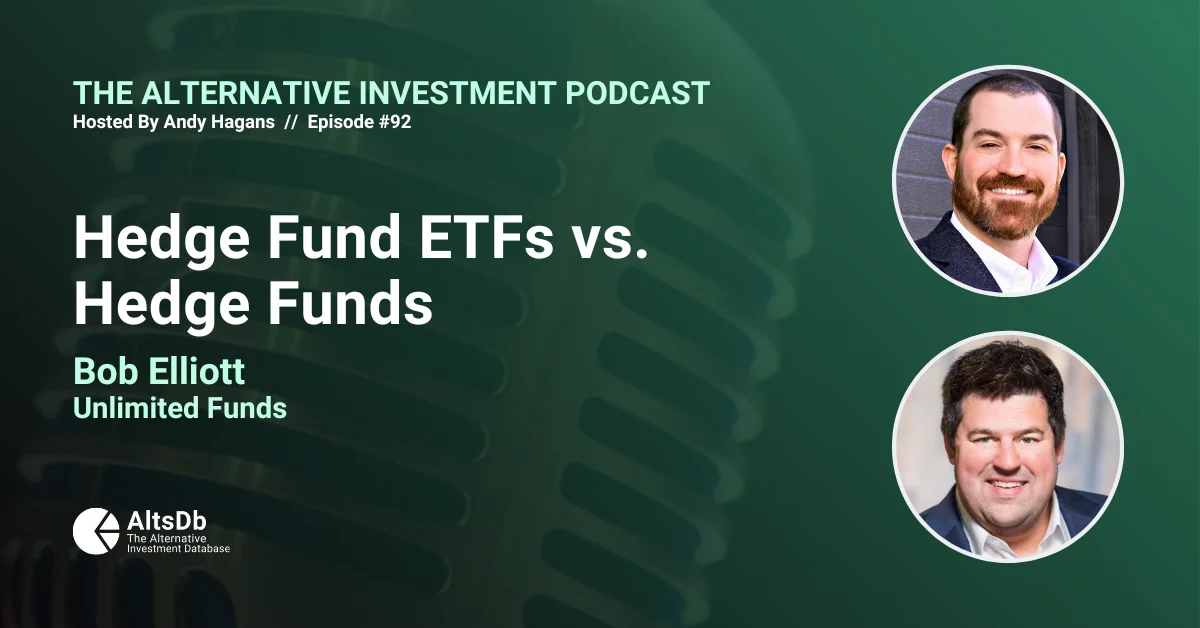
Leading hedge funds have historically been positioned as vehicles for substantial investor returns, driven by their active management strategies. However, this active approach comes with a significant cost, often manifested in high fees and limited accessibility. Bob Elliott, CEO of Unlimited Funds, recently articulated a compelling argument for the potential of alternative Exchange Traded Funds (ETFs) to not only match but surpass the net-of-fees performance of traditional hedge funds. His insights, shared on a recent episode of The Alternative Investment Podcast, shed light on a novel strategy that could democratize access to sophisticated investment approaches.
The Allure and the Obstacles of Hedge Funds
The term "hedge fund" often evokes an image of an exclusive club, accessible only to a select few. While this perception holds some truth, it also masks the complex realities of these investment vehicles. Hedge funds employ a diverse array of strategies, including global macro, equity long-short, and managed futures, all aimed at generating alpha – returns that exceed market benchmarks. Historically, their appeal has been their ability to offer uncorrelated returns, capital preservation during downturns, and sophisticated risk management.
Bob Elliott’s career trajectory provides a deep understanding of this world. He began his journey at Bridgewater Associates, a firm renowned for its systematic approach to macro investing. In its early days, Bridgewater was a challenger in the asset management landscape, with a few billion dollars under management. Elliott spent nearly 15 years there, developing a profound grasp of macroeconomic drivers and constructing systematic investment strategies. This foundational experience instilled in him a deep appreciation for how rigorous, quantitative methods could be applied to complex financial markets.
"Bridgewater’s real innovation was bringing the sort of rigorous and systematic approaches that had existed for a long time in things like equity long-short, and areas like that, and bringing that understanding into the macro space," Elliott explained. This systematic approach, he elaborated, is essentially the quantification of intuitive linkages within the economy and markets, allowing for disciplined execution of investment strategies. This discipline, he noted, is a significant advantage over purely discretionary investing, which can be susceptible to emotional biases and overreactions to incremental information.
Understanding Macroeconomic Drivers: A Systematic Approach
The macroeconomic landscape, often perceived as opaque and unpredictable, is, according to Elliott, best understood through systematic analysis. He contrasts this with traditional academic macroeconomics, suggesting that real-world application requires identifying intuitive cause-effect drivers and then quantifying them. For instance, a simple linkage like an inflation surprise leading to rising bond yields can be quantified by analyzing the pressures on inflation relative to what is already priced into the bond market.
"All systemization is, is the quantification and using that understanding in a repeated way over and over and over again, right? In a way that is disciplined," Elliott stated. This discipline is crucial, as even the most astute macro investors operate with probabilities. He drew an analogy to blackjack, where a skilled player might win 55% of their hands. While not a perfect win rate, consistently applying this edge across numerous trades can lead to exceptional results over time.
This systematic approach also helps navigate the complexities of market reactions. Elliott acknowledged that policy responses from entities like the Federal Reserve, or the market’s own pricing of future events, can create layers of complexity. However, he argued that the motivations and decision-making frameworks of these actors are often more predictable than perceived. "The motivations of the Fed, how the Fed reacts is simply a function of how the data that they’re seeing happens," he explained, suggesting that a systematic understanding of inputs like growth and inflation can allow for prediction of their behavior. This perspective implies that central bankers, to a degree, operate within constrained decision rules, akin to an algorithm.
The Rise of Alternative ETFs: Addressing Market Inefficiencies
Despite the inherent value of hedge fund strategies, several pain points have historically limited their appeal to a broader investor base. Elliott identified these key issues:
- High Fees: Traditional hedge funds typically charge management fees of 2% and performance fees of 20% (the "2 and 20" model), often resulting in annual costs of 300 to 400 basis points. These substantial fees can significantly erode investor returns, even when the underlying strategies are effective.
- Tax Inefficiency: The typical limited partnership (LP) structure of hedge funds often results in annual distributions being taxed at high marginal income tax rates, making them less tax-efficient than other investment vehicles.
- Lack of Diversification and Access: Smaller investors struggle to achieve adequate diversification within the hedge fund space due to high minimum investment requirements and the exclusive nature of the most successful funds. Investing through fund-of-funds can lead to a layering of fees, further diminishing net returns.
- Administrative Burden: The extensive paperwork, including K-1s, associated with alternative investments can be cumbersome for both individual investors and financial advisors.
It is against this backdrop that Unlimited Funds introduced its HFND Multi-Strategy Return Tracker ETF. The fund aims to replicate the gross-of-fees returns of the hedge fund industry by employing a systematic approach powered by modern machine learning techniques. "The idea of creating a portfolio which replicates the risk-return characteristics or, you know, replicates the returns, the gross of fees, returns of the hedge fund industry, you know, in that ETF wrapper in order to address a lot of those pain points," Elliott explained.
HFND: A Systematic Approach to Hedge Fund Replication
The HFND ETF seeks to provide investors with exposure to hedge fund-like returns at a significantly lower cost and with greater tax efficiency. The strategy leverages proprietary experience in developing systematic hedge fund strategies, combined with advanced machine learning algorithms. This technology allows the fund to "look over the shoulder of the hedge fund managers, see what they’re doing in close to real-time, take that understanding, translate it into long and short positions in various index products," Elliott elaborated.
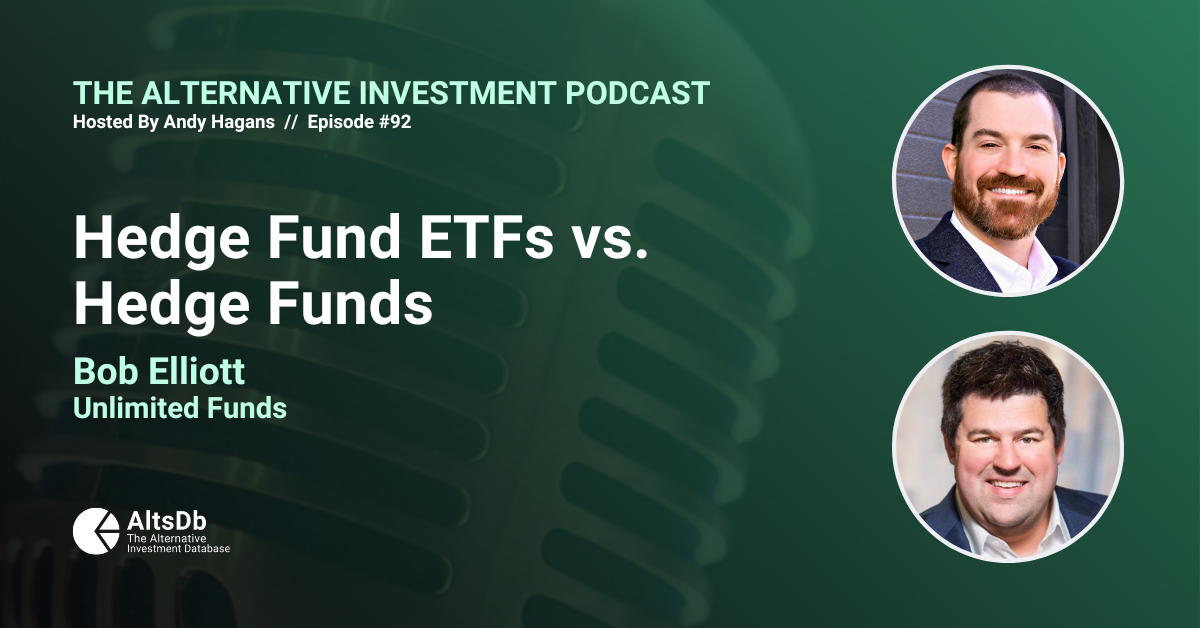
By utilizing technology rather than relying on highly compensated individual portfolio managers, HFND can offer management fees that are approximately a quarter of those charged by traditional hedge funds. Furthermore, its ETF structure makes it substantially more tax-efficient than traditional LP structures. The fund also addresses the diversification issue by providing exposure to a broad spectrum of hedge fund strategies within a single, accessible product.
"The end investor sees a much more consistent return stream and a higher return net of fees and taxes than they would were they to go out and invest in a handful of individual hedge fund positions or frankly, a lot better than what they get if they invested in a fund of fund structure," Elliott asserted. This approach democratizes access to sophisticated strategies, making them available to a wider audience, including RIAs and high-net-worth individuals who may have previously found direct hedge fund investment prohibitive.
The Evolving Landscape of Alternative Investments
The performance of hedge funds in 2022 underscored their potential role in diversifying portfolios during challenging market conditions. While the traditional 60/40 portfolio experienced significant drawdowns, the aggregate hedge fund industry, before fees, remained relatively flat. This demonstrated their ability to preserve capital and offer downside protection.
Elliott highlighted that even strategies like equity long-short, which some media outlets have criticized, delivered significant alpha relative to passive equity benchmarks in 2022. This indicates that the underlying strategies themselves are robust, even if the net returns can be hampered by fees.
The rise of actively managed ETFs, particularly in the alternative space, represents a significant evolution in investment product design. Regulatory changes in recent years have enabled managers to implement more sophisticated strategies within the ETF wrapper, provided they incorporate robust risk controls. This has opened the door for products like HFND to offer benefits such as liquidity, transparency, tax efficiency, and ease of execution – characteristics that are highly valued by investors and advisors alike.
"The ETF structure is the best structure for the investor. There’s no question about that. It’s liquid, it’s transparent, it’s, you know, it’s tax efficient, right? And it’s executable without having to fill out any paperwork," Elliott emphasized. This investor-centric structure, coupled with innovative strategies, is driving a shift in how sophisticated investment approaches are delivered to the market.
The Future of Fees and Access
Looking ahead, Elliott predicts a rationalization of fees across the investment management industry, particularly in an environment of potentially lower economic returns. The era of cheap money, which often masked the impact of high fees, is likely drawing to a close. This macroeconomic shift will inevitably bring the skill of the investor relative to their fees into sharper focus.
A bifurcation is expected within the hedge fund industry. A select group of managers generating truly unique alpha will likely continue to command their fees, accessible primarily to institutional investors. However, for the broader hedge fund landscape, the justification for high fees will come under intense scrutiny.
In this environment, hedge fund ETFs and similar replication strategies are poised to gain significant ground. By offering access to sophisticated strategies at a fraction of the cost and with greater tax efficiency, these products present a compelling alternative for investors who are not among the largest institutions. This trend is not about replacing traditional hedge funds entirely but rather about providing more choice and putting downward pressure on fees across the board.
"Money’s gonna go as much as can to the best most sophisticated managers. And then I suspect we’re gonna see a lot of capital flow into these increasingly sophisticated replication strategies put in structures like ETFs," Elliott concluded. This evolution promises to benefit investors by providing access to diversified, consistent, and lower-cost investment strategies, ultimately aligning the interests of managers more closely with those of their clients.
For those seeking to learn more about Unlimited Funds and the HFND ETF, the company’s website, unlimitedfunds.com, offers detailed information, including commentary and blog posts on investment topics. Bob Elliott also maintains an active presence on Twitter (@BobEUnlimited), where he shares insights on macroeconomics and market dynamics.
