

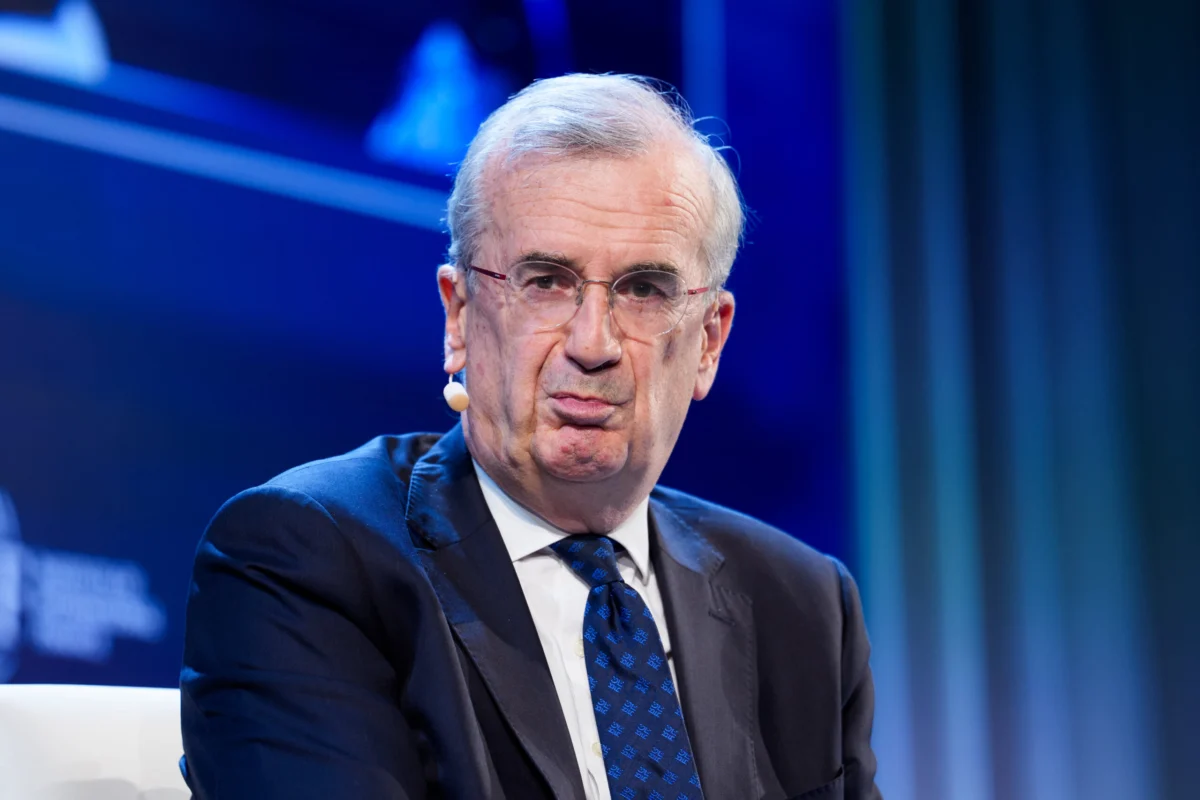
The European Central Bank (ECB) stands ready to implement all necessary measures to ensure inflation returns to its 2% medium-term target, a commitment reiterated by François Villeroy de Galhau, Governor of the Bank of France and a key member of the ECB’s Governing Council. In an interview with CNBC’s Lisa Kim in Singapore, Villeroy de Galhau sought to allay concerns in sovereign debt markets, emphasizing the central bank’s resolve in mitigating the inflationary pressures stemming from recent geopolitical events, particularly the escalating conflict in the Middle East and its impact on global energy markets.
The effective closure of the Strait of Hormuz, a critical chokepoint for global oil shipments, has triggered a sharp increase in crude oil prices. This surge has ignited fears of a renewed energy crisis, which could reignite inflationary pressures across various economies, particularly in energy-importing regions like the Eurozone. Villeroy de Galhau’s pronouncements underscore the ECB’s unwavering commitment to its price stability mandate, assuring markets that the central bank will act decisively, as an independent institution, to anchor inflation expectations and prevent a sustained deviation from the target.
"If I speak on behalf of the ECB, this means do what is necessary to bring inflation back to 2% in the medium term. Markets can be assured of that," Villeroy de Galhau stated unequivocally to CNBC. This strong declaration comes at a crucial juncture for the Eurozone economy, which had seen inflation dip below the ECB’s target to 1.9% prior to the recent escalation of hostilities. However, inflation in the Eurozone experienced a notable rebound, climbing to 3% in April from 2.6% in March, according to Eurostat data. This uptick is largely attributed to the pass-through effects of higher energy costs.
The Vulnerability of the Eurozone to Energy Shocks
Europe’s economic structure, characterized by its significant reliance on energy imports, renders it particularly susceptible to disruptions in global energy supply chains. The recent spike in prices for gasoline, diesel, and jet fuel has already prompted governmental interventions in several member states, including Germany, which has explored fuel price caps. Furthermore, airlines have issued stark warnings about potential flight cancellations during the summer travel season due to soaring jet fuel costs, highlighting the widespread economic ramifications of the energy price shock.
Villeroy de Galhau acknowledged these concerns, noting the palpable fear of inflation permeating financial markets, a sentiment particularly evident in the volatility of government bond markets. "The effect of the Middle East conflict is clear," he remarked. "In the short run, there are significant upward pressure first-round effects due to energy prices, but it’s our responsibility, I would even say our commitment to prevent second-round effects."
Navigating Inflationary Pressures: First-Round vs. Second-Round Effects
The distinction between first-round and second-round inflation effects is critical for central bank policy. First-round effects typically refer to the direct impact of a price shock, such as higher energy prices, on the overall inflation rate. Second-round effects, however, are more concerning for policymakers as they represent a broader entrenchment of inflation within the economy. These can manifest through wage-price spirals, where rising inflation leads workers to demand higher wages, which in turn increases businesses’ costs, prompting them to raise prices further, creating a self-sustaining cycle of inflation.
The ECB’s Governing Council has been meticulously monitoring data points that could signal the emergence of these second-round effects. These include indicators of underlying inflation (excluding volatile energy and food prices), inflation expectations among households and businesses, and the trajectory of wage growth. The Council’s decision last month to maintain its key interest rate at 2% was influenced by a lack of conclusive data regarding the persistence and breadth of these second-round effects.

"The data so far are telling that it’s mainly a first-round effect, but we should be extremely vigilant about possible second-round effect," Villeroy de Galhau emphasized. "So, again, have no doubt we will act as much as necessary." This cautious yet determined stance suggests that the ECB is prepared to act preemptively if evidence points to a broader and more persistent inflationary impulse.
Market Expectations and the Path Forward
Financial markets are currently pricing in a high probability of an interest rate hike at the ECB’s upcoming June meeting. Data compiled by LSEG indicates that a significant majority of traders anticipate a rise of at least 50 basis points in interest rates by the end of the year, reflecting expectations that the central bank will adopt a more hawkish monetary policy stance to combat inflation.
The volatility in global government bond markets since the onset of the conflict underscores these market expectations. Germany’s 10-year bund, a benchmark for the Eurozone, has seen its yield surge by approximately 32 basis points, while other Eurozone sovereign bonds have experienced even more pronounced swings. This rise in bond yields reflects investors pricing in higher inflation and the prospect of tighter monetary policy. Bond yields and prices move in opposite directions; an increase in yields signifies a decrease in bond prices, driven by investor demand for higher returns in an inflationary environment.
Historical Context and Previous Statements
The ECB’s current posture aligns with pronouncements made by its leadership in recent months. At the end of March, ECB President Christine Lagarde indicated the central bank’s readiness to increase interest rates, even if the anticipated rise in inflation proved to be temporary. She articulated that a significant, albeit not excessively persistent, overshoot of the inflation target could warrant "some measured adjustment of policy." Lagarde further elaborated on the communication risks of inaction, stating, "To leave such an overshoot entirely unaddressed could pose a communication risk: the public may find it difficult to understand a reaction function that does not react."
Earlier in April, speaking at the International Monetary Fund’s (IMF) Spring Meeting in Washington, D.C., Joachim Nagel, President of Germany’s Bundesbank, characterized the ECB’s situation as being "between our baseline and our adverse scenario" due to oil price volatility. Similarly, Martins Kazaks, Governor of Latvia’s central bank and a member of the ECB’s Governing Council, warned of a potential "layer cake" of economic shocks, suggesting a confluence of adverse events could create a challenging economic environment.
Chronology of Key Events and Inflation Data
- Early February 2026: Inflation in the Eurozone dips to 1.9%, falling below the ECB’s medium-term target.
- February 28, 2026: Joint U.S. and Israeli strikes on Iran mark a significant escalation of conflict in the Middle East.
- Late February – Early March 2026: The Strait of Hormuz faces effective closure, leading to a sharp increase in global oil prices.
- March 2026: Eurozone inflation rises to 2.6%.
- April 2026: Eurozone inflation climbs further to 3%.
- April 2026: The ECB’s Governing Council holds its key interest rate steady at 2%, citing the need for more data on second-round inflation effects.
- April 30, 2026: ECB President Christine Lagarde signals readiness to hike rates if inflation significantly overshoots the target.
- May 2026: Governor François Villeroy de Galhau of the Bank of France reaffirms the ECB’s commitment to using "necessary" tools to combat inflation in an interview with CNBC.
Broader Economic Implications
The sustained elevated energy prices and the resulting inflationary pressures have significant implications beyond the immediate price increases. They can dampen consumer purchasing power, leading to reduced demand for non-essential goods and services. Businesses face higher operating costs, potentially impacting profitability and investment decisions. In an energy-dependent region like Europe, this can also lead to concerns about industrial competitiveness and economic growth.
The ECB’s response will be crucial in navigating this complex environment. A premature or overly aggressive tightening of monetary policy could stifle economic activity, while a delayed or insufficient response could allow inflation to become entrenched, leading to greater economic instability in the long run. The central bank’s commitment to data-driven decision-making and clear communication remains paramount in managing market expectations and fostering economic stability. The coming months will be critical as the ECB assesses the evolving inflationary landscape and calibrates its monetary policy to achieve its primary objective of price stability. The resolve expressed by Governor Villeroy de Galhau signals that the ECB is prepared to shoulder the responsibility of steering the Eurozone economy through these turbulent times.
