

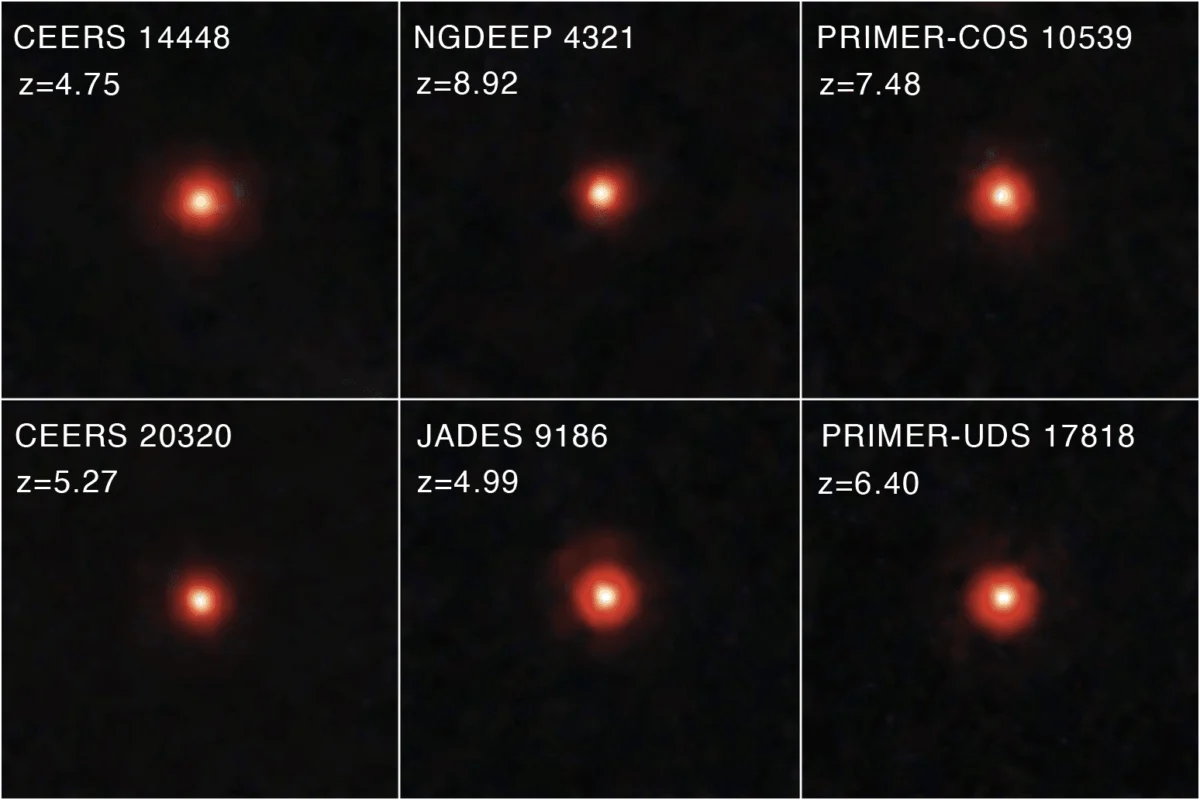
When the American rock band Soundgarden released the psychedelic anthem "Black Hole Sun" in 1994, the lyrics were widely regarded as surrealist poetry rather than an astronomical prediction. However, recent findings published in the journal Nature suggest that the concept of a "black hole star"—an object that blurs the line between a traditional stellar body and a gravitational singularity—is no longer confined to the realms of music or science fiction. Utilizing the unprecedented observational power of the James Webb Space Telescope (JWST), an international team of astronomers has identified a celestial object that may represent a missing link in our understanding of how the universe’s most massive structures formed.
The research focuses on an object designated as MoM-BH-1, a phenomenon that appears as a tiny, crimson speck in the deep field images captured by the JWST. Despite its unassuming appearance, MoM-BH-1 is a cosmic titan, roughly the size of our entire solar system and glowing with a fierce, red intensity. Located in the far reaches of the observable universe, the light from this object began its journey toward Earth when the cosmos was just 660 million years old—less than 5% of its current age of approximately 13.8 billion years. This discovery provides a rare glimpse into the "Cosmic Dawn," a period characterized by the birth of the first stars and galaxies.
The Nature of the Black Hole Star Hypothesis
At the heart of the study is the "black hole star" hypothesis, a theoretical model that describes an object fueled not by nuclear fusion, but by gravitational accretion. In a standard star, such as our Sun, the outward pressure generated by the fusion of hydrogen into helium in the core balances the inward pull of gravity. In contrast, a black hole star—often referred to in theoretical physics as a "quasi-star"—features a central black hole enveloped by a massive, dense cloud of gas.
According to the data retrieved from MoM-BH*-1, the object emits approximately 100 billion times more energy than a typical star. This level of luminosity is physically impossible for a star of that size to maintain through nuclear fusion alone. The researchers argue that the energy is instead generated by a central black hole that is voraciously consuming surrounding matter. As gas and dust spiral into the black hole, they form an accretion disk that reaches extreme temperatures, releasing vast amounts of radiation. This energy must then fight its way through a gargantuan envelope of gas before escaping into space. This process filters the light, giving it the spectral characteristics of a star while masking the violent engine at its core.
A Chronology of Discovery and the Role of JWST
The identification of MoM-BH*-1 is the culmination of a series of observations that began shortly after the James Webb Space Telescope commenced its scientific operations in the summer of 2022. Astronomers were quickly surprised by the presence of numerous "little red dots" (LRDs) in the early universe. These objects were much smaller and redder than the expansive spiral galaxies seen in the local universe, and they did not fit neatly into existing cosmological models.
The timeline of this specific discovery began with a wide-area survey designed to map the distribution of early galaxies. As the JWST’s Near-Infrared Camera (NIRCam) and Near-Infrared Spectrograph (NIRSpec) peered back in time, they captured the faint, redshifted signatures of objects that existed just after the Big Bang. By late 2023, the research team, led by Rohan Naidu of the Massachusetts Institute of Technology (MIT), focused their efforts on MoM-BH-1. Unlike other red dots that appeared to be part of larger, dust-obscured galaxies, MoM-BH-1 stood out because its light seemed "pure." It outshone its host galaxy so thoroughly that the telescope was essentially looking at the object in isolation.
The paper published on Wednesday marks the formal presentation of these findings to the scientific community, providing a detailed analysis of the light absorption patterns that characterize this unique class of celestial bodies.
Analyzing the Spectral Data: Starlight in Disguise
The primary evidence supporting the black hole star theory comes from the object’s spectrum—the breakdown of its light into different wavelengths. Stars typically exhibit "absorption lines," which occur when elements in their atmospheres soak up specific frequencies of light. MoM-BH*-1 displays a similar phenomenon, but on a scale that defies traditional explanation.
The researchers observed that a significant portion of the object’s light abruptly disappears at certain wavelengths. While a dense stellar atmosphere can cause this, the intensity of the absorption in MoM-BH*-1 suggests a gas cloud of incredible density and volume. This cloud acts as a cosmic shroud, absorbing the high-energy X-rays and ultraviolet light produced by the central black hole and re-emitting that energy at longer, redder wavelengths.
"Every little red dot is consistent with being a black hole star, embedded in a generic early galaxy," Rohan Naidu stated in a press release accompanying the study. "But what is special about MoM-BH*-1 is that the black hole star is essentially completely outshining its surrounding host galaxy, such that we’re seeing pure black hole star light."

This "pure" light allows scientists to calculate the mass and energy output of the object with greater precision than previously possible. The data suggests that the central black hole is already millions of times the mass of the Sun, a fact that poses a significant challenge to current theories of black hole growth.
Solving the "Supermassive" Mystery
The existence of MoM-BH*-1 may help solve one of the most persistent mysteries in modern astronomy: the "Massive Black Hole Problem." For decades, scientists have struggled to explain how supermassive black holes—those with masses millions or billions of times that of the Sun—could have grown so large so quickly in the early universe.
Standard models suggest that black holes grow slowly by merging with other black holes or by steadily accreting gas. However, the JWST has found several supermassive black holes that existed less than a billion years after the Big Bang. There simply was not enough time for them to reach such sizes through conventional means.
The black hole star hypothesis provides a potential solution. If these objects formed from the direct collapse of massive gas clouds, they could have started their lives as "heavy seeds." Instead of starting as a small black hole from a single dying star, a black hole star could begin with a mass of 10,000 to 100,000 Suns. This "head start" would allow them to reach supermassive status within the timeframe observed by the JWST.
Broader Implications for Cosmology
The discovery of black hole stars necessitates a re-evaluation of the evolution of the early universe. If these objects were common during the first billion years, they would have played a crucial role in the process of reionization—the period when the first light sources stripped electrons from the neutral hydrogen gas that filled space. The intense radiation from black hole stars would have been a primary driver of this cosmic transformation.
Furthermore, the prevalence of these "little red dots" suggests that the early universe was a much more violent and energetic place than previously assumed. Rather than a slow, orderly assembly of stars into galaxies, the Cosmic Dawn may have been dominated by these hybrid monsters, which eventually shed their gas envelopes to become the quiet, supermassive black holes we see at the centers of galaxies like the Milky Way today.
The scientific community has reacted to the Nature paper with a mixture of excitement and cautious optimism. While the data from MoM-BH-1 is compelling, some astronomers argue that other explanations—such as extremely compact "starburst" galaxies or unusually dusty quasars—cannot yet be entirely ruled out. However, the unique spectral signature of MoM-BH-1 makes the black hole star hypothesis the most robust explanation currently available.
Future Research and the Search for More "Red Dots"
The research team plans to continue using the JWST to hunt for similar objects across different regions of the sky. By building a larger census of black hole stars, they hope to determine how long these objects typically last and what conditions are required for them to form.
Upcoming observations will also utilize the telescope’s Mid-Infrared Instrument (MIRI) to peer even deeper into the dust clouds surrounding these objects. This could reveal the temperature and chemical composition of the gas envelopes in greater detail, providing further confirmation of the quasi-star model.
As the James Webb Space Telescope continues to peel back the layers of the early universe, it is becoming increasingly clear that our previous maps of cosmic history were incomplete. The discovery of MoM-BH*-1 is more than just the identification of a new type of star; it is a fundamental shift in how we perceive the transition from the Big Bang to the complex universe we inhabit today. The "black hole suns" of the early cosmos were not just poetic metaphors, but the foundational engines of the universe’s growth.
