

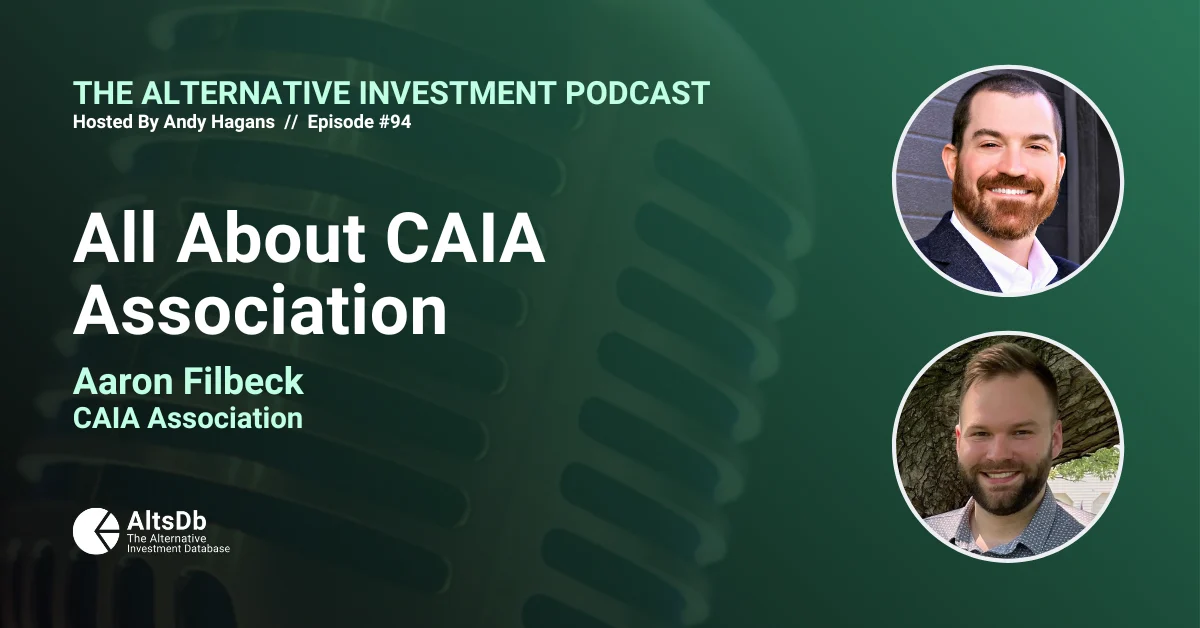
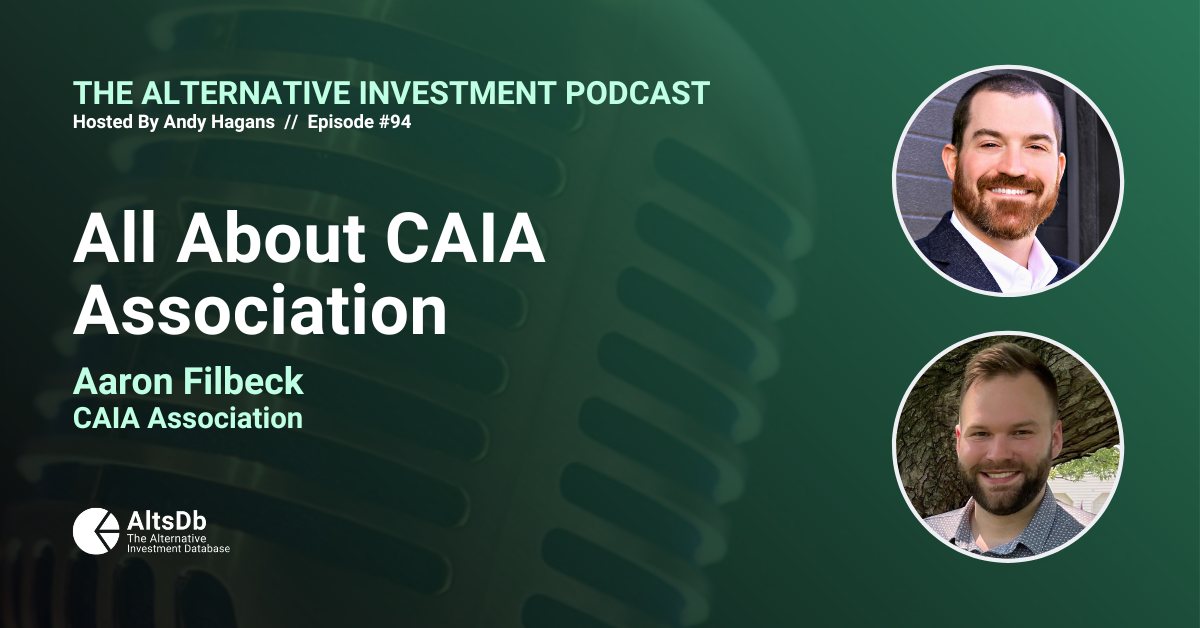
The landscape of financial advisory is undergoing a significant transformation, with alternative investments emerging as a crucial component for enhancing client portfolios and driving business growth. However, the complexity inherent in these asset classes presents a substantial challenge, leading to a persistent education gap within the advisor community. Addressing this critical need, Aaron Filbeck, Managing Director and Head of UniFi at CAIA, recently joined "The Alternative Investment Podcast" hosted by Andy Hagans to discuss how the CAIA Association is actively working to bridge this knowledge divide, ultimately aiming to improve outcomes for clients and society at large.
The Growing Demand for Alternative Investments
The appeal of alternative investments—which encompass strategies such as private equity, venture capital, real estate, hedge funds, and private debt—stems from their potential to offer diversification benefits, enhanced risk-adjusted returns, and uncorrelated performance to traditional stock and bond portfolios. As institutional investors like pension funds and endowments have long recognized and leveraged these advantages, there’s a growing momentum to make these sophisticated strategies more accessible to individual investors and the advisors who serve them. This trend has been amplified by the increasing availability of alternative investment products through various vehicles, including liquid alternatives, private placement life insurance, and direct investments.
However, the very nature of alternatives—their illiquidity, complex structures, and reliance on specialized knowledge—creates a significant barrier to entry for many financial advisors. A recent survey by [Insert hypothetical industry survey name, e.g., "The Wealth Management Institute"] found that over 60% of financial advisors cited a lack of understanding as their primary reason for not incorporating more alternative investments into client portfolios. This highlights a clear market imperative for robust educational resources.
CAIA Association: A Global Leader in Alternative Investment Education
The CAIA Association stands at the forefront of addressing this educational deficit. Founded with a mission to foster greater alignment, transparency, and knowledge across the investment industry, CAIA has a particular focus on alternative investments. As Aaron Filbeck explained, the organization is a global, member-based body with approximately 13,000 members spread across more than 100 countries. This extensive reach underscores the universal nature of the challenges and opportunities presented by alternative investments.
"We are dedicated to creating greater alignment, transparency and knowledge for all investors," Filbeck stated. "Our particular focus is on the world of alternative investments. We’re a member-based organization with a pretty wide geographic map of members around the world."
CAIA achieves its mission through multiple avenues, including formal education programs, thought leadership, and advocacy. This multi-pronged approach ensures that the organization caters to a diverse membership base, which includes limited partners (LPs), general partners (GPs), financial advisors, regulators, and distribution professionals. This inclusive model allows CAIA to foster a holistic understanding of the alternative investment ecosystem.
Bridging the Advisor-Client Divide: The UniFi Platform
A significant portion of the discussion revolved around UniFi by CAIA, a platform specifically designed to educate the private wealth management industry on alternative investments. Launched approximately a year prior to the interview, UniFi aims to upskill professionals across various segments of the wealth management sector.
"UniFi by CAIA is a learning platform that was announced by CAIA Association last year, and is really designed to educate the private wealth management industry on alternatives," Filbeck elaborated. "This includes asset managers with distribution teams new to the space, intermediaries and wirehouses, and individual RIAs and advisors."
UniFi’s delivery mechanism differs from CAIA’s more intensive charter programs. It offers a completely online, self-directed learning experience through video content and formal instruction. The platform currently features a flagship certificate program, "Fundamentals of Alternative Investments," a 20-hour course providing a 101 overview of alternative strategies. Looking ahead, UniFi plans to launch a series of micro-credentials, shorter (approximately 5-hour) programs focusing on specific topics like private debt and digital assets, allowing professionals to deepen their knowledge in targeted areas.
This flexible and accessible format is particularly beneficial for financial professionals who may not have a traditional finance background but are seeking to become conversant in alternative investments. The goal is to empower them to ask better questions, understand how these strategies fit into a client’s portfolio, and effectively communicate their value proposition.
The CAIA Charter: A Deep Dive into Institutional Alternatives
For professionals seeking a more rigorous and comprehensive understanding, the CAIA charter program remains the cornerstone of CAIA’s educational offerings. This two-level, high-stakes examination process requires candidates to dedicate an estimated 400-500 hours of self-study. The curriculum is meticulously designed to cover institutional-quality alternative investments, reflecting the allocations made by large asset owners such as endowments, pensions, and sovereign wealth funds.
Level I of the CAIA program introduces candidates to various alternative strategies, including private equity, real assets, hedge funds, and structured credit, focusing on their risk-return profiles and underlying mechanics. Level II then shifts to a top-down, allocator’s perspective, emphasizing portfolio construction, risk management, operational due diligence, and ESG considerations within the context of alternative investments.
"The focus of the program is on what we deem ‘institutional quality’ alternative investments," Filbeck explained. "We’ve constructed this curriculum to teach both at the strategy level, but also how to manage a portfolio, a big institutional portfolio, from an allocator’s perspective."
The CAIA charter is not solely for institutional investors; it is designed for a broad spectrum of professionals, including LPs, GPs, advisors, regulators, and academics. The overarching objective is to equip individuals with the mindset of an allocator, fostering a deeper appreciation for how diverse investment strategies contribute to overall portfolio objectives.
The Financial Data Professional (FDP) Charter: Navigating the Data Revolution
In addition to its alternative investment-focused programs, CAIA also offers the Financial Data Professional (FDP) charter. This designation addresses the rapidly growing intersection of data science and financial services. As data analytics, machine learning, and artificial intelligence (AI) become increasingly integral to investment strategies across all asset classes, including alternatives, the FDP program aims to bridge the communication gap between data scientists and financial professionals.
"The program is really the intersection of data science and financial services," Filbeck noted. "It helps bridge the gap between those two professions and really helps, I think in particular, the financial professional to better understand the data science and translate."
The FDP charter equips financial professionals with the knowledge to understand and leverage data science tools, enabling them to collaborate more effectively with data scientists. This is crucial for avoiding common pitfalls such as overfitting data or creating algorithms without practical financial significance. The program is a single-level examination that provides a foundational understanding of how data science can be applied to enhance financial decision-making.
Addressing the Education Gap: Progress and Future Outlook
The conversation highlighted a clear progression in the industry’s approach to alternative investment education. Filbeck drew a distinction between the initial wave of liquid alternatives around 2010, which he characterized as a "democratization wave that probably went pretty poorly" due to a focus on product over education, and the current landscape.
"Compared to what we saw 10 years ago with this move in private capital, which has really accelerated over the past couple of years, I would say that we’ve done a much better job than we did, but I think there’s still a lot of ground to cover in terms of providing education," he observed.
A key trend identified by Filbeck is the increasing willingness of financial professionals to acknowledge and address their knowledge gaps. This is partly driven by client demand, as more sophisticated investors seek to incorporate alternative investments into their portfolios. Advisors are realizing that a lack of understanding can be a significant impediment to meeting client needs and maintaining fiduciary responsibilities.
"People are much more willing to say, ‘I really need to learn about this. I need to find something’," Filbeck stated. "This gives me a lot of optimism and a trend that I’m really noticing over the past couple of years."
The future of alternative investment education, according to Filbeck, lies in leveraging technology for more accessible delivery mechanisms and, crucially, shifting the focus from product-centric education to client-objective-driven learning. The emphasis should be on understanding how alternative investments can improve client outcomes, rather than simply promoting specific products.
"We want to meet people where they’re at, and more importantly, what’s gonna be most relevant to them and where they sit in the industry," Filbeck concluded.
The CAIA Association, through its comprehensive charter programs and the innovative UniFi platform, is playing a pivotal role in equipping financial advisors with the knowledge and confidence needed to navigate the complex world of alternative investments. As the industry continues to evolve, the commitment to robust and accessible education will be paramount in unlocking the full potential of these powerful asset classes for the benefit of investors and the broader financial ecosystem.
For those interested in learning more about CAIA Association and its educational programs, the organization’s website is caia.org. They are also active on social media platforms including Twitter, LinkedIn, and Instagram.
