

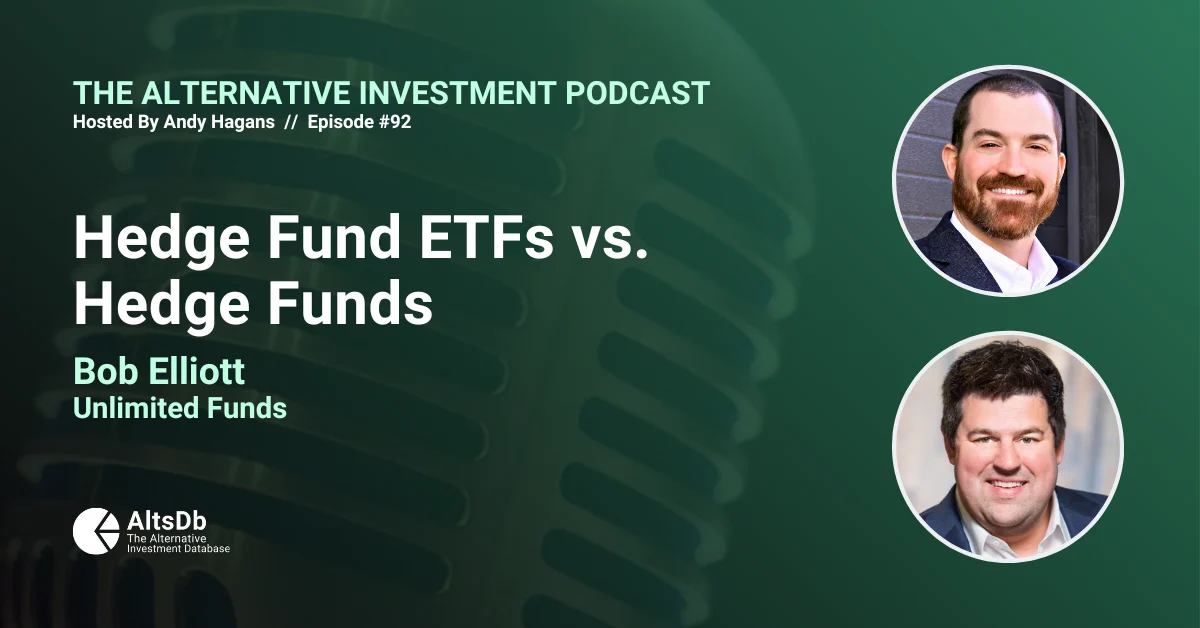
Leading hedge funds have the capability to deliver enormous returns for investors, but their active management comes at a price. Bob Elliott, CEO at Unlimited, joins the show to discuss HFND’s unique alternative strategy, and why he believes alternative ETFs have the potential to outperform hedge funds, net of fees.
The Evolving Landscape of Alternative Investments
The world of alternative investments, once a domain largely reserved for institutional investors and ultra-high-net-worth individuals, is undergoing a significant transformation. Hedge funds, known for their sophisticated strategies and potential for outsized returns, have long been a benchmark for active management. However, their high fees, limited accessibility, and complex structures have historically posed barriers for a broader investor base. This dynamic is now shifting, with the advent of innovative financial products aiming to democratize access to these strategies.
Bob Elliott, CEO of Unlimited, recently articulated this evolving paradigm in an interview on The Alternative Investment Podcast. He highlighted the inherent value of hedge fund strategies while simultaneously advocating for the growing potential of alternative Exchange Traded Funds (ETFs) to deliver comparable, if not superior, net-of-fee returns for investors. This discussion comes at a time when investors are increasingly seeking diversification and uncorrelated returns, especially following a period where traditional 60/40 portfolios experienced notable drawdowns.
From Bridgewater to Unlimited: A Journey in Macroeconomic Strategy
Elliott’s career trajectory offers a unique perspective on the intricacies of macro investing and systematic strategies. His journey began at Bridgewater Associates, a firm renowned for its pioneering work in systematic macro investing. He joined Bridgewater straight out of college, a period when the firm was a nascent player in the asset management space, managing only a few billion dollars. Over nearly 15 years, Elliott developed a deep understanding of macroeconomic drivers and the application of systematic approaches across various asset classes.
“Bridgewater’s real innovation in that space was bringing the sort of rigorous and systematic approaches that had existed for a long time in things like equity long-short, and areas like that, and bringing that understanding into the macro space,” Elliott explained. This experience provided him with a foundational understanding of how to leverage systematic strategies to gain an edge in investing. His academic background in pure sciences, specifically botany, initially seemed unrelated to finance. However, Elliott noted that his scientific training instilled a deep appreciation for understanding complex systems and the interconnectedness of various elements – a skill that proved invaluable in deciphering the macroeconomy.
Decoding the Macroeconomy: Systemization and Discipline
The prevailing understanding of macroeconomics often differs from the practical application in financial markets. Elliott emphasized that real-world macroeconomic forces and their impact on asset classes are driven by intuitive cause-and-effect linkages, which can then be quantified. For instance, a rise in inflation above expectations typically leads to an increase in bond yields. The ability to quantify these linkages and apply them systematically is the essence of systematic investing.
“Systemization is the quantification and using that understanding in a repeated way over and over and over again, right, in a way that is disciplined,” Elliott stated. The primary benefit of systemization, he elaborated, is its ability to instill discipline. Discretionary investors can be swayed by incremental information, leading to overreaction or underreaction. Systematic approaches, conversely, help synthesize vast amounts of information and execute strategies with unwavering discipline.
This disciplined approach, even with an imperfect prediction rate, can yield significant advantages. Elliott drew an analogy to blackjack, suggesting that even with a slightly better than 50% win rate over many hands, a player can become one of the best in the casino. Similarly, in macro investing, being correct approximately 55% of the time across a multitude of markets can translate into exceptional investment performance over the long term.
The Nuances of Market Reactions and Predictability
Navigating the markets involves understanding not only initial cause-and-effect relationships but also the reactions to those reactions. The Federal Reserve’s policy decisions, for example, are often influenced by incoming economic data and a set of constrained decision rules. Elliott argued that gaining an edge involves understanding the motivations and predictable behaviors of market participants, including central banks.
“The idea of bringing a systematic approach to the world is to say, let me get edge in predicting what the various people involved in the markets will do,” he explained. He further elaborated on the Federal Reserve’s actions, noting that their decisions are a function of incoming data and their established response mechanisms. By understanding these inputs and response functions, one can predict their behavior with a degree of confidence. This perspective challenges the notion of absolute unpredictability and highlights the potential for quantifiable foresight in market dynamics.
Alternative Strategies: A Compelling Intellectual Riddle
Elliott’s passion for alternative strategies stems from the intellectual challenge of understanding how complex systems, like markets and economies, function. He likens this to his background in biological systems, where understanding the totality is key. In finance, this involves not only understanding the system but also recognizing one’s own position as an actor within it.
“What investment strategies are, are ways in which you can express your understanding relative to how the rest of the market understands the world because that’s essentially what’s priced in,” he remarked. Successful investment strategies demonstrate an incrementally superior understanding of market dynamics. Conversely, incorrect predictions offer valuable learning opportunities, reinforcing the idea that investing, particularly in a macro sense, is a continuous process of learning and refinement. This continuous learning is what keeps seasoned investors engaged for decades, even into their 70s and 80s.
The Mechanics of Hedge Fund Investing
When discussing hedge funds, Elliott clarified that their strategies, particularly in macro investing, involve identifying patterns and linkages across numerous markets and asset classes. These are indeed “bets,” acknowledging the inherent uncertainty and the need to consider both potential payoffs and losses. The critical element is not just understanding a probability but understanding it relative to what is already priced into the market. This allows investors to identify mispricings, such as when market sentiment (like a fervent belief in a sports team’s success) deviates from objective probabilities.
To express these views, hedge funds employ a variety of financial instruments, including futures, swaps, options, and the direct buying and selling of cash securities. The flexibility to operate across diverse assets and take both long and short positions is a hallmark of hedge fund operations.
Accessibility and the Bifurcation of the Hedge Fund Industry
Historically, hedge funds were primarily accessible to large institutional investors like pension funds and sovereign wealth funds. While platforms like iCapital have increased accessibility for smaller investors, Elliott pointed out a significant bifurcation in the industry. The most sophisticated and successful funds often remain exclusive to institutions, as they may cap their investor base to manage capacity effectively. This can lead to a situation where smaller investors are offered access to less-than-top-tier funds.
“What we have actually, I think, is a real bifurcation in the industry where the most successful, most sophisticated funds basically only take money from institutions because they can only take money from institutions,” Elliott observed. This creates a challenge for individual investors and smaller family offices seeking to access the best opportunities.
Hedge Fund Performance in 2022: Resilience in a Challenging Year
The year 2022 presented a challenging market environment, with traditional 60/40 portfolios experiencing significant drawdowns. In this context, alternative investments, including hedge funds, largely lived up to their reputation for capital preservation. Elliott noted that the hedge fund industry, as a composite of various strategies, performed commendably.
“The hedge fund industry in aggregate, did pretty well in a challenging market environment,” he stated. While the 60/40 portfolio might have seen losses of 15-20%, hedge funds, before fees, remained largely flat or experienced minimal declines of one to two percent. Even strategies like equity long-short, which underperformed relative to cash, delivered significant alpha compared to passive equity benchmarks, falling only about 8% while the market benchmarks dropped 15-20%.
This performance underscores the ability of hedge funds to act defensively in difficult markets by reducing risk, lowering beta exposures, and identifying value opportunities. Elliott emphasized the importance of analyzing gross returns to assess the inherent quality of the strategies before considering fees.
Introducing HFND: Democratizing Hedge Fund Strategies
Recognizing the pain points associated with traditional hedge fund investments – high fees, tax inefficiencies, diversification challenges, and cumbersome paperwork – Unlimited launched the HFND Multi-Strategy Return Tracker ETF. The fund aims to provide investors with exposure to the return characteristics of the hedge fund industry’s gross-of-fees returns, but at a significantly lower cost and with greater tax efficiency.
“The first pain point is that hedge fund fees are very high. So, if you take the hedge fund industry as a whole, they’re typically adding between 300 and 400 basis points of fees on an annual basis,” Elliott explained. These fees can erode the performance advantages of the underlying strategies. Furthermore, the limited partnership (LP) structure of many hedge funds often results in less favorable tax treatment compared to ETFs.
The HFND ETF leverages modern machine learning techniques and Unlimited’s proprietary hedge fund strategies to replicate the risk-return profiles of the hedge fund industry. By observing hedge fund managers’ positions in near real-time and translating this understanding into long and short positions in index products, the ETF aims to offer a diversified and cost-effective alternative.
“We can offer it at, you know, about a quarter of the management fee that a typical hedge fund would charge,” Elliott highlighted. Moreover, its ETF wrapper offers superior tax efficiency compared to traditional LP structures. The fund also eliminates the significant paperwork and minimum investment hurdles associated with traditional hedge funds, making it accessible to a much broader range of investors, including those who can purchase just a single share.
The Future of Alternative ETFs and Investment Management
The rise of actively managed ETFs, particularly in the alternative strategies space, signifies a broader trend toward more sophisticated and investor-friendly products. Elliott believes that regulatory changes, such as those enacted in 2020 and 2021, have facilitated the development of more complex strategies within the ETF wrapper, provided robust risk controls are in place.
“ETFs, you know, in the past were seen very much as the way to run very low cost, you know, liquid indexing products. And increasingly investors are recognizing that you can run more sophisticated strategies than the ETF wrapper,” he noted. The inherent advantages of the ETF structure – liquidity, transparency, tax efficiency, and ease of execution – make it an ideal vehicle for delivering sophisticated investment strategies.
Looking ahead, Elliott anticipates a rationalization of fees across the investment management industry. In an environment of potentially lower returns, the value proposition of active management will come under increased scrutiny. He foresees a bifurcation where the truly exceptional hedge funds that generate unique alpha will continue to command their fees, albeit remaining largely inaccessible to most. For the rest of the industry, however, there will be a reckoning, with many strategies failing to justify their costs.
“When we see these various products, these various innovative products that are replicating hedge fund style strategies, but doing it at a quarter of the cost and essentially half the taxes, there’s gonna be a lot of people who are gonna look at, you know, investing in the sort of average equity long-short manager, the average macro manager, where their fees don’t make sense in the context of the alternative options that are available,” Elliott predicted. This shift will likely lead to substantial capital flowing into sophisticated replication strategies offered within structures like ETFs, ultimately benefiting investors through greater diversification, consistency, and lower costs.
For investors and financial advisors seeking to learn more about Unlimited and the HFND ETF, the company’s website, unlimitedfunds.com, offers detailed information and regular commentary. Bob Elliott also maintains an active presence on Twitter (@BobEUnlimited), where he shares insights on macroeconomic trends and investment topics, further democratizing the understanding of these complex financial landscapes.
