

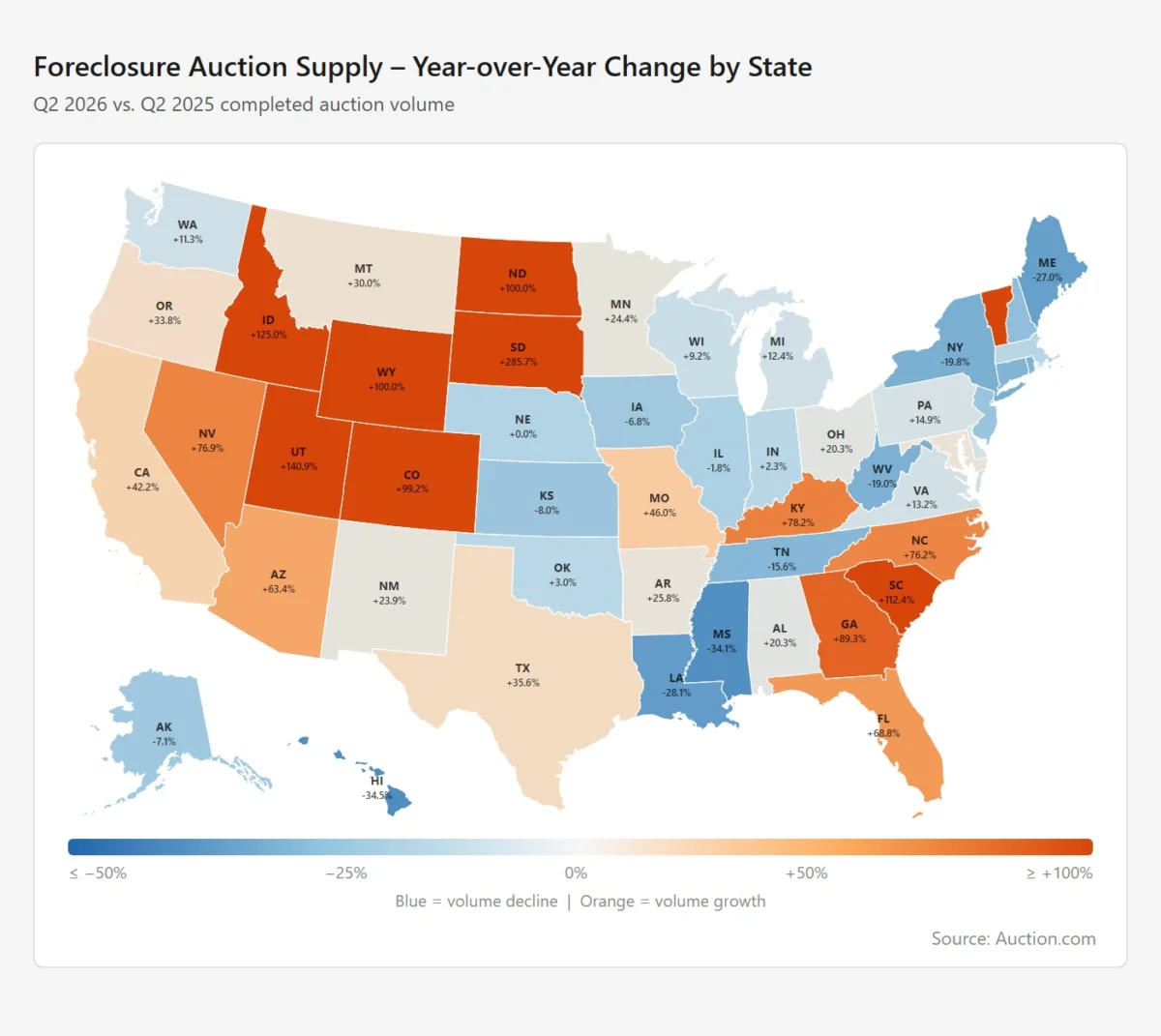
The distressed real estate market in the United States reached a significant milestone in the second quarter of 2026, as foreclosure auction volume surged by 23% compared to the same period in the previous year. This spike matches a six-year high previously established in the first quarter of 2026, marking the sixth consecutive quarter of annual increases in auction activity. As inventory levels climb, a strategic shift among sellers—comprised primarily of mortgage servicers, commercial banks, and government agencies—has led to a cooling of average auction prices. According to the latest market data, average seller pricing at foreclosure auctions fell by 3% from the previous quarter and is now down 4% from the peak recorded in late 2025. This convergence of rising supply and more aggressive pricing has created a fertile environment for local community developers and real estate investors, who are increasingly stepping in to absorb the influx of distressed assets.
The Resurgence of the Distressed Property Market
The current landscape of the foreclosure market reflects a broader normalization of the housing sector following years of volatility. The 23% year-over-year increase in auction volume is not merely a statistical anomaly but the continuation of a trend that began in early 2025. This period represents the most sustained growth in foreclosure activity since the late 2010s, signaling that the various "safety nets" and loss-mitigation programs implemented during previous economic cycles have largely expired or reached their conclusion.
Data from the Q2 2026 Auction Market Dispatch indicates that more than 10,000 properties were brought to foreclosure auction during the quarter via the Auction.com platform. Given that this platform accounts for approximately 40% of all foreclosure auctions nationwide, the total national volume is estimated to be significantly higher. Of the properties listed on the platform, nearly 5,000 were successfully sold to third-party buyers, representing a 27% increase from the previous year. This suggests that the market is not only seeing more inventory but is also seeing a higher rate of absorption by private investors.
A Strategic Shift in Seller Pricing
One of the primary catalysts for the increased sales rate is the willingness of institutional sellers to adjust their expectations. After hitting a six-year high in pricing during the fourth quarter of 2025, sellers have begun to recalibrate their reserves. Mortgage servicers and government agencies, such as the Federal Housing Administration (FHA), are increasingly prioritizing the disposition of assets over holding out for peak market values.
Pricing at auction is typically measured by the ratio of the "credit bid"—the minimum amount a seller is willing to accept—to the estimated retail market value of the property. In the second quarter of 2026, this nationwide average credit bid-to-value ratio sat at 63.8%. This is a notable decline from 65.4% in the first quarter and a sharp drop from the 66.7% peak seen at the end of 2025.
The most dramatic pricing adjustments have been observed in the FHA-insured loan sector. The average credit bid-to-value ratio for properties tied to FHA loans plummeted by more than 5 percentage points, dropping from 67.8% in Q1 2026 to 62.2% in Q2. This aggressive discounting by government-backed entities has had an immediate impact on buyer behavior, as evidenced by a 30% spike in the sales rate for FHA-insured properties over the previous quarter.
Chronology of the Foreclosure Market Transition
To understand the current state of the market, it is essential to look at the timeline leading up to the mid-2026 surge:

- Late 2024: Foreclosure starts began to tick upward as pandemic-era moratoriums and extended forbearance plans fully phased out, leaving a backlog of distressed loans.
- Q4 2025: Auction pricing reached a six-year peak. Sellers were still attempting to capture high equity values, resulting in some properties lingering in inventory or returning to the bank as Real Estate Owned (REO) assets.
- Q1 2026: Auction volume hit a six-year high. Sellers began to realize that the rapid home price appreciation of previous years had leveled off, necessitating a change in strategy.
- Q2 2026: Volume remained at peak levels while pricing dropped. This "sweet spot" of high volume and lower entry costs has invigorated the third-party buyer market.
This timeline suggests a disciplined market correction where institutional sellers are moving to "clear the decks" of non-performing assets by offering them at prices that reflect current market realities rather than past valuations.
Local Developer Insights: The "Singles and Doubles" Strategy
For local real estate investors, the current market conditions represent an opportunity to scale operations that were previously constrained by high prices and low inventory. Michael Regan, a Dallas-area investor who specializes in foreclosure auctions, notes that his acquisition pace has increased significantly.
"The last few years we’ve been averaging about 18 to 20 properties," Regan said. "This year I’m probably tracking maybe about 24 to 30."
Regan attributes this growth directly to the pricing corrections implemented by lenders. He observes that many banks are finally acknowledging that the assets they hold are no longer worth what they were three or four years ago. By discounting these properties, banks are allowing investors to move in, renovate, and return the homes to the habitable housing stock.
Regan describes his current approach as a "singles and doubles" strategy. While the market is not necessarily producing "home run" deals with massive profit margins, the consistency of the inventory allows him to keep his capital working and his crews busy. "There’s nothing that’s going to be a home run… but they more or less will keep the money working at a better return than sitting in the bank," he explained.
Impact on Affordable Housing Supply
The increase in foreclosure auction activity has a direct and positive correlation with the supply of affordable housing. Because foreclosure properties are often sold in "as-is" condition and frequently require significant rehabilitation, they are generally priced well below the retail market average.
An analysis of nearly 23,000 foreclosure auction sales from 2023 provides a roadmap for what to expect from the current 2026 surge. That data showed that 54% of properties purchased at auction were resold within two years, and of those resales, 78% became owner-occupied homes. Crucially, the average resale price for these renovated homes was $311,045—approximately 28% below the average overall retail market sales price of $433,323.
In the context of 2026, this means that the 5,000 properties sold to third-party buyers in the second quarter are likely to hit the retail market as affordable, renovated options in the near future. Given the average renovation and resale timeline of approximately 238 days (roughly eight months), the influx of inventory from the Q2 2026 auctions is expected to bolster the retail housing supply in late 2026 and the first half of 2027.

Broader Economic and Community Implications
Beyond the numbers, the work of local developers in the foreclosure space serves a vital community function. Many of the homes that reach the auction stage have been vacant for extended periods, often becoming neighborhood eyesores that depress surrounding property values.
"Our job is to clean it up and to put in a buyer that hopefully will appreciate the house and start to pay taxes on it," Regan noted. His track record supports this; over the last six years, 56% of the properties he purchased at auction have been resold, and every single one of those resales is now owner-occupied.
This transition from distressed asset to owner-occupied home is a critical component of neighborhood stabilization. When a local developer buys a property, they typically use local contractors and suppliers, keeping the economic impact of the renovation within the community. Once the home is sold to a permanent resident, the local municipality benefits from a consistent property tax stream and a revitalized piece of real estate.
Market Analysis and Future Outlook
The data from the second quarter of 2026 suggests that the foreclosure market has reached a state of high-volume equilibrium. The 12% jump in the "sales rate"—the percentage of properties brought to auction that actually sell to third parties—indicates that the market is efficiently matching supply with demand.
As we move into the latter half of 2026, several factors will determine if this trend continues:
- Interest Rate Environment: If mortgage rates remain stable or decrease slightly, the demand for the finished "retail-ready" homes produced by investors will remain strong.
- Lender Behavior: Should banks continue their current trend of realistic "credit bid" pricing, the sales rate at auction is likely to remain high.
- Inventory Pipeline: While auction volume is at a six-year high, it remains to be seen if the "backlog" of distressed loans is nearly exhausted or if a new wave of defaults is forming.
For now, the increase in foreclosure auctions serves as a vital "release valve" for the housing market. By allowing distressed assets to be repriced and renovated by local experts, the industry is creating a pipeline of affordable housing that would otherwise not exist in the current high-cost construction environment. The "singles and doubles" being hit by investors today are poised to become the starter homes for a new generation of buyers in 2027.
