

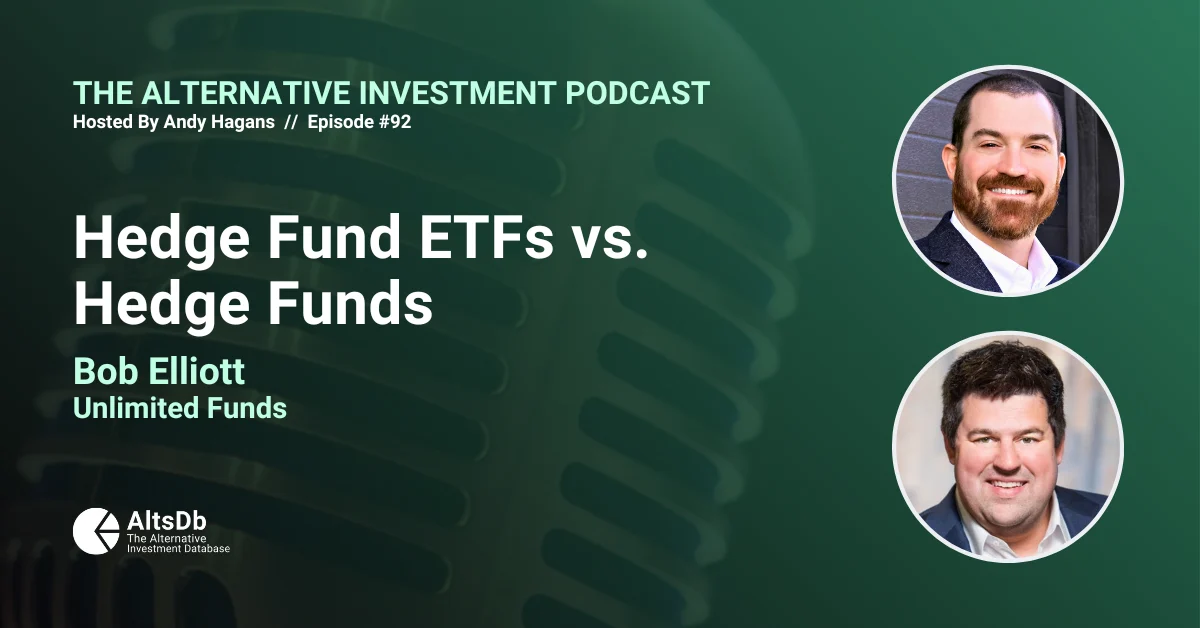
Leading hedge funds have long been recognized for their potential to deliver substantial returns for investors. However, this active management prowess comes with a significant price tag, often including high fees and limited accessibility. In a recent discussion on The Alternative Investment Podcast, Bob Elliott, CEO of Unlimited, presented a compelling argument for the potential of alternative ETFs, specifically highlighting HFND’s unique strategy and its capacity to outperform traditional hedge funds after accounting for all costs.
The conversation delved into the intricate world of hedge fund strategies, the challenges faced by investors seeking access to top-tier managers, and the innovative solutions emerging in the exchange-traded fund (ETF) landscape. Elliott, drawing from his extensive experience, including nearly 15 years at Bridgewater Associates, articulated a vision for democratizing access to sophisticated investment approaches.
Understanding the Hedge Fund Landscape
Hedge funds, often perceived as exclusive and opaque, operate by employing a diverse range of strategies aimed at generating alpha – returns above a benchmark – while often seeking to mitigate risk. These strategies can include long/short equity, global macro, event-driven, and relative value, among others. The core of many of these strategies, particularly in the global macro space, involves a deep understanding of macroeconomic trends, policy decisions, and their subsequent impact on various asset classes.
Elliott explained that the fundamental principle behind successful macro investing, and indeed many systematic strategies, lies in identifying and quantifying cause-and-effect relationships within the economy and financial markets. "The macroeconomy works very differently than what you’d learn in a college macroeconomics class," Elliott noted. "A big part of developing that understanding was sort of understanding and thinking about the intuitive cause-effect drivers of the macroeconomy in asset classes." This intuition is then translated into systematic processes, which involve quantification and disciplined execution.
The essence of systemization, Elliott elaborated, is the ability to quantify insights and apply them repeatedly and with discipline. This discipline is crucial, as even the most skilled discretionary investors can be swayed by incremental information, leading to overreactions or underreactions. Systematic approaches, by contrast, help synthesize vast amounts of data and execute strategies as designed, providing an edge in markets where even top performers are correct only about 55% of the time in any given month. This slight edge, when applied consistently across numerous trades, can lead to superior long-term results.
The 2022 Performance of Hedge Funds: A Year of Defense
The year 2022 presented a formidable challenge for traditional investment portfolios. The widely followed 60/40 stock-bond allocation experienced significant drawdowns, with some estimates placing losses between 15% and 20%. In this environment, alternative investments, in general, demonstrated their value proposition. Managed futures, for instance, reportedly surged by as much as 20%, a remarkable turnaround after a decade of subdued performance.
Hedge funds, as a collective, also navigated the turbulent market with notable resilience. Elliott highlighted that the aggregate hedge fund industry, before accounting for fees, performed largely flat to slightly negative in 2022, a stark contrast to the losses in traditional markets. Even strategies like equity long-short, often criticized in media narratives, delivered significant alpha relative to passive equity benchmarks, falling by approximately 8% compared to 15-20% for the market.
"Hedge funds in these sorts of difficult market environments, they’re very good at preserving capital in general," Elliott stated. "What they do is they cut their risk, they manage, you know, they hold lower beta exposures. They find, you know, value stocks and other value opportunities and move into those positions in order to be defensively positioned through these difficult market environments." This defensive posture underscores the strategic advantage hedge funds can offer during periods of market stress.
Challenges for Investors: Fees, Access, and Complexity
Despite the strategic merits and performance of hedge funds, several significant hurdles prevent many investors from fully benefiting. One of the most prominent is the fee structure, typically characterized by the "2 and 20" model – a 2% management fee and a 20% performance fee. Over time, these fees can significantly erode returns, particularly when gross performance is only modestly better than passive strategies.
"Hedge fund fees are very high," Elliott emphasized. "So, if you take the hedge fund industry as a whole, they’re typically adding between 300 and 400 basis points of fees on an annual basis." This substantial cost can negate the outperformance generated by skilled managers.
Beyond fees, accessibility remains a critical issue. While platforms like iCapital have improved access for smaller investors, the most sought-after and sophisticated hedge funds often remain exclusive to large institutional investors or ultra-high-net-worth individuals. This creates a bifurcation in the market, where smaller investors may be relegated to less elite funds or face the added layer of fees associated with funds of funds.
Tax efficiency is another concern. Traditional Limited Partnership (LP) structures common in hedge funds can lead to unfavorable tax treatments, with annual distributions often taxed at marginal income tax rates. For financial advisors managing client portfolios, the administrative burden of managing multiple K-1s and navigating complex paperwork further complicates the investment process.
The Rise of Alternative ETFs: HFND’s Approach
Recognizing these persistent pain points, Unlimited developed the HFND Multi-Strategy Return Tracker ETF. The fund’s objective is to replicate the return characteristics of the hedge fund industry’s gross-of-fees returns, with the explicit goal of outperforming hedge funds on a net-of-fees basis.
"We saw all those, those pain points that existed in the market," Elliott explained. "And what we thought was, was there a way to bring the kind of low-cost diversified indexing approach… to apply it to the world of two and 20?"
HFND aims to achieve this by leveraging proprietary hedge fund strategies developed over decades of experience, combined with modern machine learning techniques. This technological approach allows the fund to "look over the shoulder of the hedge fund managers, see what they’re doing in close to real-time, take that understanding, translate it into long and short positions in various index products, and package that up in an ETF form."
The benefits of this ETF structure are manifold. Firstly, it offers significantly lower expenses, estimated at about a quarter of typical hedge fund management fees. Secondly, being an ETF, it provides greater tax efficiency compared to traditional LP structures. Thirdly, it eliminates the burdensome paperwork and minimum investment requirements associated with private funds, making sophisticated strategies accessible to a much broader investor base, including those who can invest as little as a single share.
Machine Learning and the Future of Investment Management
The integration of machine learning into investment strategies represents a paradigm shift. Elliott highlighted that while the fund’s process is systematic and data-driven, it is not devoid of human oversight. The technology is used to understand the collective wisdom of hedge fund managers, translating that insight into actionable long and short positions. This systematic process is continuously monitored and refined by Elliott and his partner, ensuring that the replication of hedge fund strategies remains robust and efficient.
The rise of actively managed ETFs, particularly those focused on alternative strategies, signals a broader trend in the investment industry. Regulatory evolutions, such as those implemented in 2020-2021, have enabled managers to run more sophisticated strategies within the ETF wrapper, provided they implement robust risk controls. This has opened the door for a new generation of investor-friendly products that combine the benefits of the ETF structure – liquidity, transparency, tax efficiency, and ease of execution – with the potential for alpha generation.
Implications for the Investment Landscape
The emergence of alternative ETFs like HFND is poised to create a significant rationalization of fees across the investment management industry. In an era of potentially lower returns and higher scrutiny on value, investors will increasingly demand that fees align with demonstrable skill and alpha generation.
"There are absolutely hedge funds that deserve the fees that they charge," Elliott conceded. "But that is also a relatively small portion of the hedge fund industry, and it’s a part of the hedge fund industry that’s very hard to access for the vast majority of investors."
For the broader investor base, the choice will increasingly become between paying high fees for potentially inaccessible top-tier hedge funds, or opting for sophisticated replication strategies offered at a fraction of the cost within accessible ETF structures. This bifurcation suggests a future where capital flows towards both the most elite, differentiated managers and innovative, cost-effective replication strategies.
The ultimate impact of this evolution will be a significant benefit to investors, who will gain access to diversified, more consistent, and significantly lower-cost investment strategies. As the industry shifts towards investor-centric solutions, the focus will move from enriching managers to delivering maximum value to those entrusting them with their capital.
For further information on Unlimited and the HFND ETF, interested investors and financial advisors can visit the company’s website at unlimitedfunds.com. Bob Elliott also maintains an active presence on Twitter, @BobEUnlimited, where he frequently shares commentary on macroeconomic trends and investment topics, further democratizing understanding of complex financial markets.
