

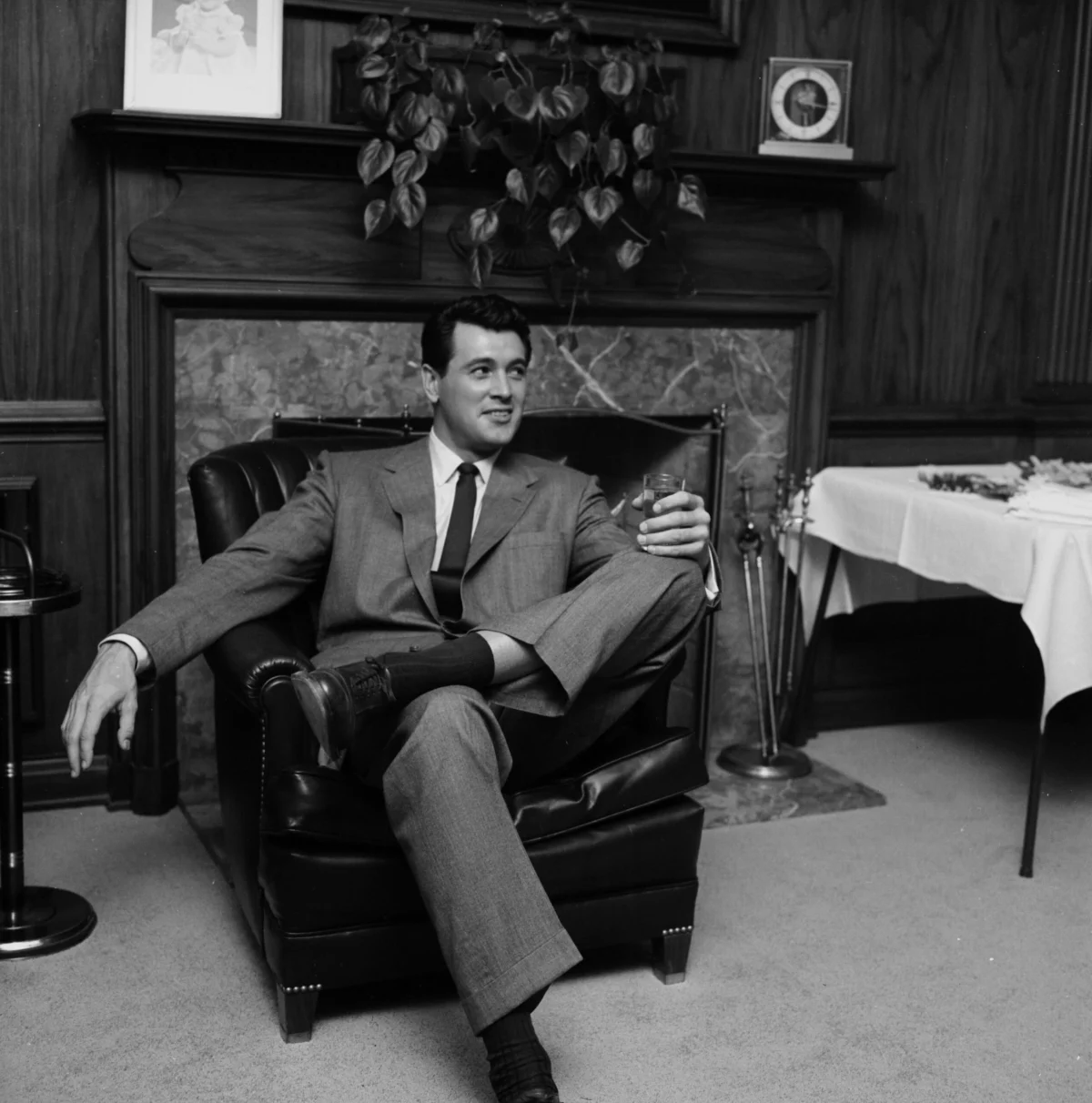
Rock Hudson remains one of the most enduring symbols of Hollywood’s Golden Age, a period defined by manufactured personas, rigid studio contracts, and the carefully curated image of the leading man. While Hudson was known to millions as the quintessential masculine heartthrob of the 1950s and 60s, his private life was a complex tapestry of hidden identities and a deep-seated need for domestic sanctuary. Throughout his decades-long career, the actor’s relationship with his homes evolved from the cramped quarters of a Depression-era upbringing to the sprawling, high-walled estates of Beverly Hills. These residences were more than mere real estate; they were the only places where Roy Harold Scherer Jr.—the man behind the Rock Hudson moniker—could shed the expectations of the public eye and engage in his passions for architecture, interior design, and horticulture.
From Humble Roots to Hollywood Heights
Born Roy Harold Scherer Jr. on November 17, 1925, in Winnetka, Illinois, the future star’s early years were characterized by financial hardship and domestic density. During the Great Depression, Hudson lived with his mother and maternal grandparents in a modest one-bedroom bungalow located at 719 Center Street in suburban Chicago. According to biographical accounts in Sara Davidson’s Rock Hudson: His Story, the living conditions were staggeringly tight, with a single bathroom shared among six adults and five children. This early experience with overcrowding likely fueled Hudson’s later obsession with spaciousness and privacy.

Hudson’s ascent in Hollywood was rapid, propelled by his 6-foot-4-inch stature and traditional good looks. After a stint in the Navy and a series of odd jobs, he was discovered by talent scout Henry Willson, who rebranded him as "Rock Hudson." By the mid-1950s, he was a top-tier star, earning an Academy Award nomination for his role in the 1956 epic Giant and becoming a staple of romantic comedies alongside Doris Day in films such as Pillow Talk and Lover Come Back. As his fame grew, so did the necessity of finding a "refuge" from the relentless scrutiny of the tabloid press and the predatory nature of the studio system.
The Formative Years: North Hollywood and the Lavender Lens
In 1952, as his career began to gain momentum, Hudson shared a residence in North Hollywood with fellow actor Bob Preble. This period marked the beginning of Hudson’s interest in modern architecture. Their final shared home on Avenida del Sol was considered ahead of its time, featuring futuristic glass fixtures and expansive views of the San Fernando Valley and the surrounding mountain ranges.
The three-year cohabitation was the subject of significant industry rumors. In an era where being openly gay would have ended a career instantly, Hudson’s domestic arrangements were carefully managed. Preble later suggested that while they experimented with their relationship, the social barriers of the time prevented a "definite relation." Preble eventually moved out to marry actress Yvonne Rivero, a move that reflected the societal pressures on men in the industry to conform to heteronormative standards.

The Warbler Place Era and the Strategic Marriage
By 1954, Hudson had moved toward a more traditional domestic setup, at least in the eyes of the public. He purchased a two-bedroom ranch-style house at 9151 Warbler Place, located just off the Sunset Strip. This home became the setting for one of the most discussed chapters of his life: his marriage to Phyllis Gates.
Gates, a secretary for Hudson’s agent Henry Willson and an aspiring interior designer, moved into the Warbler Place residence shortly before their 1955 wedding. The house featured a warm, rustic aesthetic with a brick-and-wood kitchen. Interestingly, despite Hudson’s growing wealth, he had invested so much capital into the property itself that the couple initially furnished their living room with redwood lawn chairs.
The marriage lasted only three years, ending in divorce in 1958. Historians and biographers often categorize the union as a "lavender marriage," arranged by the studio to suppress rumors regarding Hudson’s sexuality. Upon their legal separation, Gates was awarded the Warbler Place home, then valued at approximately $35,000, along with a decade of alimony. While Gates maintained for years that their love was genuine, the divorce allowed Hudson to transition into a new phase of bachelorhood and architectural exploration.

Coastal Solitude: The Malibu Stilt House
Following his divorce, Hudson sought a change of pace and moved to the coast. In 1958, he took up residence in a Malibu beach house uniquely situated on stilts. This coastal retreat served as his primary home during the filming of the 1959 classic Pillow Talk. The house offered a visceral connection to nature; at high tide, the Pacific waves would crash directly beneath the floorboards.
In Malibu, Hudson cultivated a different persona, befriending a group of stuntmen and athletes. He embraced an active outdoor lifestyle, engaging in swimming, scuba diving, and sailing. However, the lack of total privacy on the beach eventually led him back toward the hills of Los Angeles, where he could better control access to his personal life.
The Acquisition of 9402 Beverly Crest Drive
The most significant property in Hudson’s portfolio was undoubtedly 9402 Beverly Crest Drive, a residence he would eventually name "The Castle." His journey to owning this estate was a masterclass in Hollywood contract negotiation.

In 1961, while filming Lover Come Back, Universal Studios leased the property for Hudson from agent and producer Sam Jaffe. The estate spanned three-and-a-half acres and featured a classic Spanish-style main house with stucco walls, red-tile roofs, and heavy dark wood beams. Hudson fell in love with the property’s secluded cliffside location but initially found the purchase price beyond his reach.
Recognizing the actor’s attachment to the home, Universal Studios used the property as leverage during contract negotiations in 1962. The studio agreed to purchase the house for $167,000 and transfer the title to Hudson after five years in exchange for his continued commitment to the studio. This arrangement secured Hudson’s "forever home," where he would reside for the next 24 years.
Architecture and Interior Design: Building The Castle
Once he gained ownership, Hudson embarked on an extensive renovation project that reflected his deep interest in Mexican Colonial architecture. He reportedly treated books on the subject as "Bibles," meticulously planning stone archways, hand-painted tiles, and ceilings constructed from natural tree limbs to evoke the aesthetic of the American Southwest and Mexico.

The interior of The Castle was an eclectic mix of international influences and personal interests:
- Art and Sculpture: The grounds featured numerous bronze works by Mexican artist Victor Salmones, often focusing on the nude male form.
- Thematic Decor: Hudson decorated with animal motifs, including brass elephant heads in the primary bedroom that served as towel racks, and an ornate lion’s head fountain.
- Amenities: The estate was transformed into a private resort, complete with a 40-foot swimming pool, a private theater, and a spa.
Despite the high walls and "The Castle" moniker, Hudson maintained a surprising "open-door policy." He rarely locked his doors, a habit his friends attributed to a desire for spontaneous social encounters and a fundamental trust in his inner circle.
The Green Thumb: Horticulture as Therapy
At his Beverly Crest estate, Hudson became an avid gardener. He worked alongside Clarence Morimoto, the gardener he inherited from the previous owner, to create a lush, productive landscape. The actor’s greenhouse was a point of pride, filled with orchids and exotic flowers.

Hudson also used his land for agriculture, growing limes, mint, peaches, corn, and tomatoes. He famously made peach ice cream every summer and mixed daiquiris using fruit grown on the property. In his memoirs, he noted that gardening provided a level of relaxation that acting could not, stating that he often worked out his roles and career decisions while weeding or pruning for hours. He once remarked that had he not been an actor, he likely would have pursued a career as a landscape architect.
The Final Act and Real Estate Legacy
The Castle served as the backdrop for the final, tragic chapter of Hudson’s life. In the early 1980s, Hudson was diagnosed with HIV/AIDS, a diagnosis he kept private until 1985. His announcement and subsequent death on October 2, 1985, marked a turning point in the global awareness of the AIDS pandemic.
Hudson’s memorial service was held at the estate, attended by 300 guests, including his long-time friend Elizabeth Taylor. At the time of his death, the property was appraised at $3 million. However, its value would skyrocket in the following decades, partly due to its celebrity provenance and partly due to the explosive growth of the Los Angeles luxury real estate market.

In 1997, Microsoft co-founder Paul Allen purchased the estate for $9 million. Allen, a known admirer of historical properties, maintained the home until his own death in 2018. In 2021, the estate was listed for $55.5 million, a testament to the enduring allure of the "Hudson House."
Chronology of Rock Hudson’s Residences
- 1925–1940s: 719 Center Street, Winnetka, IL. A crowded bungalow shared with eleven family members.
- 1952–1954: Various North Hollywood locations, including a glass-featured modern home on Avenida del Sol shared with Bob Preble.
- 1954–1958: 9151 Warbler Place, Los Angeles. A ranch-style home shared with Phyllis Gates; later awarded to her in the divorce.
- 1958–1960: Malibu Beach. A stilt-supported coastal house where he resided during his peak romantic comedy era.
- 1961–1985: 9402 Beverly Crest Drive ("The Castle"). A 3.5-acre Spanish/Mexican Colonial estate acquired through a deal with Universal Studios.
Impact and Implications
The history of Rock Hudson’s homes offers a unique lens into the "closeted" architecture of Mid-Century Hollywood. For Hudson, these properties were not just status symbols but defensive structures designed to protect a private identity that was at odds with his public brand. The transition from the shared, cramped spaces of his youth to the fortified "Castle" of his later years mirrors the trajectory of a man who spent his life seeking a space where he could truly be himself.
The massive appreciation of his Beverly Crest estate—from a $167,000 studio purchase to a $55.5 million listing—highlights the "celebrity premium" in real estate. However, beyond the financial figures, the house remains a monument to Hudson’s personal tastes: his love for the Southwest, his passion for gardening, and his quiet defiance of the rigid studio system that sought to control every aspect of his life. In the end, Hudson’s true legacy is found not just on the silver screen, but in the walls he tore down and the bricks he laid in the sanctuary he built for himself.
