

In November 2020, amidst the height of the global pandemic, Mark Carney, the former Governor of the Bank of England and the Bank of Canada, delivered the BBC’s prestigious Reith Lectures. Titled “How to Get What We Value,” the lectures served as a profound critique of modern capitalism, which Carney argued had shifted from a market economy to a market society. He posited that the global financial system had become ethically fragile, succumbing to a cycle of privatizing profits while socializing losses. Carney’s central thesis was that the world needed a fundamental reset—a shift toward a system where financial markets serve human values rather than the other way around. Today, as Carney serves as a key economic advisor to the Canadian federal government, his philosophical framework is being tested against a backdrop of increasing geopolitical tension and economic protectionism.
The Canadian economy currently faces a pivotal moment. The era of unfettered globalization is being replaced by a more fragmented and competitive landscape, particularly as the United States adopts aggressive industrial policies to secure its own economic dominance. This shift has forced Canadian policymakers to reconsider the concept of economic sovereignty. It is no longer merely a matter of managing trade tariffs or interest rates; it is about ensuring that Canadian capital is deployed to build domestic productive capacity, secure critical infrastructure, and provide citizens with a direct stake in the nation’s growth. The emergence of the Canada Strong Fund and the push for community-based finance represent a strategic attempt to bridge the gap between abstract financial markets and the tangible needs of local communities.
The Philosophical Shift: From Market Values to Human Values
Mark Carney’s transition from a central banker to a proponent of value-based capitalism has been marked by a consistent call for long-termism. In his book Value(s): Building a Better World for All, he argued that the crises of the 21st century—the 2008 financial collapse, the COVID-19 pandemic, and the ongoing climate emergency—all stem from a common root: the decoupling of price from value. When society values only what can be priced in a market, it neglects the "social capital" and "environmental capital" that sustain human life.
In the Canadian context, this philosophy is manifesting as a drive for "nation-building" projects. The federal government, guided by these principles, is seeking to diversify trade and reduce over-reliance on the U.S. economy. However, true sovereignty requires more than just government spending; it requires the mobilization of private wealth. Currently, a significant portion of Canadian savings is exported, fueling the growth of foreign corporations rather than addressing domestic challenges like the housing crisis or the transition to a low-carbon economy.
The Capital Paradox: Analyzing Canadian Investment Trends
Data from Statistics Canada reveals a striking paradox in the nation’s financial landscape. As of late 2024, total Canadian financial assets reached approximately $11.95 trillion. Of this, roughly 35%, or $4.18 trillion, is held in personal investments, including stocks, bonds, and mutual funds. Despite this immense pool of wealth, a disproportionate amount of it is invested outside of Canada. By the end of 2024, Canadian investors held $3.04 trillion in U.S. securities alone.
This capital flight is driven by the perceived safety and high returns of large-cap U.S. stocks. The S&P 500, for instance, is increasingly dominated by a small group of technology giants; the ten largest companies in the index now account for nearly 41% of its total value. While these investments may provide individual returns, they contribute little to the "productive capacity" of Canada. They do not build Canadian hospitals, they do not fund Canadian startups, and they do not insulate Canadian towns from global supply chain shocks.
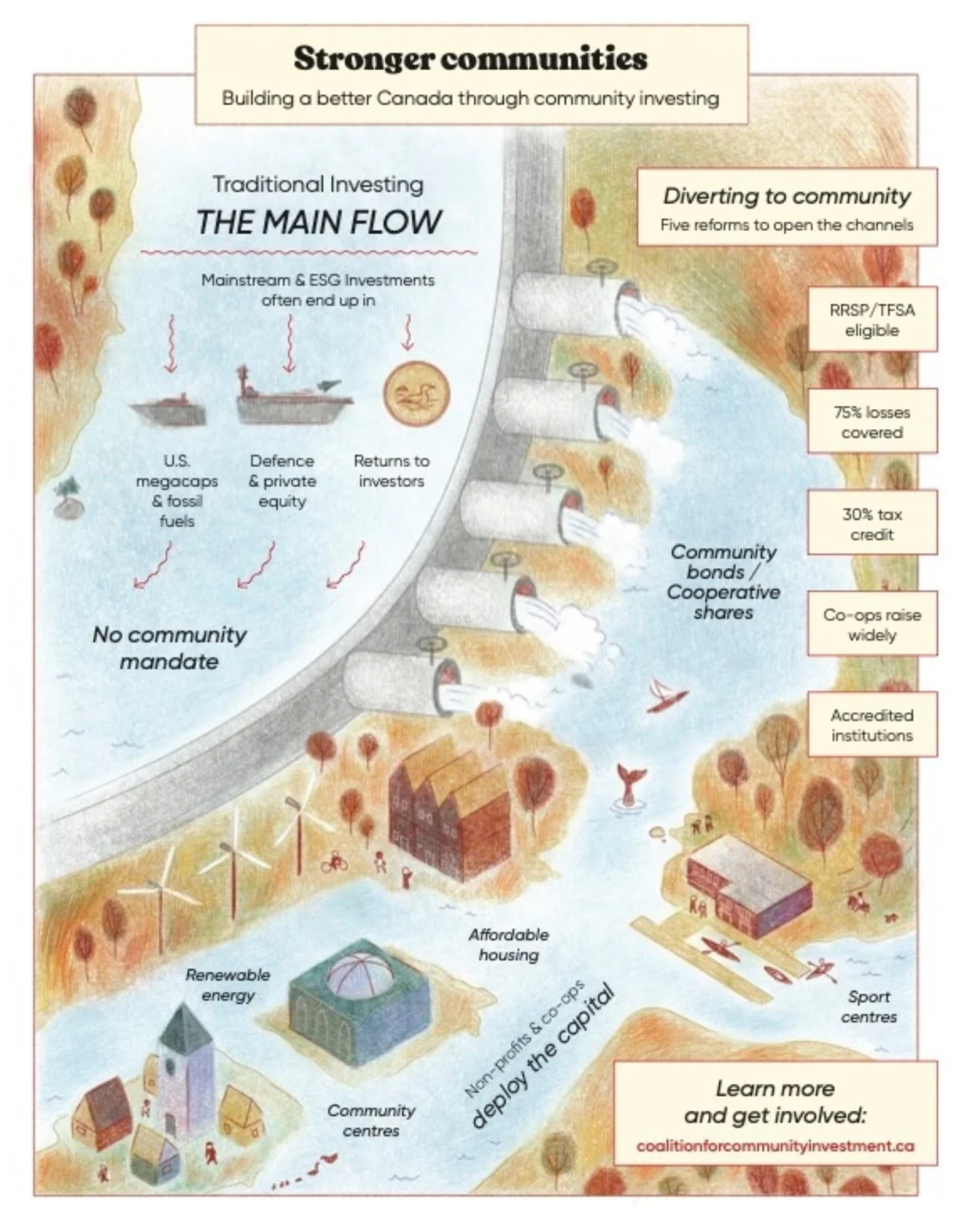
The Canadian Coalition for Community Capital (CCCC), an advocacy network comprising over 30 organizations, argues that even a minor shift in this investment pattern could transform the country. Research conducted by Corporate Knights suggests that if just 1% of Canadian personal investments were redirected into community bonds and cooperative shares, the community-finance market would explode from its current $150 million to approximately $42 billion. This capital would stay within the country, circulating through regional economies and funding projects with high social utility.
A Roadmap for Reform: Five Strategic Policy Pillars
To unlock this potential, the CCCC has proposed five specific regulatory and tax reforms to the federal government. These measures are designed to level the playing field between community-based investments and traditional financial products.
1. Modernizing Tax-Advantaged Savings Accounts
Currently, Canadians utilize Registered Retirement Savings Plans (RRSPs) and Tax-Free Savings Accounts (TFSAs) to build long-term wealth. However, community bonds—which fund local infrastructure like solar farms or affordable housing—are often ineligible for these accounts or face prohibitive administrative hurdles. By streamlining the eligibility of community-finance instruments for RRSPs, TFSAs, and the new First Home Savings Accounts (FHSAs), the government would allow everyday investors to support their communities without sacrificing the tax benefits offered by Wall Street products.
2. Implementing Loss-Sharing Mechanisms
Investment risk is a primary barrier for community finance. Unlike multinational corporations, local non-profits and cooperatives often lack the diverse revenue streams to weather economic downturns. The proposed reform suggests allowing investors to deduct 75% of losses on eligible community securities against their income. This "risk-sharing" approach acknowledges that community investments provide "co-benefits"—such as reduced carbon emissions or increased social cohesion—that benefit the government and society at large, justifying a higher level of public support.

3. Creating a Community-Capital Tax Credit
The Canadian tax code already uses incentives to steer capital toward specific sectors, such as the Scientific Research and Experimental Development (SR&ED) tax credit or the Clean Technology Investment Tax Credit. Advocates are calling for a 30% Community-Capital Tax Credit (consisting of a 20% non-refundable and 10% refundable portion) capped at $10,000 per investor. This would provide an immediate incentive for Canadians to prioritize local bonds over foreign equities, directly funding government priorities like affordable housing and renewable energy.
4. Expanding the Reach of Cooperatives
Cooperatives are a vital part of the Canadian economic fabric, particularly in the agricultural and energy sectors. However, current regulations often limit co-ops to raising capital only from their existing membership base. By allowing cooperatives to sell shares to the general public, the federal government would enable these democratic organizations to scale their operations and compete more effectively with traditional corporate structures.
5. Strengthening the Institutional Ecosystem
For community finance to become a mainstream asset class, it requires a robust supporting infrastructure. This includes the development of accredited intermediaries and institutions that can vet projects, facilitate bond issuances, and provide transparent reporting to investors. Federal support for this "ecosystem" would ensure that community bonds are viewed as credible, professional financial instruments rather than niche philanthropic endeavors.
Economic Modeling and the Multiplier Effect
The argument for community capital is not based solely on social altruism; it is grounded in rigorous economic modeling. Independent analysis indicates that the proposed tax reforms would more than pay for themselves. Under conservative estimates, every dollar of federal tax expenditure on community-capital incentives is projected to generate $17 in Canadian Gross Domestic Product (GDP).
This high multiplier effect occurs because community investments are inherently localized. When a citizen invests in a local housing cooperative, the funds pay for local labor and materials, and the resulting housing stability allows residents to participate more fully in the local economy. This creates a virtuous cycle of domestic growth. Furthermore, the increased economic activity generates federal tax revenue that exceeds the initial cost of the tax credits, making it a fiscally responsible strategy for long-term growth.
Official Responses and Public Sentiment
Suzanne Faiza, the coordinator for the Canadian Coalition for Community Capital, emphasizes that these reforms align with a growing public desire for local accountability. “Canadians want their money to stay here,” Faiza notes. She observes that the same consumer sentiment that leads people to buy Canadian-made products at the grocery store is now moving into the financial sector. Canadians are increasingly aware that their retirement savings are often used to fund global entities that may not share their values or interests.
While the federal government has expressed interest in these concepts through the preliminary development of the Canada Strong Fund, the formal adoption of the CCCC’s five pillars remains a subject of active policy debate. Proponents argue that these changes are necessary to democratize the economy, while some fiscal traditionalists remain cautious about expanding tax expenditures. However, the "Carney doctrine" of shoring up economic sovereignty suggests that the status quo—where trillions of Canadian dollars flow to the U.S. every year—is no longer sustainable in a world of heightened geopolitical risk.
Broader Impact and Long-Term Implications
The successful implementation of a community-capital framework would represent a significant shift in the Canadian economic model. It would move the country toward a more "distributive" economy, where wealth is not just concentrated in major financial hubs like Toronto or Vancouver, but is reinvested in rural and mid-sized communities.
Furthermore, this movement has profound implications for the energy transition. Many of the projects funded by community bonds are focused on decentralized, renewable energy. By allowing citizens to own a piece of their local energy grid, the government can reduce public resistance to green infrastructure and accelerate the path to net-zero emissions.
In the final analysis, the push for community capital is about more than just financial reform; it is about the "security" that Mark Carney and the current administration frequently cite. Real security comes from a resilient domestic economy where citizens have the tools to build their own future. As the global landscape becomes more uncertain, the ability to channel domestic savings into domestic solutions may be the most important "value" Canada can pursue. The transition from $150 million to $42 billion in community finance is not just a statistical possibility—it is a roadmap for a more sovereign and equitable nation.
