

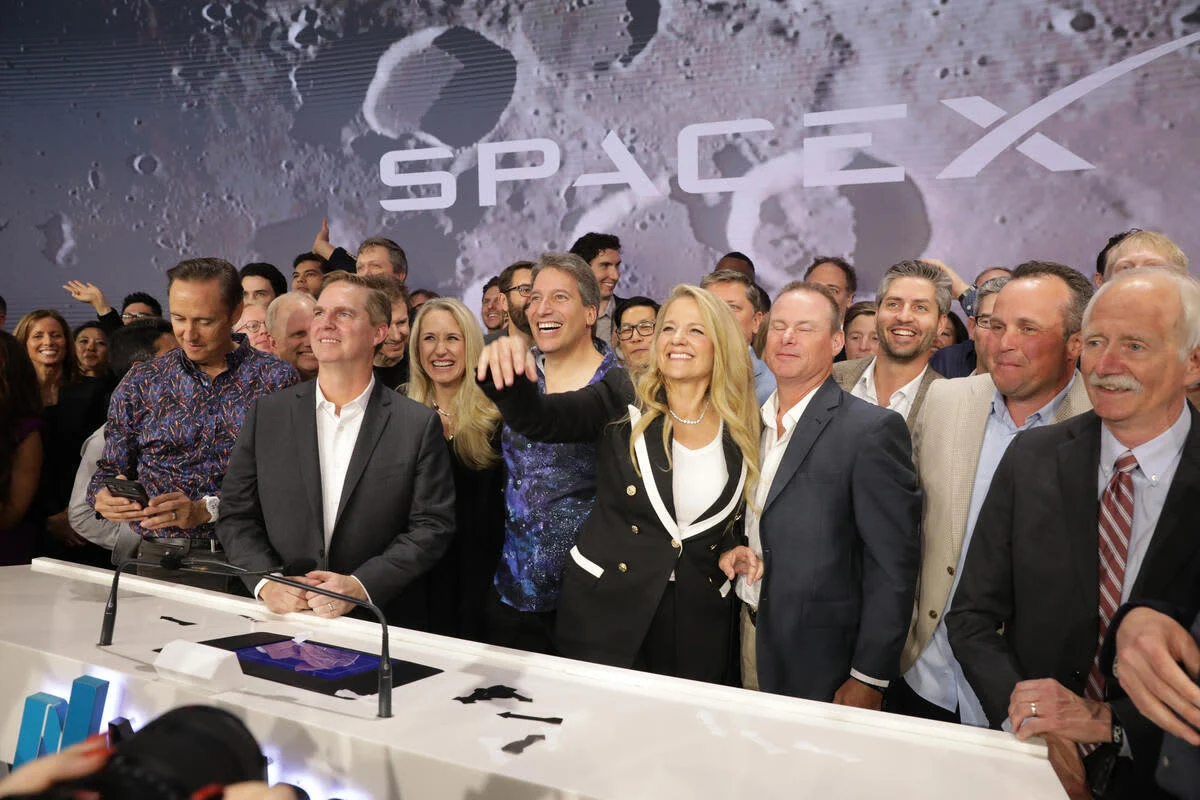
Gwynne Shotwell, President and COO of SpaceX, celebrated the monumental SpaceX IPO with executives at the Nasdaq on June 12th, 2026, marking a historic moment for both the aerospace industry and global financial markets. The highly anticipated public offering saw shares debut with significant investor enthusiasm, propelling the company to an astounding $2.7 trillion market capitalization, making it the fifth largest company in the world following a robust 4.5% rally on Tuesday. While the IPO represents a triumph for Elon Musk’s ambitious space venture, its immediate integration into some of the largest exchange-traded funds (ETFs) has sparked considerable debate and concern among financial advisors and money managers, raising questions about market stability, index methodologies, and investor choice.
The Dawn of a New Era: SpaceX’s Public Debut
SpaceX, founded by Elon Musk in 2002, has consistently pushed the boundaries of space exploration and commercial spaceflight. From its reusable Falcon 9 rockets and the ambitious Starship program designed for Mars missions, to its rapidly expanding Starlink satellite internet constellation, the company has cultivated a reputation for innovation, audacious goals, and disruptive technology. For years, SpaceX remained a closely held private entity, attracting significant investment from venture capitalists and institutional players who bought into Musk’s long-term vision. Its transition to a public company through the Nasdaq IPO on June 12th, 2026, was not merely a financial event but a cultural milestone, symbolizing the maturation of the commercial space industry. The company’s initial public offering was met with fervent demand, reflecting both the speculative appetite for high-growth tech ventures and a genuine belief in SpaceX’s transformative potential. The celebratory atmosphere at Nasdaq, with Shotwell leading the charge, underscored the immense achievement of bringing such a capital-intensive, long-horizon enterprise to the public markets at an unprecedented valuation.
A Polarizing Investment: Parallels with Bitcoin
From a financial perspective, many market observers draw parallels between SpaceX and assets like Bitcoin. Both entities, despite their vastly different underlying technologies and missions, share several characteristics that challenge conventional investment wisdom. SpaceX, much like Bitcoin, currently operates without significant earnings, prioritizes long-term growth and capital expenditure over immediate profitability, and has yet to establish a consistent yield for investors. Its stock performance has been characterized by extreme volatility since its debut, fluctuating wildly in early trading sessions. Furthermore, the company, like the cryptocurrency, garners an intensely divided following, boasting a legion of hardcore believers who champion its future potential, alongside a significant contingent of skeptics and "haters" who question its valuation, business model sustainability, and the long-term viability of its grand ambitions. The key distinction, as noted by some financial professionals, lies in the element of choice: "One big difference: no one’s forcing you to own bitcoin," a sentiment that encapsulates the core of the controversy surrounding SpaceX’s index inclusion.
The Passive Investing Dilemma: Forced Ownership for Millions
The crux of the current market consternation stems from the imminent integration of SpaceX shares into some of the largest and most widely held exchange-traded funds (ETFs) this summer. These ETFs, which track broad market indexes like those provided by CRSP, Nasdaq, FTSE Russell, and MSCI, are staples in millions of American investment portfolios, often forming the bedrock of retirement savings and diversified holdings. For advisors and money managers invested in these index funds, the inclusion of SpaceX translates into an involuntary ownership of Elon Musk’s astronomically ambitious venture. This "forced ownership" challenges the traditional principles of active fund management and raises questions about the passive investing paradigm itself.
Ayman Saidi, a partner at Strategic Investment Solutions, an Orland Park, Illinois-based Registered Investment Advisor (RIA), voiced strong criticism regarding this development. "Vanguard and other large money managers who are going along with Nasdaq’s mandate and rule change are betraying U.S. savers," Saidi asserted. He highlighted the direct impact on his own portfolios: "VUG in my portfolios will likely own SpaceX soon. This is why I like Dimensional Funds: they do not simply copy an index. It will be a major market distortion." VUG refers to the Vanguard Growth Index Fund ETF, a massive fund that tracks the CRSP U.S. Large Cap Growth Index. Saidi’s concerns resonate with a segment of the financial community that believes index providers and passive fund managers have a fiduciary responsibility to protect investors from undue risk, even when adhering to predefined index rules. The argument posits that while passive investing offers benefits like low costs and broad diversification, it should not automatically subject investors to the extreme volatility of unproven, non-earning, multi-trillion-dollar enterprises.
Index Methodology Adjustments: Paving the Way for SpaceX
The inclusion of a company like SpaceX, with its unique financial profile and gargantuan market capitalization, necessitated specific adjustments by major index providers. CRSP market indexes, Nasdaq, FTSE Russell, and MSCI have all made accommodations to integrate SpaceX within their large-cap trackers. These changes are crucial because index providers typically have strict criteria for inclusion, often considering factors such as market capitalization, liquidity, profitability, and free float (the percentage of shares available for public trading).
Rodney Comegys, CIO and head of global equity at Vanguard Capital Management, explained Vanguard’s position in an email, referencing CRSP’s existing framework: "Fast-track rules for Vanguard funds tied to CRSP indexes have been in place since 2013. CRSP made a small adjustment this year to allow large companies with lower float to qualify under the fast track rule." Comegys further clarified Vanguard’s philosophy: "Vanguard believes indexes should incorporate IPOs based on what is truly available to investors." This statement suggests that if a company is publicly traded and meets revised inclusion criteria, it should be reflected in the index, regardless of its specific financial characteristics, to accurately represent the investable market. The "lower float" adjustment is particularly significant for SpaceX, as a substantial portion of the company’s shares are likely held by insiders, early investors, and Elon Musk himself, limiting the number of shares readily available for public trading and potentially exacerbating price swings. Historically, lower free float can contribute to higher volatility because fewer shares chasing demand can lead to more dramatic price movements.
Unprecedented Volatility and Valuation Metrics
SpaceX’s financial metrics immediately set it apart from its peers in the upper echelons of global corporations. Its implied volatility was almost 120 on Tuesday, a staggering figure approximately three times higher than that of the iShares Bitcoin ETF (IBIT), which itself is known for significant price swings. To put this into perspective, if SpaceX were already part of the S&P 500 and Nasdaq 100 as of Tuesday’s trading, it would be the single most volatile stock within those indices. Furthermore, it holds the unique distinction of being the only trillion-dollar-plus market-cap company that does not generate profit. This lack of profitability, combined with extreme volatility, presents a novel challenge for passive index funds designed to track broad market performance with a degree of stability.
Typically, companies of such immense scale and market influence (e.g., Apple, Microsoft, Amazon, Alphabet, Nvidia) are well-established, highly profitable enterprises with robust earnings reports and relatively stable cash flows. SpaceX’s valuation, built largely on future potential and an aggressive growth trajectory rather than current financial performance, stands in stark contrast. The argument for its inclusion, from the index providers’ perspective, is that it represents a significant and undeniable component of the "investable market" by virtue of its market capitalization. However, for investors accustomed to traditional valuation metrics, this presents a significant departure from norms.
Historical Precedents and Market Distortion Concerns
The addition of a new, large-cap company to a major index is not without precedent, but the scale and characteristics of SpaceX’s inclusion are unique. Kevin Kelly, co-founder of Delphi Digital, a research firm established by former Bloomberg analysts in 2018, contrasted SpaceX’s entry with a recent high-profile addition. "At this point, if you’re allergic to volatility, you might just want to be in bonds," Kelly quipped. He drew a comparison to the addition of MicroStrategy (MSTR) to the Nasdaq 100 in December 2024, noting that MicroStrategy was trading under a $100 billion market cap at the time. SpaceX’s $2.7 trillion valuation dwarfs this, making its impact on index-level volatility far more pronounced. Kelly also observed the speculative environment, stating, "AI has captivated a lot of the speculative audience and some of these AI stocks look like early token charts. Plus, SpaceX is so polarizing, there are people in the more traditional sell-side camp that couldn’t even get past this if it IPO’d at $600-or-700 billion." This highlights the difficulty for traditional financial analysis to reconcile with the current valuation and the company’s polarizing nature.
The broader concern about "market distortion" raised by Saidi and others centers on the idea that mandatory purchases by passive funds, driven solely by index rules, can disconnect a stock’s price from its fundamental value. When trillions of dollars automatically flow into a stock regardless of its earnings, profitability, or traditional risk metrics, it can create artificial demand, potentially inflating valuations and increasing systemic risk within the market. This phenomenon is particularly pertinent for a company like SpaceX, which, despite its innovative prowess, operates in a highly capital-intensive sector with long development cycles and inherent risks.
The Future of Volatility: Will Index Inclusion Stabilize SpaceX?
Despite the immediate concerns about elevated volatility, some market participants believe that SpaceX’s inclusion in major indexes might paradoxically lead to a degree of stabilization over time. Investors who are wary of the initial "SpaceX ride" may find comfort in the idea that the extreme volatility observed in its early trading days could be short-lived. Analysis of implied volatility in SpaceX options reveals a tendency for these figures to "slip" or decrease in later-dated contracts, particularly those stretching beyond the typical lockup period for insiders, suggesting a market expectation of future moderation.
Noel Smith, CIO and founder of Convex Asset Management, articulated this perspective in a text message: "Going in the index will reduce SpaceX vol — no way it stays at 120." He elaborated on the mechanisms that could contribute to this stabilization: "HFTs constantly rebalancing, passive flows that don’t sell, there’s way more liquidity." High-Frequency Trading (HFT) firms, which execute a vast number of trades at extremely rapid speeds, play a crucial role in maintaining market liquidity and efficiently pricing securities. Their constant rebalancing activities in response to minor price discrepancies could help to smooth out some of the extreme swings. Moreover, the continuous, non-discretionary buying associated with passive index fund flows could provide a steady base of demand, increasing overall liquidity and potentially dampening price fluctuations that might otherwise occur in a less liquid, more speculative market. The argument is that while the initial index rebalancing may cause a surge in trading activity, the subsequent steady flow of passive investment could act as a stabilizing force, gradually reducing the stock’s outsized volatility relative to other index components.
Broader Implications for Investors and the Market Landscape
The SpaceX IPO and its subsequent index inclusion represent a pivotal moment, highlighting several critical trends and implications for the broader investment landscape. For individual investors, particularly those heavily reliant on passive index funds for their long-term savings, it underscores the importance of understanding the underlying composition and methodologies of their chosen investment vehicles. While passive investing offers undeniable advantages in terms of cost and broad diversification, it also means relinquishing control over individual stock selection and implicitly accepting the inclusion of all eligible companies, regardless of their specific risk profiles.
For money managers and financial advisors, the situation presents a challenge to their fiduciary duties and portfolio construction strategies. Those with mandates to minimize volatility or adhere to strict fundamental analysis criteria may need to re-evaluate their reliance on certain index funds or explore actively managed alternatives that offer greater discretion in stock selection. The growing influence of mega-cap, high-volatility, non-earning companies within major indices could also prompt a renewed debate on index construction methodologies and the role of "fast-track" rules. Regulators may also begin to scrutinize how these large-scale inclusions impact market integrity, investor protection, and the potential for systemic risk if future such companies exhibit similar characteristics.
Ultimately, SpaceX’s journey from a private startup to a $2.7 trillion public entity, swiftly integrated into the fabric of mainstream investment portfolios, symbolizes a new era where technological ambition, visionary leadership, and unprecedented market valuations converge. It challenges traditional financial metrics and forces a re-evaluation of what constitutes a "blue-chip" investment in the 21st century. While the excitement surrounding SpaceX’s innovations is palpable, its integration into index funds has undeniably launched a profound discussion about the evolving nature of investing, the passive paradox, and the responsibilities of market gatekeepers in an increasingly dynamic and complex financial world.
