

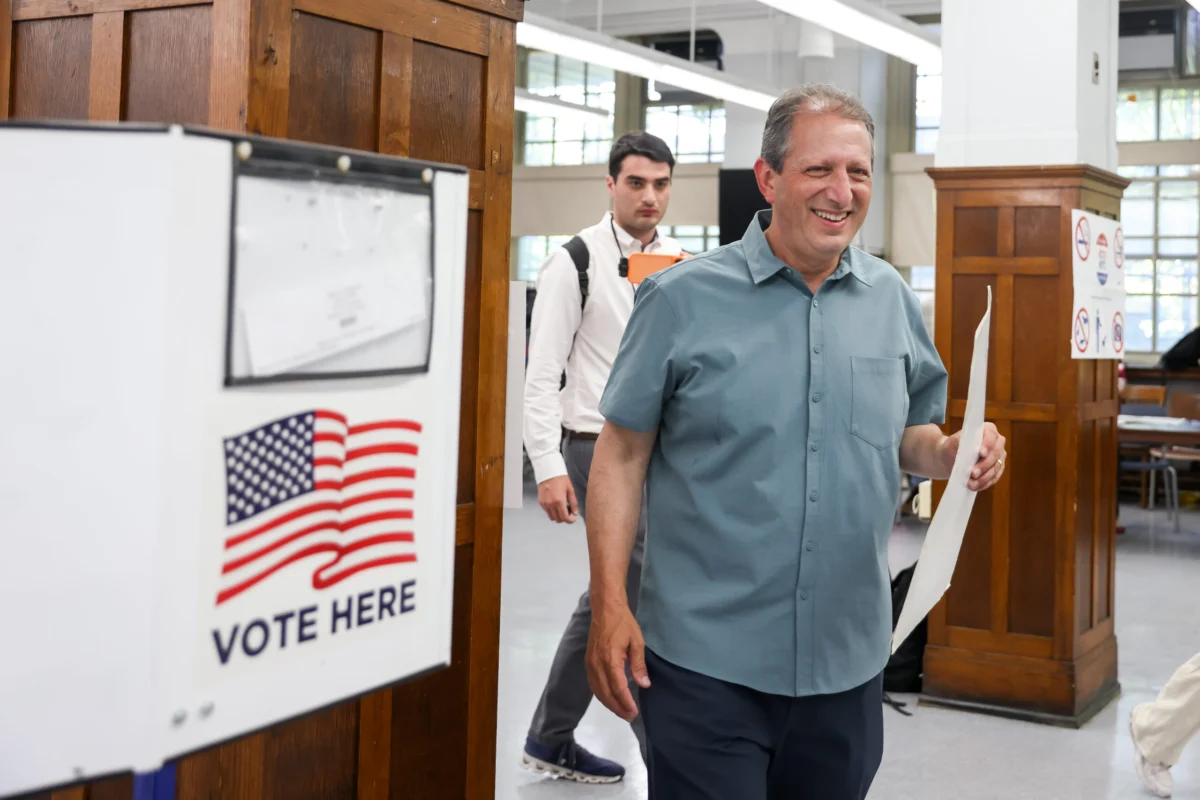
The political landscape of New York’s 10th congressional district is currently a crucible of progressive ambition and incumbent resilience, culminating in a Democratic primary on June 25, 2026, that has defied conventional political wisdom. Representative Dan Goldman, a two-term incumbent with a largely scandal-free record, a consistent community presence, and a voting history aligned with his party, would typically be poised for a smooth re-nomination. Yet, the district finds itself embroiled in an unexpectedly "ugly, contentious battle" for Goldman’s political life, as a potent challenge from former New York City Comptroller Brad Lander gains significant traction.
The Progressive Wave and Mamdani’s Ascendancy
Lander, who previously ran for city mayor in 2025, finishing a distant third despite a crucial cross-endorsement with then-candidate Zohran Mamdani that consolidated the progressive vote, is now strategically positioning himself as the torchbearer of an "anti-establishment sentiment" sweeping through Democratic primaries nationwide. His campaign has garnered high-profile endorsements from influential progressive figures, including Mayor Zohran Mamdani and US Senator Bernie Sanders (I-Vt.), alongside institutional backing from organizations like the New York Working Families Party. These endorsements signal a clear intent to challenge Goldman from a distinctly leftward stance.
The race for NY-10 serves as a significant barometer for several evolving dynamics within the Democratic Party. Foremost among them is the growing political influence of Mayor Mamdani, whose early and enthusiastic endorsement of Lander in December—even before his own swearing-in as mayor—underscored his commitment to a progressive agenda. "[Brad] has been a trusted ally and partner of mine, and I’m proud to support him," Mamdani stated upon Lander’s candidacy announcement. "I know he’ll keep delivering for those who need government to show up for them the most." Mamdani’s backing is particularly impactful in a district that overwhelmingly supported him by nearly 25 percentage points in the November 2025 mayoral general election, signaling a deep resonance with his progressive message.
Beyond Mamdani’s influence, the primary also stands as a high-profile test of how deeply the complex "division over Israel" influences election outcomes among Democratic voters. While not explicitly detailed in the campaign’s public statements, progressive candidates often face scrutiny over their positions on the Israeli-Palestinian conflict, and this issue frequently becomes a litmus test for the left wing of the party. Lander’s alignment with prominent progressive voices suggests a stance that resonates with a segment of the electorate critical of current U.S. foreign policy toward the region, implicitly differentiating him from Goldman, who, as an incumbent, likely maintains a more traditional Democratic-aligned position.
A District Primed for Progressive Upset?
New York’s 10th congressional district is a demographic and political stronghold for the Democratic Party, recognized as the 12th-most leftward-leaning congressional district in the entire country by the Cook Political Report’s Partisan Voting Index. Its progressive tilt makes it fertile ground for a challenger like Lander, who can harness the energy of the party’s left flank. The limited polling data available for the race, though somewhat split, offers a startling picture. A recent Emerson College poll indicated Lander holding a commanding 34-point lead over Goldman, a margin that would be considered an electoral earthquake. Further reinforcing this perception, prediction markets like Kalshi have seen Lander’s odds of winning the nomination soar to nearly 100%, suggesting that many political observers believe the outcome is all but decided.
This unexpected shift in momentum has compelled Goldman, an heir to the Levi Strauss fortune and one of the wealthier members of Congress, to take aggressive measures. In April 2026, he publicly pledged to match up to $1 million in campaign donations, a clear attempt to inject significant financial resources into his re-election bid and counter Lander’s surging popularity. Goldman also strategically moved to co-opt an issue long considered sacrosanct to American progressivism: a strong alliance with organized labor. New York City boasts a union affiliation rate of approximately 20% among its workers, double the national average. This makes unions indispensable electoral allies, often leading to fierce competition among candidates to demonstrate their commitment to labor’s concerns and priorities.
The Section 485-x Controversy: A Flashpoint for Labor and Housing
At the heart of the current contest lies a fierce debate over Section 485-x of the New York State Real Property Tax Law. This statute, enacted in April 2024 to replace the controversial Section 421-a, offers substantial tax incentives for up to 40 years to developers constructing affordable housing. Crucially, it also mandates strict wage floors and annual increases for construction workers on eligible projects. Specifically, sites with at least 100 units must pay a minimum of $40 an hour, while those with over 150 units must offer either $63 or $72.45 an hour, depending on the construction zone, or a percentage of the zone’s highest prevailing wage. These wages are further subject to a 2.5% annual increase.
However, a significant "loophole" within 485-x exempts projects with fewer than 100 units from these wage and affordable housing requirements. This exemption has become a focal point of Lander’s critique. In a forum last month with New York Law School, Lander asserted, "I think that the governor gave in to the building trades, and, as a result, no new housing is being produced under that program." He further characterized the policy as a "cockamamie approach" that created "a whole new bureaucracy" to satisfy labor unions, ultimately failing to deliver new housing.
Goldman swiftly seized upon Lander’s comments, framing them as an attack on organized labor. In a late May Facebook post, the congressman challenged Lander’s progressive credentials: "My opponent says he’s the true progressive in this race, which is interesting, because he clearly has a problem with our city’s labor unions." Goldman continued, "Last week in a forum, he blamed the building trades for… our housing crisis in New York City. That doesn’t seem very much like pro-labor to me; that doesn’t seem very progressive."
The Lander campaign vehemently defended his stance, arguing that the loophole in 485-x has effectively undermined its stated goals. In a statement to Spectrum News 1, a Lander spokesperson explained, "Brad has criticized the 485x program because it’s just not working to build affordable housing or to protect workers and everyone knows it. It’s strange for elected officials or labor union officials to be defending a program in which 99% of the developments have taken advantage of a loophole that requires zero affordable housing or good jobs." This highlights a core progressive tension: balancing the need for worker protections with the imperative to create genuinely affordable housing, especially when existing legislation is perceived as failing on both counts.
The building trades unions, whose members directly benefit from the mandated wage floors in larger 485-x projects, reacted with outrage to Lander’s criticism. Kevin Elkins, director of political action for the NYC District Council of Carpenters (NYCDCC), launched a scathing attack in a May X post, labeling Lander "Scab Lander"—a term typically reserved for those who cross picket lines and betray union solidarity. Later that month, NYCDCC members escalated their protest, picketing outside Lander’s Brooklyn office and chanting "Who’s the rat? Lander!" The intensity of these attacks underscores the unions’ perceived threat to their hard-won wage protections and their deep loyalty to policies they believe benefit their members. The Lander campaign did not respond to CNBC’s requests for comment on these specific protests.
A Divided House of Labor
Goldman has fully embraced the support of the NYCDCC, frequently rallying with carpenters and touting their endorsements as proof of his pro-labor bona fides. "New York’s working families and organized labor have been my North Star throughout my time in office, and I’m deeply honored that the overwhelming majority of unions representing the hard-working men and women who keep New York City running are supporting me in this race," Goldman stated in a campaign release. "I will always fight for organized labor – the heart and soul of our city."
Indeed, twenty New York City-based labor unions have publicly endorsed Goldman’s re-election bid. Mario Cilento, president of the powerful New York State AFL-CIO, commended Goldman for fighting "to create thousands of family-sustaining construction jobs in Brooklyn and put workers first by co-sponsoring a bill to raise taxes on corporations that pay their executives more than 50 times what they pay their workers." Janella Hinds, vice president for academic high schools at the United Federation of Teachers, echoed this sentiment at a June campaign rally, stating, "We need Dan Goldman to make sure that the voices of working people are always heard, that unionized workers have a voice in Congress and in our government."
However, Goldman’s narrative of being the sole champion of labor is complicated by a significant splintering of union support—a rare occurrence for an incumbent in his position. In previous progressive insurgencies, such as Alexandria Ocasio-Cortez’s upset victory in the 2018 NY-14 Democratic primary or Jamaal Bowman’s 2020 win in NY-16, New York City unions largely coalesced behind the incumbent. This time, major unions, including the United Auto Workers (UAW), the New York State Nurses Association (NYSNA), and the Communications Workers of America (CWA), have enthusiastically thrown their weight behind Lander.
A CWA spokesperson articulated their endorsement: "There really is no legislator who has been a greater friend to CWA than Brad Lander. He’s devoted his entire career to public service, and in every elected office he’s held, he’s used his position to advocate for working people and has really walked the walk in terms of prioritizing working families and the middle class." The CWA specifically cited Lander’s commitment to pushing for robust pro-labor legislation, such as the Protecting the Right to Organize (PRO) Act, as a key factor in their decision, believing Lander is better positioned to overcome political gridlock and deliver tangible reforms. This sentiment reflects a broader national frustration among labor leaders over the stalling of major federal labor reforms under previous Democratic administrations, leading to a strategic shift toward state and municipal levels for advancing worker power.
Manny Pastriech, President of 32BJSEIU, highlighted Lander’s track record at the local level: "As NYC Comptroller, he worked furiously to enforce our city’s worker protection laws and helped win justice and overdue wages for thousands of wronged workers, including in industries 32BJ organizes in." Pastriech also praised Lander’s legislative achievements in the City Council, such as the Fair Workweek Law, which brought stability to working people’s lives and was a top priority for 32BJ.
Implications for the Democratic Party and Beyond
The primary in New York’s 10th congressional district presents a fascinating and consequential dilemma for the labor movement and the broader Democratic Party. Unions are faced with a rare trade-off: do they back a labor-friendly incumbent who represents institutional power and established relationships, or do they go all-in for an insurgent challenger whom they believe to be a more effective, proactive legislator aligned with their long-term reform goals? This internal division within organized labor could signal a strategic re-evaluation of how unions engage with political candidates, potentially prioritizing legislative impact and progressive alignment over traditional incumbency.
Should Lander prevail, it would solidify the continued ascendance of the progressive wing within the Democratic Party, demonstrating that even established, well-funded incumbents are vulnerable to challenges from the left, especially in deeply progressive districts. This outcome would further amplify Mayor Mamdani’s political capital and potentially embolden other progressive challengers nationwide. Conversely, a Goldman victory, defying the polls and prediction markets, would underscore the enduring power of incumbency, financial resources, and traditional union alliances, even in the face of strong progressive headwinds.
Regardless of the outcome, the intense debate surrounding Section 485-x and the broader issue of affordable housing and worker wages will undoubtedly influence future policy discussions in New York and potentially serve as a model or cautionary tale for other major cities grappling with similar challenges. The fight over who truly represents the "heart and soul" of working-class New York City—and who can best deliver for them through policy—has transformed this primary into a bellwether election. As polls close on Tuesday night, the results from New York’s 10th congressional district will offer crucial insights into the evolving priorities and fault lines within the Democratic Party, shaping its trajectory for years to come.
