

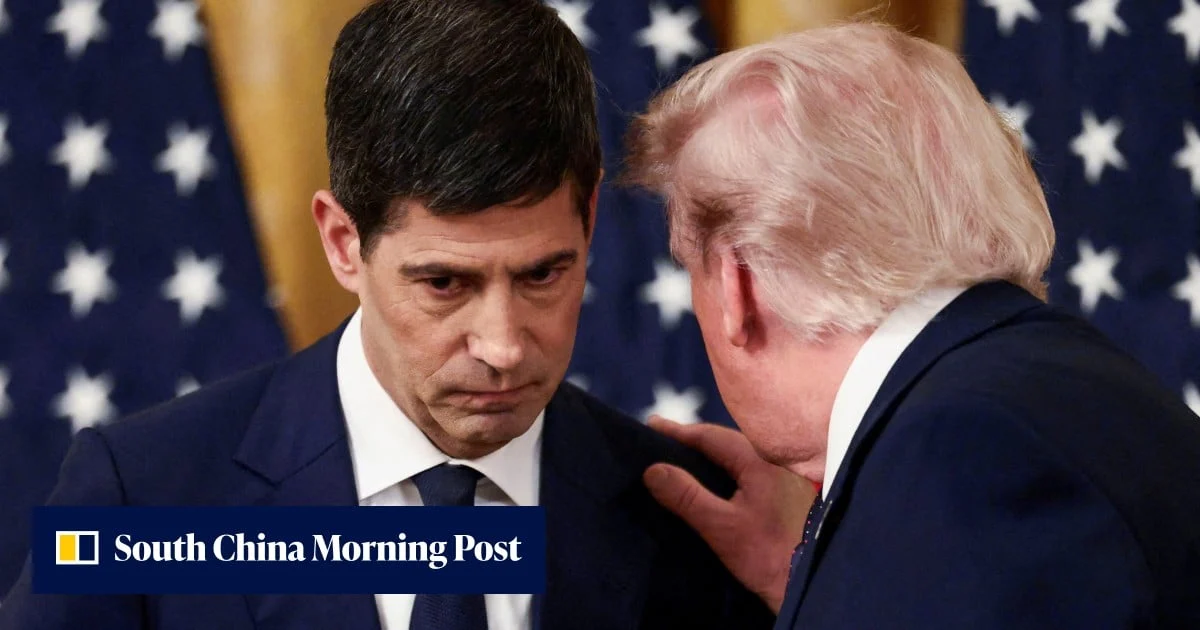
President Donald Trump intensified pressure on the Federal Reserve to lower interest rates, threatening to cut off trade with certain economies with which the US has a deficit if the central bank does not act. This dramatic escalation of rhetoric represents a significant departure from the traditional independence maintained between the executive branch and the nation’s central bank, signaling a potential shift in how the administration intends to leverage trade policy to influence domestic monetary decisions.
Trump issued his demands on Friday in a lengthy social media post after a stronger-than-expected August jobs report, which could bolster the case for Fed officials to raise rates at their next policy meeting starting September 15. The robust employment data, while typically a sign of economic health, has become a point of contention for an administration that views lower interest rates as essential for maintaining economic momentum and narrowing the trade gap. In his post, the president exhorted his hand-picked Fed Chairman Kevin Warsh, whom he called “great,” and board members to “get smart” and “BE PATRIOTS for a change.”
The ultimatum was explicit and linked directly to the United States’ international commercial relationships. “LOWER THE RATE OR I’LL STOP TRADING WITH COUNTRIES WITH WHICH WE HAVE A DEFICIT,” Trump posted. “High interest rates put the U.S.A. at a very unfair disadvantage, and I won’t allow that to happen!” This statement ties two traditionally separate spheres of government policy—the Federal Reserve’s control over the money supply and the President’s authority over international trade—into a single, high-stakes demand.
The August Jobs Report and the Fed’s Dilemma
The catalyst for the president’s latest outburst was the release of the August employment figures. According to the Bureau of Labor Statistics, the economy added more jobs than analysts had projected, continuing a trend of labor market resilience. In a standard economic environment, such strength often leads the Federal Reserve to consider raising interest rates to prevent the economy from overheating and to keep inflation within its 2% target range.
Economists note that when the labor market is tight, wages tend to rise, which can lead to increased consumer spending and higher prices for goods and services. To counteract this, the Federal Reserve’s Federal Open Market Committee (FOMC) typically uses rate hikes to "cool" the economy. However, the Trump administration has consistently argued that the current economic landscape allows for both low unemployment and low interest rates without the risk of runaway inflation.
The upcoming September 15 meeting is now being viewed by market participants as a pivotal moment. If Chairman Kevin Warsh and the board choose to raise rates or even maintain them at current levels, they risk further ire from the White House. Conversely, if they lower rates in response to executive pressure, they risk undermining the perceived independence of the Federal Reserve, a cornerstone of global financial stability.
A Chronology of Increasing Tensions
The relationship between President Trump and the Federal Reserve has been characterized by a steady erosion of traditional norms. While previous presidents have occasionally expressed preferences for lower rates, few have done so with the frequency or public intensity of the current administration.
- Early Appointment Phase: Upon appointing Kevin Warsh as Chairman, the President initially praised his economic outlook, expecting a "dovish" approach to interest rates that would favor growth over inflation control.
- Mid-Year Pivot: As the Fed maintained a neutral stance despite White House calls for cuts, the President’s rhetoric began to sharpen, transitioning from "suggestions" to public rebukes of the Board’s intelligence and loyalty.
- The Tariff Integration: In recent months, the administration has increasingly linked trade tariffs to monetary policy, arguing that other nations are devaluing their currencies to gain a trade advantage—an advantage the President believes is compounded by high US interest rates.
- The Friday Ultimatum: Following the August jobs report, the President reached a new rhetorical peak by threatening a total cessation of trade with deficit partners, effectively using the global supply chain as leverage against his own central bank.
The Trade Deficit and Currency Dynamics
At the heart of the President’s frustration is the relationship between interest rates and the value of the US dollar. In international finance, higher interest rates typically attract foreign investment seeking better returns. This increased demand for dollars drives up the currency’s value. While a strong dollar makes imports cheaper for American consumers, it makes American exports more expensive for the rest of the world, thereby widening the trade deficit.
President Trump has long viewed the trade deficit—the gap between what the US buys from other countries and what it sells to them—as a primary metric of economic failure. By demanding lower interest rates, the President is seeking to weaken the dollar, which would theoretically make American goods more competitive abroad and help shrink the deficit with major trading partners such as China, the European Union, and Mexico.
However, the threat to "stop trading" with deficit countries is a blunt instrument that economists warn could have catastrophic consequences. A trade embargo on countries with which the US has a deficit would involve cutting off ties with many of the world’s largest economies. Such a move would likely disrupt global supply chains, spike prices for American consumers, and potentially trigger a global recession.
Legal Authority and the Supreme Court
Trump said the US Supreme Court, which struck down his previous tariff regime, had acknowledged his authority to do that. This reference likely alludes to the executive’s broad powers under the International Emergency Economic Powers Act (IEEPA) of 1977 and Section 232 of the Trade Expansion Act of 1962. These laws allow a president to regulate or block commerce during a "national emergency" or if imports are deemed a threat to national security.
However, legal experts are skeptical that these powers could be used so broadly as to halt all trade with specific nations based on a disagreement with the Federal Reserve. While the Supreme Court has historically granted the executive branch significant leeway in matters of foreign policy and national security, a total trade embargo predicated on domestic interest rate policy would almost certainly trigger an immediate and robust legal challenge from industry groups, agricultural exporters, and foreign governments.
The previous tariff regime mentioned by the President faced multiple hurdles in the lower courts before reaching the high court. A move toward a total trade stoppage would represent a much more aggressive use of executive power than the 10-12.5% tariffs recently slapped on 60 economies.
Market and International Reactions
The reaction from the financial community to the President’s social media post has been one of cautious alarm. While markets have become somewhat accustomed to the President’s unconventional communication style, the specific threat to dismantle trade relationships adds a layer of "tail risk"—a low-probability but high-impact event that can cause significant volatility.
"The independence of the central bank is not just a political tradition; it is an economic necessity for market confidence," said a senior analyst at a major Wall Street firm. "If investors believe that monetary policy is being dictated by political threats rather than data, the risk premium on US assets will inevitably rise."
Internationally, the response has been one of bewilderment. Officials in several of the 60 economies recently hit with new tariffs have expressed concern that the US is moving toward an isolationist stance that could dismantle the post-WWII global economic order. It remains unclear how a trade embargo would help lower US borrowing costs; in fact, many analysts argue it would do the opposite. By restricting trade, the US would likely see a reduction in the "petrodollar" and foreign holdings of US Treasuries, which could actually force interest rates higher as the government struggles to find buyers for its debt.
Analysis of Potential Implications
The implications of this standoff extend far beyond the September 15 Fed meeting. If the President continues to link trade policy to monetary policy, it creates a feedback loop of uncertainty.
- Impact on the Fed: Chairman Kevin Warsh finds himself in an impossible position. If he cuts rates, he appears to be yielding to political pressure, which could damage the Fed’s credibility for years. If he raises rates based on the strong jobs data, he risks a direct confrontation with the White House that could lead to an executive attempt to restructure the Fed’s leadership.
- Impact on Trade Partners: Nations with trade surpluses with the US may begin to look for alternative markets or diversify their currency reserves away from the dollar to protect themselves from sudden American policy shifts. This could accelerate the "de-dollarization" of the global economy.
- Impact on Domestic Industry: US manufacturers who rely on global supply chains would face immediate cost increases and logistical nightmares if trade were halted. The agricultural sector, which relies heavily on export markets to manage surpluses, would be particularly vulnerable to retaliatory measures.
The President’s assertion that high interest rates put the U.S.A. at a “very unfair disadvantage” highlights a fundamental disagreement between his administration and the current economic orthodoxy. While the Fed views its role as maintaining price stability and maximum employment, the President views the Fed as a tool for international economic competition.
As the September 15 meeting approaches, the world will be watching to see if the Federal Reserve maintains its course or if the President’s unprecedented trade threats will force a shift in the American economic trajectory. For now, the global economy remains in a state of high tension, caught between the data-driven mandates of the central bank and the policy-driven demands of the Oval Office.
