

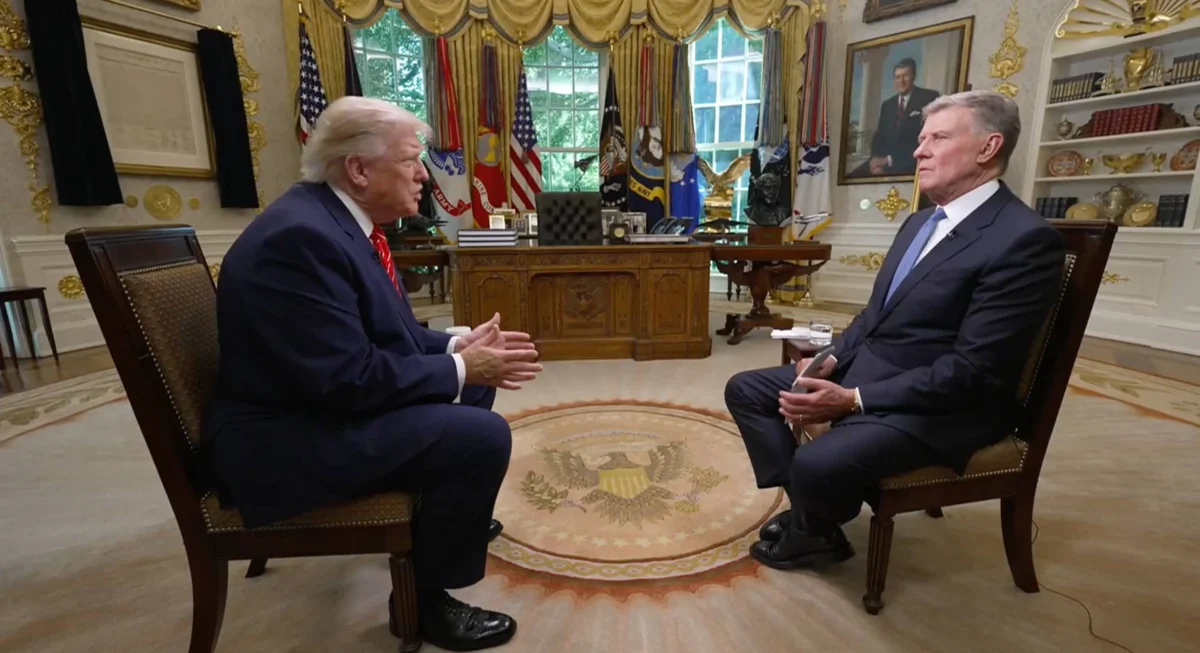
In a recent candid interview from the Oval Office, former President Donald Trump addressed a spectrum of contentious issues, ranging from the business dealings of his adult children and his personal financial disclosures to his ongoing efforts to remove Federal Reserve Governor Lisa Cook, the legislative blockade of a bipartisan housing bill, and his perspective on the Supreme Court’s ideological divisions. The remarks offered a rare glimpse into the former president’s current priorities and grievances, particularly concerning the intersection of his family’s business empire with his public office and his persistent challenges to institutional norms.
Scrutiny Over Trump Family Business Ventures and Potential Conflicts of Interest
A central theme of the interview revolved around the intense scrutiny faced by Trump’s children regarding their business investments and activities, which the former president lamented as an unfair consequence of his political stature. Trump expressed sympathy for his children, suggesting that the immense power of the presidency inadvertently casts a shadow of potential conflict of interest over even their most mundane commercial endeavors. "Anything they do, because the presidency is so powerful… if they buy a cupcake company, well, the energy to make the cupcakes, is you know, sort of like, how’s my energy policy?" Trump stated, illustrating his point with a hyperbolic example. He further elaborated, "Almost anything they do, if they want to buy a truck… if they buy an energy efficient truck, they have insider information."
This sentiment underscores a long-standing debate surrounding the ethical implications of a president retaining ownership stakes in a vast global business enterprise, particularly when managed by close family members. Upon assuming office, presidents traditionally divest from their business holdings or place them in a genuinely "blind trust" to avoid even the appearance of impropriety. However, Trump famously opted against this convention during his previous term, instead transferring management of the Trump Organization to his sons, Donald Jr. and Eric Trump, while retaining ownership. This arrangement, which ethics watchdogs widely criticized as a "semi-blind trust" at best, meant that the president could be aware of his holdings and potentially benefit from policy decisions or foreign government interactions.
The investments of the younger Trumps have indeed been subjected to rigorous examination, particularly as their portfolio has shown a propensity to align with the strategic objectives and policy directions of the Trump administration. Instances where the administration approved deals or contracts with companies in which the younger Trumps held stakes—ranging from drone manufacturers to mining ventures—have consistently fueled accusations of potential insider trading and conflicts of interest. These concerns are not merely academic; they directly impact public trust in government and raise questions about whether presidential decisions are made in the national interest or for personal financial gain.
Congressional Democrats, in particular, have been vocal in their demands for greater transparency and accountability, launching various inquiries aimed at scrutinizing these deals. The Emoluments Clauses of the U.S. Constitution, which prohibit federal officials from accepting gifts or benefits from foreign governments or states without congressional consent, have also been central to these ethical debates. While the legal challenges surrounding these clauses largely dissipated after Trump left office, the underlying ethical questions persist and are amplified by any potential return to the presidency. The implications extend beyond legalities, impacting the perception of fairness, integrity, and the rule of law within the highest echelons of government.
Financial Disclosures and the Role of Eric Trump in Managing Assets
The interview followed closely on the heels of a massive financial disclosure that revealed the former president made more than $2 billion in 2025. Addressing the management of these considerable assets, Trump confirmed that his son, Eric Trump, plays a significant role, alongside large financial institutions. "It’s given to big firms… my son Eric handles it," Trump explained. He clarified his involvement, stating, "I don’t talk to him about things such as this. I think I’d be allowed to, I’m not sure even what the status is, but I don’t." Trump characterized Eric’s role as placing funds into "semi-blind trusts or blind trusts where people invest," reiterating a previous White House stance that his finances were managed by his children.
The concept of a "blind trust" is fundamental to preventing conflicts of interest for high-ranking government officials. It requires an official to transfer management of their assets to an independent trustee who has sole discretion over investment decisions, with the official having no knowledge of the specific holdings or transactions. The purpose is to ensure that officials cannot use their position for personal financial gain, nor can their policy decisions be influenced by their private investments. The arrangement described by Trump, however, has consistently fallen short of the standard definition of a blind trust, primarily because his children, who are not independent and are deeply involved in the Trump Organization, manage the assets. This lack of true independence means that the president could, at least theoretically, have insight into or influence over his family’s business dealings, or that his policy decisions could inadvertently or directly benefit his financial interests.
The recent financial disclosure has indeed intensified the scrutiny over potential profiteering from the presidency. A significant portion of the reported income, approximately $515 million, came from Trump-aligned World Liberty Financial (WLF) token sales, with an additional $65 million from equity sales in WLF’s holding company. This foray into cryptocurrency, a relatively new and often unregulated financial frontier, has added another layer of complexity to the ethical concerns. Critics argue that leveraging a presidential profile for such ventures blurs the lines between public service and private enrichment, especially when the value of such tokens could be influenced by political rhetoric or government policies. Trump, however, dismissed these concerns, asserting in the interview that there was "nothing illegal" and "nothing wrong" with the crypto venture. The White House has consistently denied any wrongdoing in response to such allegations, maintaining that the president’s financial arrangements comply with all applicable laws. However, ethics watchdogs continue to argue that while potentially legal, these arrangements deviate significantly from established ethical norms for presidential conduct, posing challenges to the integrity of the office.
Persistent Efforts to Remove Federal Reserve Governor Lisa Cook
In a notable display of unwavering intent, Trump reiterated his desire to remove Federal Reserve Governor Lisa Cook, despite a recent Supreme Court ruling that temporarily blocked such an action. The high court’s decision earlier in the week prevented Cook’s immediate ouster, citing that her legal challenge against her potential firing was still ongoing. Crucially, the justices, in a 5-4 decision, left open the possibility of Cook being fired on the merits of the case once legal proceedings conclude.
Trump expressed confidence that he would ultimately prevail, stating he would oust Cook by "winning the case." He emphasized that the Supreme Court’s decision was based on "process and procedure," not on the "merits" of his claims against her. This distinction is critical to understanding Trump’s strategy, as it suggests he believes the legal pathway remains open for her removal once procedural hurdles are cleared.

The impetus behind Trump’s campaign against Governor Cook stems from allegations of mortgage fraud, which were reportedly unearthed by Bill Pulte, the head of the Federal Housing Finance Agency (FHFA), who also currently serves as the acting Director of National Intelligence. These allegations, which Cook denies, form the basis of Trump’s justification for seeking her removal. The situation is highly unusual, as Federal Reserve governors are typically appointed to 14-year terms to ensure their independence from political pressure, a cornerstone of monetary policy stability. The President can remove a Fed Governor only for "cause," a standard traditionally interpreted as significant dereliction of duty or legal misconduct, and not simply policy disagreements.
The broader implications of a president attempting to unilaterally remove a sitting Federal Reserve governor are profound. Such an action could severely undermine the perceived independence of the U.S. central bank, which is vital for maintaining economic stability and market confidence. The Federal Reserve’s ability to make decisions on interest rates and monetary policy without political interference is globally recognized as a strength of the U.S. economic system. Any erosion of this independence could lead to increased market volatility, diminished investor confidence, and questions about the integrity of U.S. economic governance. Economists and financial experts widely view attempts to politicize the Fed as detrimental to the nation’s financial health. The ongoing legal battle and Trump’s persistent pursuit of Cook’s removal thus represent a significant challenge to a fundamental pillar of American economic policy.
Legislative Standoff: Housing Bill and the SAVE America Act
The former president offered a lukewarm response regarding a bipartisan housing bill that had successfully cleared Congress the previous month, signaling his reluctance to sign it without the passage of his preferred legislation, the SAVE America Act. This stance followed his dramatic intervention a week prior, where he torpedoed a triumphant signing ceremony for the housing bill on Capitol Hill, just hours before it was scheduled to begin.
"There’s a lot of Democrat points in there that I don’t even think are good, but it’s fine," Trump said, downplaying the bipartisan achievement. He clarified his conditional support: "But I’ve made the case I’d rather not sign anything until we sign the SAVE America Act." This ultimatum has effectively stalled a significant legislative effort aimed at addressing the nation’s growing housing affordability crisis, an issue of pressing concern for millions of Americans across the political spectrum.
For months, Trump has been a vocal proponent of the SAVE America Act, a bill that seeks to implement stringent voter identification requirements at polling places, demand proof of citizenship for voter registration, and impose a ban on mail-in voting. Proponents argue these measures are necessary to ensure election integrity and prevent voter fraud. However, critics contend that such provisions, particularly the proof of citizenship and mail-in voting ban, could disproportionately disenfranchise low-income individuals, minorities, and elderly voters, who may face greater hurdles in obtaining required documentation or relying on mail-in ballots due to accessibility issues. The bill also includes other conservative "wish list" items that enjoy only limited bipartisan support in Congress.
The president’s insistence on linking the housing bill to the SAVE America Act has created a significant legislative bottleneck, leading to a shutdown of the House floor. Certain Republican members of Congress, aligning with Trump’s position, have threatened to vote down other pieces of legislation until the SAVE Act is passed, effectively paralyzing legislative activity. This tactic, while demonstrating a unified front within a segment of the Republican party, has drawn criticism for holding essential, bipartisan legislation hostage to a highly contentious and politically divisive issue.
The SAVE America Act faces formidable obstacles in the Senate, where it currently lacks the necessary 60 votes to overcome a filibuster. Senate Majority Leader John Thune (R-S.D.) and his caucus have shown little appetite for eliminating the filibuster, a procedural tool that requires a supermajority for most legislation to pass. Trump, however, remains resolute in his call to change Senate rules, stating, "What I’d really like is for them to kill the filibuster, terminate the filibuster." Despite the legislative gridlock, the bipartisan housing bill is expected to become law with or without Trump’s signature, unless he opts for a formal veto, which he did not indicate in the interview. The broader impact of this standoff is a demonstration of how deeply partisan issues can impede progress on widely supported initiatives, contributing to legislative dysfunction and public frustration with governance.
Observations on the Supreme Court: "Our" Justices and Ideological Divides
Shifting to the judiciary, Trump voiced a familiar complaint during the interview concerning the perceived ideological alignment within the Supreme Court. He expressed frustration that the three liberal justices consistently vote as a bloc, while the six conservative justices, a majority of whom he appointed, often splinter in their decisions.
"Very, very seldom do they not vote as a bloc," Trump remarked about the liberal justices, asserting a level of ideological cohesion he believes is absent on the conservative side. He contrasted this with his appointees, stating, "Whereas our people, and we have six, but they move around a little bit." Trump further opined on the motivations behind the conservative justices’ varied rulings: "Republicans want to show everybody how they’re not controlled, how they’re so honorable." This comment suggests a belief that conservative justices prioritize demonstrating their independence over adhering to a unified ideological front, a characteristic he views as a disadvantage compared to the liberal bloc.
The concept of judicial independence is a cornerstone of the American legal system. Supreme Court justices are technically nonpartisan, appointed for lifetime terms to insulate them from the political pressures of elections and partisan politics. While presidents typically nominate candidates whose judicial philosophies align with their own ideological tilt, the expectation is that once confirmed, justices will rule based on their interpretation of the Constitution and law, rather than party affiliation or political loyalty. Historically, justices appointed by the same president have often diverged in their rulings, illustrating the complexities of legal interpretation and the independence of judicial thought. Notable examples include President Dwight D. Eisenhower’s later regrets over appointing Chief Justice Earl Warren, whose liberal jurisprudence profoundly shaped civil rights law.
The current Supreme Court, with its 6-3 conservative majority, has indeed seen instances where conservative justices have sided with their liberal colleagues or penned dissenting opinions that diverge from their more conservative brethren. This phenomenon, while perhaps frustrating to those who seek predictable ideological outcomes, is often viewed by legal scholars as a testament to the Court’s independence and the rigorous intellectual debate that characterizes its deliberations. Conversely, the perception of a consistent "bloc" vote among the liberal justices, while often true on certain high-profile cases, is also a reflection of shared judicial philosophies rather than necessarily a coordinated political effort.
Trump’s characterization of "our" justices, however, highlights a common political tendency to view judicial appointments as extensions of a president’s political legacy and to expect certain outcomes aligned with their appointing party’s agenda. This perspective, while understandable in the highly politicized environment of judicial nominations, can clash with the ideal of an impartial judiciary. The broader implication of such rhetoric is a potential erosion of public confidence in the Court’s nonpartisan nature, reinforcing perceptions that judicial decisions are driven by politics rather than law, thereby undermining the legitimacy of the institution in the eyes of some segments of the public.
