

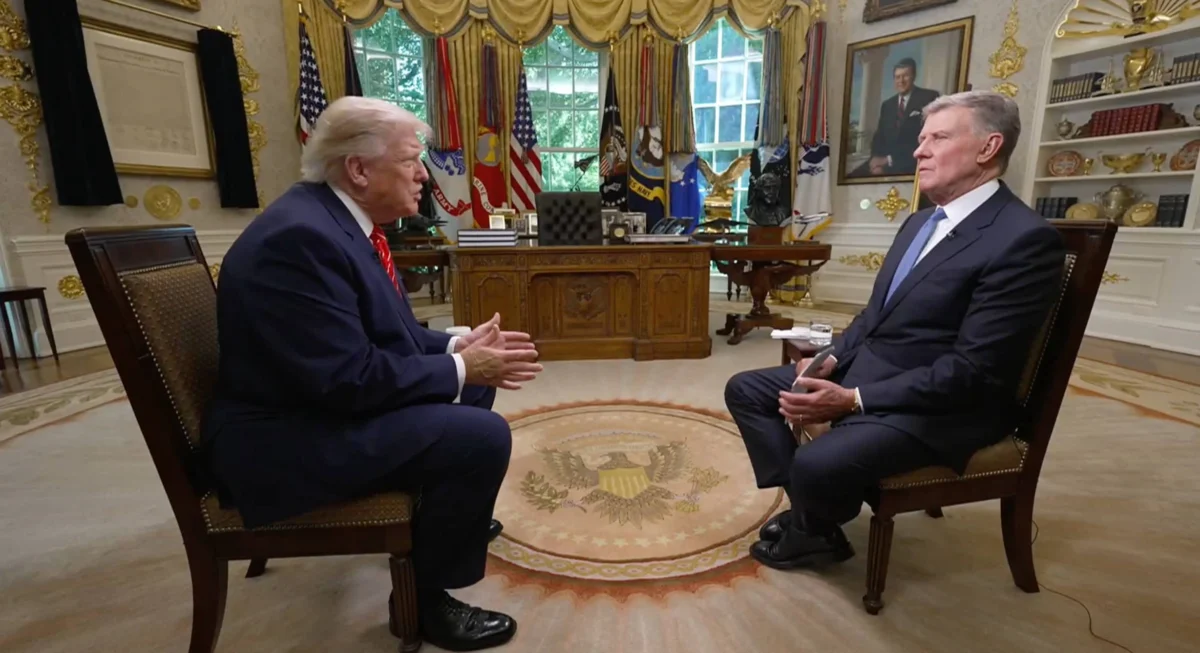
In a recent comprehensive interview, former President Donald Trump addressed a series of high-profile issues, ranging from the ongoing scrutiny of his children’s business ventures and the management of his personal finances to his determined efforts to remove a Federal Reserve Governor, legislative gridlock over a bipartisan housing bill, and his perspectives on the Supreme Court’s ideological divisions. The remarks, made during a discussion in the Oval Office, offered insights into his current priorities and his approach to governance, touching upon themes of conflicts of interest, executive power, and the mechanisms of legislative and judicial branches.
Presidential Family Finances Under Renewed Scrutiny
A significant portion of the interview focused on the persistent ethical questions surrounding the business dealings of President Trump’s adult children. Trump expressed sympathy for his children, acknowledging that the inherent power of the presidency inadvertently casts a shadow of potential conflict of interest over any commercial activity they undertake. "Anything they do, because the presidency is so powerful… if they buy a cupcake company, well, the energy to make the cupcakes, is you know, sort of like, how’s my energy policy?" Trump articulated, highlighting the broad scope of potential implications. He further elaborated, "Almost anything they do, if they want to buy a truck… if they buy an energy efficient truck, they have insider information."
This sentiment underscores a long-standing concern that has shadowed the Trump administration, both during his previous term and in the current political climate. Ethics watchdogs and Congressional Democrats have consistently raised alarms about the intertwining of the Trump family’s extensive global business empire with the strategic goals and policy decisions of the administration. Over the years, numerous reports have detailed instances where companies with which the younger Trumps had invested or conducted business subsequently received approvals for deals or contracts from government entities. These ventures have spanned diverse sectors, from advanced drone technology manufacturers to international mining operations, leading to allegations of potential insider trading and undue influence. The absence of a traditional "blind trust" for the president’s assets, which were instead managed by his adult children, has been a central point of contention, diverging from historical norms designed to prevent perceived or actual conflicts of interest. Critics argue that even the appearance of impropriety can erode public trust in government institutions and the integrity of the presidency.
Further complicating the financial landscape, the interview coincided with the release of a massive financial disclosure indicating the president earned over $2 billion in 2025. Trump clarified that his son, Eric Trump, manages his finances in collaboration with large financial institutions. "It’s given to big firms… my son Eric handles it," Trump stated, adding, "I don’t talk to him about things such as this. I think I’d be allowed to, I’m not sure even what the status is, but I don’t." He described the arrangement as a "semi-blind trusts or blind trusts where people invest," a structure that has drawn scrutiny for its perceived lack of complete separation from the family’s direct influence.
Among the notable disclosures was approximately $515 million derived from Trump-aligned World Liberty Financial (WLF) token sales and an additional $65 million from the sale of equity in WLF’s holding company. This foray into the cryptocurrency market has generated significant discussion. Trump defended the crypto venture, asserting there was "nothing illegal" and "nothing wrong" with it. However, the involvement of a former president in such a novel and often volatile financial instrument has sparked immense scrutiny over potential profiteering from his political stature and public profile. The White House has consistently denied any wrongdoing, maintaining that all financial activities are transparent and within legal bounds. Yet, the confluence of high-value business dealings, family management, and a powerful political position continues to fuel public and congressional debate regarding ethical standards in the highest office.
Persistent Pursuit to Remove Federal Reserve Governor Lisa Cook
In a notable reaffirmation of his intent, President Trump reiterated his desire to dismiss Federal Reserve Governor Lisa Cook, despite a recent Supreme Court ruling that temporarily barred such an action. The high court’s decision, issued earlier this week, stated that Trump could not fire Cook "for now," as her legal challenge against her dismissal is still actively progressing through the judicial system. While a 5-4 majority of the justices left the door open for Cook to be fired on the merits of the case at a later stage, Trump viewed the ruling as a procedural rather than a substantive block.
"They sent it back, not based on the merits" but on "process and procedure," Trump stated, indicating his resolve remains undiminished. He expressed confidence that he would ultimately oust Cook by "winning the case." This stance highlights a direct challenge to the traditional independence of the Federal Reserve, a cornerstone of U.S. economic policy that aims to insulate monetary policy decisions from short-term political pressures. Federal Reserve governors are typically appointed to 14-year terms to ensure this independence, and their removal is generally understood to require "for cause" justification, such as dereliction of duty, rather than simple policy disagreement.

Lisa Cook, a distinguished economist, was appointed to the Federal Reserve Board of Governors by the current administration, bringing extensive expertise in macroeconomics, international finance, and innovation. Her appointment was hailed by many as a significant step towards diversifying the Federal Reserve’s leadership. Trump’s attempt to remove her stems from allegations of mortgage fraud, which he claims were uncovered by Bill Pulte, the head of the Federal Housing Finance Agency (FHFA), who also currently serves as the acting director of national intelligence. The allegations themselves have been met with skepticism and strong denials from Cook and her supporters, who view them as politically motivated. The ongoing legal battle sets a critical precedent for the balance of power between the executive branch and independent financial institutions, potentially impacting the perceived impartiality and stability of the nation’s monetary policy authority. Should a president gain unfettered power to remove Fed governors, it could introduce significant uncertainty into financial markets and compromise the Fed’s ability to act independently in managing inflation, employment, and overall economic stability.
Legislative Gridlock: Housing Bill, SAVE Act, and the Filibuster
The interview also shed light on significant legislative roadblocks, particularly Trump’s lukewarm reception to a bipartisan housing bill that had successfully cleared Congress last month. His reticence comes just a week after he abruptly derailed a planned triumphant signing ceremony on Capitol Hill for the bill, primarily due to the stalled progress of his favored SAVE America Act, a voter-ID bill.
When questioned about signing the housing bill, which aims to address the nation’s burgeoning affordability crisis, Trump offered a tepid response. "There’s a lot of Democrat points in there that I don’t even think are good, but it’s fine," he conceded. However, he quickly pivoted to his primary condition: "But I’ve made the case I’d rather not sign anything until we sign the SAVE America Act." This conditional approval has effectively stalled a legislative achievement that both parties had hoped to showcase as a rare example of cross-aisle cooperation on a critical national issue. The housing bill, a culmination of months of negotiation, seeks to alleviate the severe housing affordability crisis gripping many parts of the country, characterized by soaring rents, prohibitive home prices, and a chronic shortage of available units. Economists and housing advocates have repeatedly called for comprehensive legislative action, citing the crisis’s profound impact on economic mobility, social equity, and overall quality of life.
The SAVE America Act, championed by Trump for months, is a package of proposed electoral reforms that would mandate voter identification at polls for proof of citizenship to register to vote. Additionally, Trump seeks to attach other conservative priorities to the bill, notably a ban on mail-in voting. Proponents argue that such measures are essential for ensuring election integrity and preventing voter fraud, while critics contend that these requirements disproportionately disenfranchise low-income individuals, minorities, and the elderly, making it more difficult for eligible citizens to exercise their right to vote. The push for the SAVE Act has created significant legislative friction, leading to a de facto shutdown of the House floor, as certain Republican members of Congress have vowed to vote down other pieces of legislation until the SAVE Act is passed.
Despite its strong support within a segment of the Republican caucus, the SAVE Act faces an uphill battle in the Senate. Senate Majority Leader John Thune (R-S.D.) and his caucus reportedly do not possess the necessary votes to pass the measure, nor do they appear to have the appetite to eliminate the 60-vote filibuster, which would be required to advance such a contentious bill with only a simple majority. Trump, ever the pragmatist when it comes to legislative strategy, expressed his frustration with the procedural hurdle. "What I’d really like is for them to kill the filibuster, terminate the filibuster," he stated, echoing a sentiment he has often voiced regarding legislative impasses. The filibuster, a Senate tradition requiring 60 votes to end debate on most legislation, has become a frequent target of both parties when they are in the minority, but its elimination remains a highly contentious issue, seen by many as a critical safeguard for minority party rights and a check on unchecked majority power. The housing bill, in the absence of a presidential veto, is expected to become law eventually, with or without Trump’s signature, as the President did not indicate an intent to veto it during the interview. However, his current stance ensures a significant delay, potentially prolonging the suffering caused by the housing crisis.
"Our" Justices and the Supreme Court’s Ideological Divide
Finally, President Trump offered his candid observations on the voting patterns and perceived partisanship within the Supreme Court. He voiced a common complaint among conservatives that the Court’s three liberal justices frequently vote as a cohesive bloc, while the conservative majority often "splinters."
"Very, very seldom do they not vote as a bloc," Trump remarked concerning the liberal justices. In contrast, he noted, "Whereas our people, and we have six, but they move around a little bit." Trump further elaborated on his perception of the conservative justices’ motivations: "Republicans want to show everybody how they’re not controlled, how they’re so honorable." This comment suggests a belief that conservative justices, perhaps to demonstrate their judicial independence, are less predictable in their alignment compared to their liberal counterparts.
The Supreme Court, by design, is intended to be a nonpartisan body, with justices holding lifetime appointments precisely to shield them from the vagaries of political pressure and partisan leanings. However, the reality of judicial appointments often sees presidents selecting candidates who broadly align with their ideological perspectives. The current composition of the Court, with a 6-3 conservative supermajority, has frequently led to landmark decisions reflecting this ideological tilt. Yet, as Trump noted, conservative justices have indeed "moved around" in certain cases, forming unexpected coalitions or issuing dissenting opinions that diverge from purely ideological lines. This phenomenon, while perhaps frustrating to a president seeking consistent outcomes, is often lauded by legal scholars as a sign of judicial independence and a commitment to legal principles over partisan loyalty. Conversely, the perception of liberal justices voting as a bloc is often attributed to a shared interpretative philosophy or consistent application of established legal precedents, rather than overt partisanship. The enduring tension between the ideal of an impartial judiciary and the public perception of ideological divisions remains a defining characteristic of the modern Supreme Court, with presidential comments serving to further underscore these debates.
