

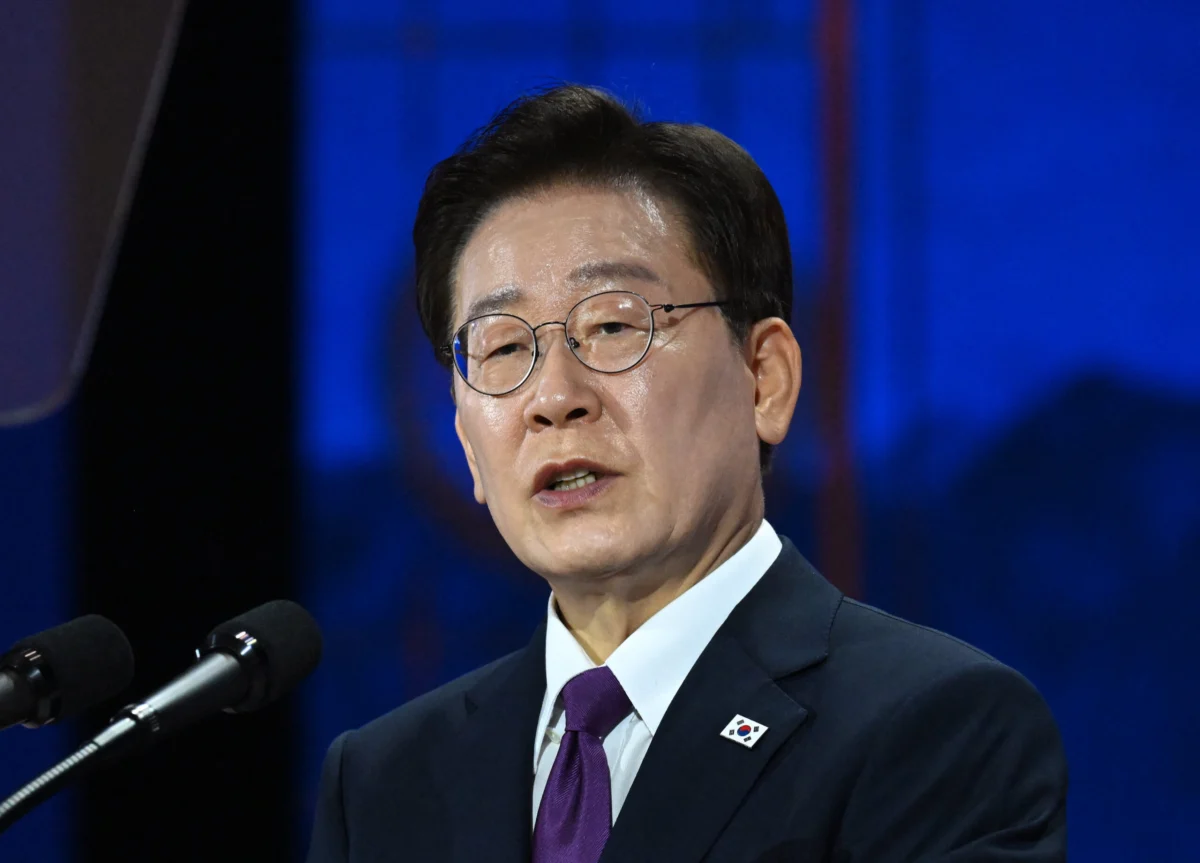
South Korean President Lee Jae Myung has ignited a significant public discourse by invoking Japan’s profound property crash of the early 1990s, a comparison designed to underscore mounting concerns about Seoul’s burgeoning real estate market. His remarks come as the administration prepares to introduce pivotal tax revisions aimed at stabilizing the nation’s housing sector, a move that signals the government’s heightened vigilance against potential economic vulnerabilities.
Speaking at a public discussion on real estate policy on Thursday, President Lee highlighted that "quite a few people" in South Korea fear the country could similarly face Japan’s "lost" two or three decades. This direct reference to Japan’s "lost decades"—a period of protracted economic stagnation following a catastrophic real asset and stock market collapse—serves as a potent warning. Lee specifically pointed out that Tokyo’s housing market had "burst like a balloon" in the early 1990s, drawing a stark parallel to South Korea’s currently overheating real estate conditions. The President delivered these comments during the opening ceremony of the 48th session of the UNESCO World Heritage Committee at BEXCO convention and exhibition centre in Busan on July 19, 2026, seizing a prominent platform to address a critical domestic issue.
Echoes of Japan’s "Lost Decades": A Historical Parallel
To fully grasp the gravity of President Lee’s comparison, it is essential to revisit the economic trajectory of Japan in the late 1980s and early 1990s. During this period, Japan experienced an unprecedented asset price bubble, fueled by aggressive monetary easing, speculative lending practices, and a cultural emphasis on land ownership. Real estate and stock market values soared to unsustainable levels, creating immense paper wealth. For instance, at its peak in 1989, the total value of real estate in Japan was estimated to be four times that of the entire United States, with the Imperial Palace grounds in Tokyo reportedly valued more than all the real estate in California.
The Bank of Japan, initially hesitant to tighten policy, eventually began raising interest rates in December 1989. This decisive, albeit belated, action, coupled with stricter lending regulations, triggered a dramatic implosion of the bubble. Asset prices plummeted, leading to widespread bankruptcies, a banking crisis, and a prolonged period of deflation and minimal economic growth. This era, stretching for over two decades, became infamously known as Japan’s "lost decades," characterized by stagnant wages, declining productivity, and a general sense of economic malaise. President Lee’s invocation of this historical precedent is not merely rhetorical; it reflects a deep-seated concern that South Korea, with its own unique set of economic characteristics, might be treading a similar path if unchecked.
South Korea’s Overheated Real Estate Landscape
The President’s warning is rooted in South Korea’s undeniable reliance on real estate as a primary component of household wealth. Data consistently shows that South Korea is among the countries globally with the highest proportion of household wealth concentrated in real assets. As of the end of March 2025, real assets accounted for a substantial 75.8% of Korean household assets, dwarfing financial assets which stood at 24.2%. This heavy concentration means that fluctuations in property values have a disproportionate impact on household finances and overall economic stability.
The rapid appreciation of housing prices, particularly in metropolitan areas like Seoul, has been a defining feature of the South Korean economy for years. Factors contributing to this overheating include limited land supply, strong demand driven by urbanization, low interest rates in recent history, and a pervasive belief that real estate is the safest and most lucrative investment. This cultural inclination towards property ownership, often seen as a crucial marker of social status and financial security, further fuels speculative demand. Previous governments have implemented various measures, including stricter loan-to-value (LTV) and debt-to-income (DTI) ratios, increased property taxes, and the designation of speculative zones, yet the market has consistently demonstrated resilience, often finding new avenues for price appreciation.
President Lee’s Economic Vision and Previous Bold Calls
President Lee Jae Myung is no stranger to making bold pronouncements and setting ambitious economic targets. Ahead of the 2025 presidential election, when the benchmark Kospi index hovered near 2,500 points, Lee, then a candidate, reportedly set an audacious target of 5,000 for the Kospi during his term. This pledge was intrinsically linked to his broader commitment to resolve the so-called "Korea discount," a persistent undervaluation of South Korean equities compared to global peers, often attributed to corporate governance issues, complex ownership structures, and geopolitical risks.
His strategy aimed to steer household wealth away from the overheated housing sector and redirect it into financial markets, fostering a more balanced and productive allocation of capital. Remarkably, the Kospi briefly crossed the 5,000-point threshold in January 2026, just over six months after he assumed office, buoyed significantly by the global AI-powered chip boom which propelled the stock prices of South Korean tech giants like Samsung Electronics and SK Hynix. This achievement, while partially attributable to global market dynamics, lent credibility to his administration’s ability to influence economic outcomes.

However, despite the Kospi’s surge, the government’s overarching strategy of rebalancing household wealth has only partially succeeded. While financial assets have seen growth, real estate remains dominant. The South Korean benchmark index now hovers at around 6,700, having experienced considerable volatile swings, largely due to its heavy dependence on these semiconductor heavyweights. This volatility underscores the inherent risks of a concentrated market and the ongoing challenge of diversifying national wealth away from property.
Navigating Financial Stability: The Role of Household Debt
A critical component of the real estate debate in South Korea is the nation’s substantial household debt. As of 2024, the household debt-to-GDP ratio in the country stands at 90.14%. While this figure represents a decrease from its record high of 98.67% in 2021, it remains the second-highest in Asia, trailing only Australia. This elevated level of household indebtedness, largely comprising mortgages and other forms of consumer credit, poses a significant risk to financial stability, particularly in an environment of rising interest rates and potential economic slowdowns.
Recognizing these risks, the South Korean authorities have implemented and maintained stringent controls on mortgage lending conditions for several years. ING’s senior economist for South Korea and Japan, Kang Min Joo, affirmed that mortgage lending conditions have been "relatively tight." Authorities have consistently applied strict controls on loan-to-valuation (LTV) and debt-to-income (DTI) ratios. For instance, while the LTV ratio was previously as high as 80% in some instances, it has been significantly reduced to below 40% and even lower in the highly sought-after Seoul area. These measures are designed to prevent excessive leverage and mitigate the potential for widespread defaults should property values decline. President Lee’s recent comments, therefore, reflect a deep concern about the recent resurgence in housing prices, signaling a proactive stance to prevent a full-blown real asset bubble from forming or bursting, rather than an immediate crisis.
Expert Perspectives: Overblown Fears or Prudent Caution?
While President Lee’s warning is stark, economists offer a more nuanced assessment of the immediate danger. Many concur that the comparison with Japan, while serving as a useful cautionary tale, might overstate the immediate threat of a real asset bubble burst in South Korea.
-
Regulatory Safeguards and Market Dynamics: Kang Min Joo of ING believes that "the probability of a real asset bubble burst in Korea is limited." She points to the aforementioned tight mortgage lending conditions and strict LTV/DTI controls as crucial preventative measures. These regulations ensure that borrowers are not excessively leveraged, thereby reducing the systemic risk to financial institutions. Furthermore, Gareth Leather, senior economist for Asia at Capital Economics, supports this view, stating that "fears of a bubble appear exaggerated." He highlights that the rapid rise in property prices is predominantly concentrated in Seoul. Even within the capital, prices are only approximately 10% above their January 2022 levels. In contrast, cities like Busan have seen prices fall to almost 80% of their January 2022 levels, indicating a more localized rather than nationwide overheating. Leather also underscores that financial stability risks are mitigated by the requirement for house buyers to put down substantial down payments, which significantly reduces the likelihood of negative equity and subsequent difficulties for banks.
-
Comparing Apples and Oranges: Key Distinctions from Japan: Experts also point out several key differences between South Korea’s current situation and Japan’s pre-crash environment. Ma Tieying, senior economist at DBS Group Research, acknowledges that South Korea shares certain characteristics with Japan before its bubble burst, such as a high credit-to-GDP ratio and a significant stock market capitalization, making it vulnerable to higher interest rates, tighter credit conditions, and global economic shocks. However, Ma emphasizes that Korea is not experiencing the large capital inflows or persistent currency appreciation that characterized Japan a few years prior to its bubble’s implosion. This distinction provides the Bank of Korea with greater flexibility to calibrate its monetary policy without being unduly constrained by external pressures. Moreover, Ma notes that the central bank in Korea has demonstrated a more pre-emptive response to inflation and financial imbalances compared to Japan’s belated actions before its bubble burst, suggesting a more proactive and adaptive policy framework.
The Path Forward: Implications for Policy and Society
President Lee’s administration is now poised to introduce revisions to real estate taxes, a critical component of its strategy to stabilize the housing market. These revisions are likely to aim at discouraging speculative investment, promoting more equitable distribution of property ownership, and potentially increasing the supply of affordable housing. The government’s challenge will be to craft policies that cool the market without triggering an abrupt downturn that could destabilize household wealth and the broader economy.
The implications of these policies extend beyond economic metrics. High housing costs contribute to significant social inequalities, impacting youth, low-income families, and overall quality of life. The struggle to afford housing can influence demographic trends, including birth rates, and contribute to social discontent. Therefore, the government’s approach to real estate policy is not merely an economic exercise but a societal imperative.
The administration’s efforts to shift wealth from real estate to financial markets, alongside its commitment to address the "Korea discount," indicate a broader strategic vision for South Korea’s economic future. By fostering a more dynamic and equitable financial landscape, the government hopes to enhance productivity, encourage innovation, and build a more resilient economy less susceptible to the cyclical boom-and-bust patterns of asset bubbles. However, the delicate balance between market intervention and allowing natural market forces to operate will be crucial for the long-term success of these reforms. The ultimate goal is to create a sustainable and stable environment where housing is primarily a place to live, rather than solely a speculative investment, thereby avoiding the pitfalls that led to Japan’s "lost decades."
