

In the late 1990s, the City of Markham, Ontario, faced a critical developmental crossroads common to many North American municipalities: continue the path of low-density suburban sprawl or pivot toward a more sustainable, high-density urban future. Recognizing that the long-term pressures of climate change and the global energy transition were already appearing on the horizon, Markham’s city councillors took a definitive step in 1999. They opted to invest in a district energy system designed to heat and cool its emerging downtown core. Rather than leaving individual developers to install separate boilers and air conditioning units in every new building, the city backed a centralized, shared energy network. This infrastructure was engineered specifically to scale in tandem with the city’s growth, providing a blueprint for how Canadian municipalities can balance rapid development with environmental stewardship.
Today, nearly a quarter-century since that initial investment, the results of Markham’s foresight are visible both above and below the ground. A complex network of insulated pipes buried beneath the city’s streets carries hot and chilled water between centralized energy plants and a diverse array of connected buildings. This system now services more than 14 million square feet of commercial and residential development. The Markham model has proven that municipal investment in shared infrastructure can deliver a faster transition to clean energy while simultaneously building urban resilience through improved energy reliability and flexibility.
The Mechanics of Centralized Energy Systems
The fundamental advantage of a district energy system lies in its ability to centralize thermal production. In a traditional urban setup, each building operates its own mechanical room, often relying on aging or inefficient natural gas boilers and electricity-heavy chillers. In contrast, district energy networks utilize high-grade, industrial-scale equipment housed in central plants. These plants are significantly more efficient than the sum of individual building units and are maintained by specialized engineers, ensuring optimal performance throughout their lifecycle.
According to Peter Ronson, the Chief Operating Officer of Markham District Energy, the centralized nature of these systems allows for the rapid adoption of emerging technologies. While an individual building owner might be hesitant to invest in experimental or expensive green technology, a district energy provider can integrate these innovations at the plant level, instantly decarbonizing every building connected to the loop. This creates a "future-proof" infrastructure where buildings benefit from the transition to a lower carbon footprint without needing to undergo invasive or costly internal retrofits.
A Chronology of Innovation and Expansion
The evolution of Markham’s energy landscape provides a timeline for how municipalities can transition from traditional utility models to sustainable networks.
In 1999, the project began with a modest vision to support the "Markham Centre" development. The initial phase focused on creating the core infrastructure necessary to attract developers to the new downtown area. By providing a reliable, "plug-and-play" energy solution, the city reduced the capital costs for developers, who no longer needed to allocate significant square footage for large mechanical rooms or rooftop cooling towers.
By the mid-2000s, the system had already begun to demonstrate its scalability. As the Markham Centre grew, so did the network of pipes. The project received a significant boost through its partnership with the Federation of Canadian Municipalities (FCM) and its Green Municipal Fund (GMF). Over a 20-year period, the GMF provided more than $17 million in grants and loans, which acted as a catalyst for further private and public investment.
Currently, Markham operates two distinct district energy systems supported by four energy plants, with a fifth facility currently being commissioned. This newest addition represents the cutting edge of circular economy technology: it is designed to recover thermal energy from a large sanitary sewer line running adjacent to the plant. By using industrial heat pumps and heat exchangers, the system will extract warmth from wastewater to heat buildings, further reducing the city’s reliance on fossil fuels.
The National Context: Canada’s Competitive Gap
Despite the success seen in Markham, Canada as a whole continues to lag behind international peers in the adoption of shared community energy. In regions such as Scandinavia, Northern Europe, and parts of East Asia, district energy is the standard for urban heating and cooling. For example, in Denmark, over 60% of households are connected to district heating networks, significantly contributing to the country’s high energy efficiency and low carbon emissions.

In Canada, the adoption has been more sporadic, though successful outliers provide compelling data. In Yellowknife, Northwest Territories, a district energy system utilizing biomass has been projected to save the community up to $160,000 annually in energy costs. These savings are particularly impactful in northern climates where heating costs represent a massive portion of municipal and residential budgets.
The broader shift toward centralized thermal energy is now viewed as a necessity for Canada’s economic resilience. As the country aims for net-zero emissions by 2050, the decarbonization of the building sector—which accounts for approximately 13% of Canada’s total greenhouse gas emissions—is a primary hurdle. District energy offers a path to address these emissions at scale rather than through a fragmented, building-by-building approach.
Financial Viability and the Role of "De-risking"
One of the primary obstacles to district energy is the significant upfront capital required for subterranean infrastructure. Laying kilometers of insulated piping and constructing central plants requires "patient capital"—investment that prioritizes long-term stability over immediate, high-risk returns.
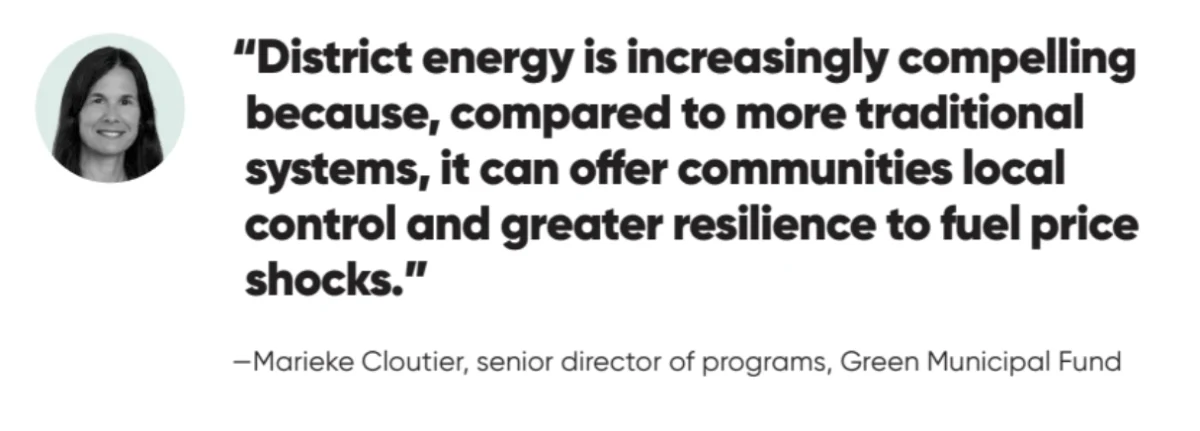
This is where organizations like the FCM’s Green Municipal Fund play a pivotal role. Marieke Cloutier, Senior Director of Programs at the GMF, notes that district energy projects are increasingly compelling because they offer local control and protection against fuel price shocks and supply disruptions. The GMF’s role is often described as "de-risking." By funding early-stage feasibility studies and providing low-interest loans for the first phase of construction, the fund creates a "bankable" project that can then attract larger institutional investors.
The financial trajectory of Markham District Energy serves as a prime example of this leverage. The initial support from the GMF paved the way for the utility to attract more than $270 million in additional capital. This funding came from diverse sources, including the Canada Infrastructure Bank (CIB) and commercial lenders like the Canadian Imperial Bank of Commerce (CIBC). This demonstrates that once the initial risk is mitigated, green infrastructure can compete for capital in the same way as traditional utilities or real estate developments.
Resilience in the Face of Climate Volatility
Beyond carbon reduction and economic returns, district energy systems provide a critical layer of urban resilience. Gerard MacDonald, Principal at Reshape Infrastructure Strategies in Vancouver, emphasizes that networked systems are inherently more robust during disasters. Because these systems can draw from multiple energy sources—including natural gas, electricity, biomass, and waste heat—they are less vulnerable to the failure of a single fuel source.
Global data supports this. During major weather events, such as ice storms in North America or hurricanes in the Caribbean, district energy systems have often remained operational while individual building systems failed. The centralized maintenance of industrial-grade equipment ensures that the system is better prepared for extreme fluctuations in temperature and demand. In a world where climate-related outages are becoming more frequent, the reliability of a shared energy grid becomes a significant competitive advantage for a city.
Broader Implications for Urban Planning and Public Interest
The success of the Markham model suggests that the public interest is best served when municipalities take an active role in energy planning. The economic benefits extend to the end-users—the residents and businesses who pay the utility bills. Because district energy is more efficient and can hedge against volatile commodity prices by switching energy sources at the plant level, it often results in more stable and lower long-term costs for consumers.
Furthermore, district energy allows for more creative and aesthetic urban design. Without the need for bulky HVAC equipment on every rooftop or large mechanical rooms on every ground floor, architects have more freedom to design buildings that are aesthetically pleasing and optimized for human use. This contributes to the creation of more vibrant, walkable, and dense urban cores—exactly the "pivot" Markham sought in the 1990s.
As Canada continues to urbanize, the lessons from Markham, supported by the Green Municipal Fund, provide a clear roadmap. The transition to net-zero requires more than just better lightbulbs or individual electric heat pumps; it requires a fundamental rethinking of how energy is distributed across the community. By investing in shared, scalable, and resilient infrastructure, cities can ensure they are prepared for the energy demands of the 21st century while protecting the economic interests of their citizens. The "Markham Pivot" is no longer just a local success story; it is a national imperative for sustainable growth.
