


The current landscape of artificial intelligence adoption presents business leaders with a profound challenge, akin to navigating treacherous mountain passes in unpredictable winter conditions. While the external forces of technological advancement and market shifts are beyond immediate control, the internal capacities of an organization—its leadership agility, its established trust, and its execution prowess—serve as the critical "tires" that significantly enhance the likelihood of a successful journey. This is the central thesis emerging from recent analyses of CEO sentiment and strategic execution, which highlight a significant gap between ambition and the ability to realize transformative AI initiatives.
The analogy of a perilous drive, particularly the challenging route between Provo and Seattle that traverses the Blue Mountains in Oregon, vividly illustrates this point. This stretch of road is notorious for its steep grades, sharp turns, and the ever-present threat of severe winter weather. During such conditions, even well-maintained vehicles can become stranded, underscoring the fragility of unpreparedness. The author recalls navigating this route as a college student, acknowledging the uncontrollability of the weather but emphasizing the personal control exercised over vehicle maintenance: ensuring good tire tread, a properly serviced engine, and even carrying essential supplies like a gallon of water. These were the organizational "capabilities" that provided a buffer against the unforeseen.
Today, many chief executive officers find themselves in a similar predicament with artificial intelligence. The path forward is fraught with uncertainty, and the potential for setbacks is substantial. The "weather"—the rapid evolution of AI capabilities, shifting market demands, and emergent competitive threats—is uncontrollable. However, the "tires" and the "engine"—the core organizational capabilities—are firmly within a leader’s purview. These include the strength and adaptability of leadership teams, the depth of trust cultivated throughout the organization, and the demonstrated capacity for effective execution.
The Growing Execution Gap: Ambition Outpacing Capability
A recent survey by Bain & Company, detailed in their report "The 2026 CEO Agenda: Where Ambition Outpaces Execution," reveals a stark reality for business leaders. While a substantial majority of chief executives (83%) report that their strategic decisions and investments are future-focused and aligned with their most critical priorities, and 87% believe their executive leadership teams are aligned with this ambition, a significant shortfall exists in the perceived ability to translate this vision into reality. Critically, only 46% of CEOs express confidence that they possess the right talent in the right roles to deliver on these strategic objectives.
David Michels of Bain & Company aptly describes this phenomenon as an "ambition gap" that is narrow, contrasting sharply with a "large execution gap." The author of the original analysis pushes this observation further, suggesting that in the rapidly evolving domain of AI, where new models and capabilities emerge constantly, the notion that any organization has definitively completed a successful AI transformation is premature. Consequently, the confidence expressed by the 46% might be more aspirational than grounded in empirical evidence. On a difficult day, the author admits to aligning with the 54% who harbor doubts, recognizing that in the current AI landscape, all CEOs are, to some extent, operating with limited precedents and making informed estimations.
The implications of this widespread lack of confidence in execution are profound. Over half of CEOs admitting to doubts about their organization’s capacity to execute strategic agendas poses a significant risk. Embarking on AI transformation without the foundational leadership and operational capabilities to execute it effectively can jeopardize the existing core business before new ventures have a chance to gain traction. In such scenarios, the pursuit of innovation could inadvertently lead to the erosion of the current enterprise, a potentially more detrimental outcome than maintaining the status quo. However, the author also posits that for many organizations, maintaining the status quo is no longer a viable option in the face of technological disruption.
The Dual Promises of AI: Efficiency vs. Transformation
Boards of directors are increasingly demanding clarity from CEOs regarding the expected outcomes of AI investments. Broadly, AI promises two distinct types of payoffs:
-
Cost Structure Reset and Efficiency Gains: This represents a one-time recalibration of operational expenses, leading to enhanced efficiencies and improved profit margins. This outcome is a familiar one, often associated with significant technological implementations.
-
Transformational Growth: This involves the creation of entirely new products, business lines, revenue streams, and categories of customer value. This is a more ambitious and potentially disruptive outcome.
A compelling example of transformative AI adoption is evident in Eli Lilly’s strategic pivot. The pharmaceutical giant leveraged its extensive proprietary data, amassed from the performance of hundreds of thousands of molecules at a cost exceeding $1 billion, to create a powerful AI-driven platform. In the past year, Lilly launched TuneLab, offering biotech companies access to AI models trained on this invaluable dataset. In return, participating companies contribute their own research results, which, in turn, refine and enhance the AI models for all users, while safeguarding proprietary information. This initiative has seen over 1,300 biotech firms gain access to the platform. A century-old pharmaceutical company, traditionally focused on drug sales, has now successfully diversified into a provider of intelligence, continuously augmenting its capabilities with each new partnership.
While efficiency is undoubtedly important, it alone may not justify the substantial investments required for AI adoption. If the sole outcome is a marginally leaner version of the existing business, the investment case may falter. The greater and more sustainable benefits are likely to accrue to organizations that pursue transformations beyond simply optimizing current operations with fewer resources.

Experienced CEOs understand that achieving efficiency and driving transformation necessitate different organizational capabilities. The path to efficiency is generally more predictable, easier to model, and simpler to gain internal buy-in for. Transformation, conversely, demands a fundamental reimagining of the business, questioning its current structure, envisioning its future state, and navigating the complex journey from the present to that envisioned future.
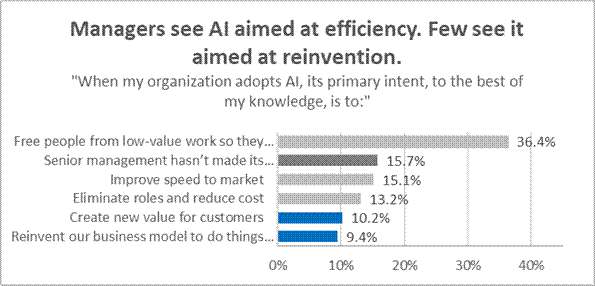
Data from FranklinCovey’s own survey of 1,480 professionals in the summer of 2026 supports this observation. When asked about their organization’s primary intent for AI adoption, managers overwhelmingly cited freeing employees from low-value tasks (efficiency-focused), nearly doubling the next highest response. In stark contrast, only a fraction of respondents (under 10%) indicated that reinventing the business model was their primary AI objective. This suggests a prevailing inclination towards incremental improvements rather than radical reinvention.
AI Implementation: Beyond the ERP Playbook
Historically, major technology deployments, such as Enterprise Resource Planning (ERP) or Customer Relationship Management (CRM) systems, offered a relatively clear roadmap. Organizations could anticipate timelines, costs, training requirements, and predictable outcomes.
However, the landscape of AI implementation is fundamentally different. No definitive playbook exists, not even for the leading research labs, whose own projections are subject to frequent revision. The inherent unpredictability of AI development means that past implementation strategies may not be directly applicable.
Furthermore, the unique nature of AI does not exempt it from the universal challenges that confront any strategic initiative. Inertia and resistance to change are persistent headwinds. Research into organizational execution consistently reveals that leaders tend to underestimate the powerful gravitational pull of daily operational demands—the urgent need to serve customers and meet quarterly financial targets. This "whirlwind" of immediate priorities frequently conflicts with breakthrough efforts, often proving victorious in ways that leaders may not fully anticipate or readily admit.
What Leaders Can Control: Building Resilient Organizational Capabilities
Despite the inherent uncertainties of the AI revolution, leaders retain significant control over crucial foundational elements of organizational readiness. These controllable factors are the bedrock upon which successful adaptation and transformation are built.
- Culture of Resilience: Leaders shape the fundamental nature and resilience of their organizational culture. This includes fostering an environment where individuals feel psychologically safe to propose innovative ideas, even those that carry a risk of failure.
- Trust and Transparency: The level of trust between the executive team and the front-line workforce, as well as among executives themselves, is a direct product of leadership actions. A culture of open communication and mutual respect is paramount.
- Execution Systems: Establishing robust systems for translating strategic decisions into tangible actions is critical. Without such mechanisms, new initiatives can easily dissipate when confronted with the demands of daily operations.
These controllable elements are analogous to having high-quality tires on a slippery road. They cannot prevent the adverse conditions from occurring, but they demonstrably increase the probability of a safe and successful arrival at the intended destination.
Navigating the Unknown: Resisting Premature Certainty and Stagnation
A crucial discipline for leaders in the AI era is to guide their organizations towards the right outcomes—those that are most aligned with the organization’s long-term future. This requires a delicate balance: avoiding paralysis by fear while also eschewing complacency and incrementalism.
The discourse surrounding AI’s impact has been marked by volatility. Six months prior to this analysis, a prevailing consensus suggested that AI would lead to widespread white-collar job displacement by 2028. Today, the same voices often describe a more gradual transition, while significant safety and ethical risks are drawing increased attention. The trajectory of the internet’s impact offers a historical parallel; in 1999, predictions about its future were largely inaccurate, with few foreseeing the rise of ridesharing apps, for instance, and many envisioning more literal interpretations of connectivity.
This dynamic underscores the need for intellectual humility. Leaders must possess the self-awareness to acknowledge the vast unknowns and the limitations of their current understanding. Steering an organization down a path that ultimately proves to be incorrect carries an inherent existential risk. Effective leadership involves ensuring that the team is not inadvertently driven into a strategic "ditch."
However, one certainty remains: a future where high trust is not a significant competitive asset is inconceivable. Looking ahead three years, no CEO is likely to regret having invested in building greater organizational capability, fostering deeper trust, and enhancing execution capacity. These are the enduring strengths that will empower organizations to navigate the most challenging terrain and emerge successfully on the other side of the AI-driven transformation.
