

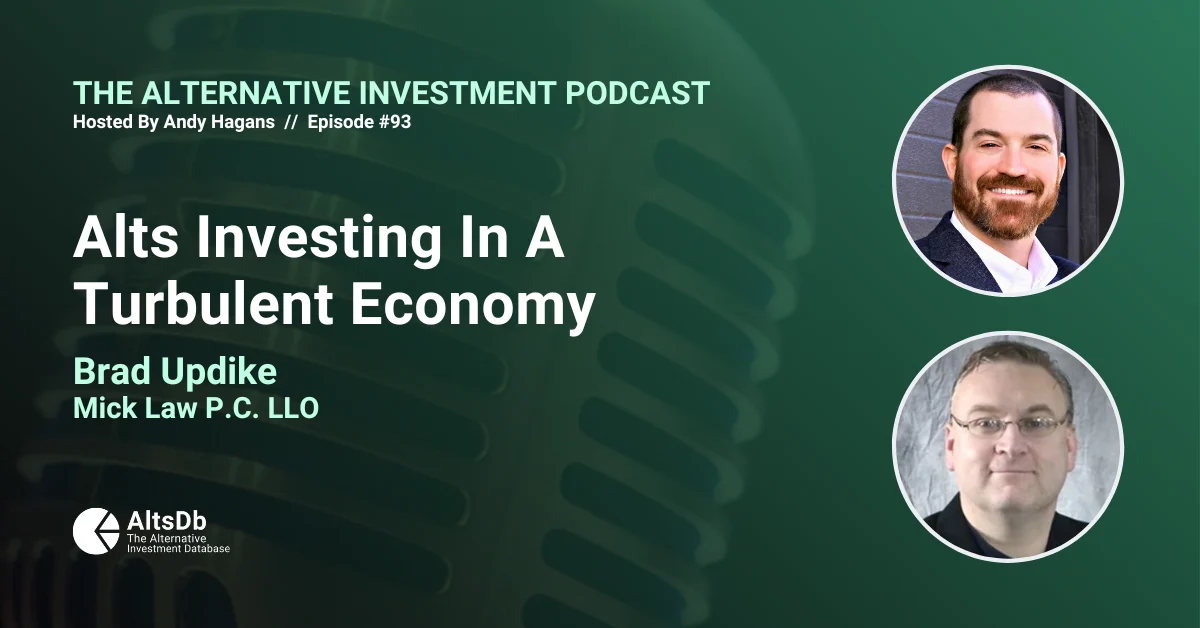
The landscape of alternative investments, encompassing private equity, venture capital, real estate, and more, presents a complex terrain for financial advisors tasked with allocating client funds. In recent years, this complexity has been amplified by a rapidly evolving market and a volatile global economy, creating new and significant challenges for wealth managers. To shed light on these issues, Brad Updike, an attorney at Mick Law P.C. LLO, joined "The Alternative Investment Podcast" to discuss the critical role of due diligence in alts investing for advisors navigating today’s turbulent economic climate.
Mick Law, based in Omaha, Nebraska, operates as a specialized law firm providing crucial underwriting and due diligence support. Their network spans approximately 300 broker-dealers, investment advisors, and family offices that actively raise capital in non-traded alternative investments, including debt and equity offerings. This expertise positions them as a vital resource for advisors who may not possess the internal capacity or time to conduct the exhaustive research required for these often intricate investments.
The fundamental difference between traditional and alternative investments underscores the necessity for rigorous due diligence. While publicly traded securities benefit from the oversight of stock exchanges, standardized reporting requirements, and extensive analyst coverage, the alternative investment sector operates with fewer regulatory touchpoints. As Updike explained, the public markets are characterized by highly capitalized firms whose debt and equity are readily traded. In contrast, the non-traded alternative sector involves products such as 1031 exchange offerings (DSTs, real estate LLCs and LPs, Qualified Opportunity Funds), oil and gas programs, and registered non-traded products like non-traded REITs and Business Development Companies (BDCs).
This distinction is not merely academic. The sheer volume of capital sought in the private placement market is substantial. Annually, an estimated 20,000 Form D filings are made by companies seeking approximately $1 trillion in debt and equity capital. While not all of these filings result in successful capital raises, a significant portion, roughly 15% to 20%, involve FINRA-regulated firms such as broker-dealers and investment advisors. Within specific sub-sectors, the activity is even more pronounced. For instance, in 2022, approximately $9.2 billion was raised through 40 different sponsors in the DST market, representing a 30% year-over-year increase. The oil and gas sector also experienced notable growth, with about $1.1 billion raised by a dozen companies covered by Mick Law, a 100% increase from 2021. Even Qualified Opportunity Funds, despite the phasing out of certain tax basis step-ups, continue to attract interest due to their remaining tax deferral benefits.
The core of due diligence in this space lies in bridging the gap left by the absence of readily available public information and standardized underwriting. Unlike public securities where investment banks conduct thorough research, interviews, risk assessments, and valuations before a security is priced and traded, private placements lack this pre-market scrutiny. Instead, broker-dealers and investment advisors are bound by stringent due diligence and suitability requirements. Mick Law’s role is to perform a comprehensive underwriting function, helping these firms determine if an offering warrants their consideration and, crucially, if it aligns with their clients’ investment objectives and risk tolerance.
Regulatory Frameworks and Fiduciary Duties
For financial advisors, particularly those operating under FINRA regulations or as Registered Investment Advisors (RIAs), understanding and adhering to due diligence requirements is paramount. While broker-dealers traditionally operate under a "suitability" standard, and RIAs under a "fiduciary" duty, the practical demands of due diligence often converge. FINRA Rule 2111 mandates that broker-dealers perform sufficient due diligence to ensure an investment is suitable for at least one type of investor. More recently, Regulation Best Interest (Reg BI) has further strengthened these requirements, obligating broker-dealers to understand and disclose conflicts of interest, fees, risks, and costs associated with all securities. This includes a comparative analysis of different investment opportunities.
Similarly, RIAs, bound by their fiduciary duty, must act in the client’s best interest. This inherently necessitates a deep understanding of any investment product placed in a client’s portfolio. While RIAs are not directly subject to FINRA rules, their fiduciary obligation compels them to conduct thorough research and analysis, essentially mirroring many of the due diligence steps required of broker-dealers. The objective is to ensure that the investment serves the client’s specific financial goals and risk profile.
Sponsor and Offering Diligence: A Two-Pronged Approach
A critical aspect of due diligence involves evaluating both the sponsor (the entity managing the investment) and the offering itself. Trust in a well-known sponsor with a long track record is often a factor, but this should not replace a comprehensive review. As Updike emphasized, even highly capitalized and experienced sponsors can face financial distress, a reality underscored by recent economic cycles and events like the COVID-19 pandemic, which exposed vulnerabilities in various real estate sectors.
Therefore, a dual approach is essential. Sponsor-level analysis focuses on the operational and financial capabilities of the management team to guide a program to a successful conclusion. Offering-level analysis, conversely, scrutinizes the fairness of the investment structure to investors, considering the risks, asset quality, and potential returns.
The shelf life of a sponsor-level review is typically two to four years. However, ongoing monitoring of financial statements, performance data, and any significant changes in a sponsor’s operations or market outlook is crucial. If substantial changes occur, more frequent sponsor-level due diligence may be warranted, potentially every 12 to 18 months.
The Due Diligence Framework Across Sectors
While the specific expertise required may vary, Mick Law employs a consistent framework for due diligence across different alternative investment sectors. This framework centers on five key areas:
- Risk of Execution Failure: Assessing the likelihood that the sponsor or offering will fail to meet its stated objectives.
- Reward Potential: Evaluating the expected returns under realistic and conservative assumptions.
- Quality of the Asset: Determining the intrinsic value and potential of the underlying assets.
- Disclosure of Material Risks: Ensuring that all significant risks are clearly and accurately disclosed in offering documents, such as the Private Placement Memorandum (PPM) and prospectus.
- Fairness to Investors: Examining investor rights, including access to financial information and voting rights.
A cornerstone of this process is the "alignment of interest test," a formula developed by Brian Mick, the firm’s founder. This test evaluates who is investing money, who is taking money out, and whether sponsor compensation is performance-based, providing insight into the alignment between investors, sponsors, and issuers.
Beyond legal and structural analysis, financial and investment analysis is integral. This includes engaging independent appraisers and, for sectors like oil and gas, reservoir engineers and geologists. While sponsors provide pro forma financial projections, Mick Law conducts its own independent underwriting, constructing its own pro formas by analyzing projected revenues, costs, sponsor compensation, and loads. The deviation between the sponsor’s pro forma and Mick Law’s independently derived pro forma can range from a narrow 5-10% for experienced sponsors with well-understood operational areas to significant divergences when sponsors’ assumptions are overly optimistic or based on cherry-picked outcomes.
Sector-Specific Diligence Approaches
While the core framework remains constant, the application varies by sector. For instance, oil and gas diligence involves specialized expertise from geologists and reservoir engineers to assess field conditions and production potential. Real estate diligence relies on appraisers and individuals with designations like CCIM to analyze markets and assets.
The timeline for diligence also differs. While real estate offerings, particularly DSTs and 1031 products, can often be completed within five to seven days, oil and gas diligence typically requires a more extended period of four to five weeks due to the complexity of technical assessments.
Navigating Current Economic Headwinds
The current economic climate presents significant headwinds for alternative investments. In the real estate sector, rising borrowing costs are a major concern. With prime lending rates surging from around 3.25% to 7.5% over a relatively short period, the cost of capital has dramatically increased. Coupled with persistent inflation, which has hovered around 6.5% to 7%, driving Net Operating Income (NOI) and supporting distributions has become increasingly challenging. This is reflected in declining cash-on-cash returns for some DST products, which have fallen from historical highs of 5-6.5% to around 3.99% in early 2023 for year-one returns.
When assessing these products, a holistic view is crucial. Advisors must consider the broader investment landscape and peer group performance, as mandated by regulations like Reg BI. While a specific sector may be experiencing compressed yields, the diligence process must still ascertain if the marketed yield is achievable and if the product can return capital within its intended holding period.
Rewarding Aspects of Due Diligence
Despite the rigorous nature of the work, certain aspects of due diligence can be particularly rewarding. Site visits, though often underappreciated, offer invaluable insights into a company’s operational pulse, staff morale, and management’s alignment with mission and goals. Interviews with bankers, contract vendors, and suppliers can also yield crucial, often candid, information about a sponsor’s reputation and financial stability, even if sponsors provide references they believe will speak favorably. The ability to extract critical information through skilled interviewing and information gathering is a key component of the job.
Common Pitfalls and Best Practices for Advisors
Mistakes in due diligence can have significant consequences. Historically, advisors have erred by attempting to pay yield on non-yielding businesses, failing to adequately assess the underlying assets’ capacity to support distributions. In oil and gas, over-reliance on outsourced services, particularly in geology and drilling, has proven less effective than vertically integrated sponsors who directly supervise field operations. A misunderstanding of prior performance, where past successes are not relevant to current strategies or market conditions, is another common pitfall. Transparency, including investor access to audits, quarterly financials, appraisals, and reserve reports, is also a critical factor.
Conversely, advisors and RIAs who excel in due diligence share common traits:
- Product Knowledge: A deep understanding of the investment products they offer, often enhanced by reviewing third-party due diligence reports.
- Ongoing Diligence: Regular and ongoing assessment of sponsors and offerings, ensuring that information remains current.
- Comparative Analysis: The ability to differentiate between competing products and understand their relative strengths and weaknesses.
- Client Focus: A steadfast commitment to knowing their clients and treating them fairly, ensuring investments are appropriate for individual circumstances.
These best practices, coupled with a thorough understanding of regulatory requirements and the economic landscape, are essential for navigating the complexities of alternative investments successfully. As the alternative investment industry continues to mature and grow, the importance of robust, independent due diligence remains a cornerstone of responsible financial advising.
