

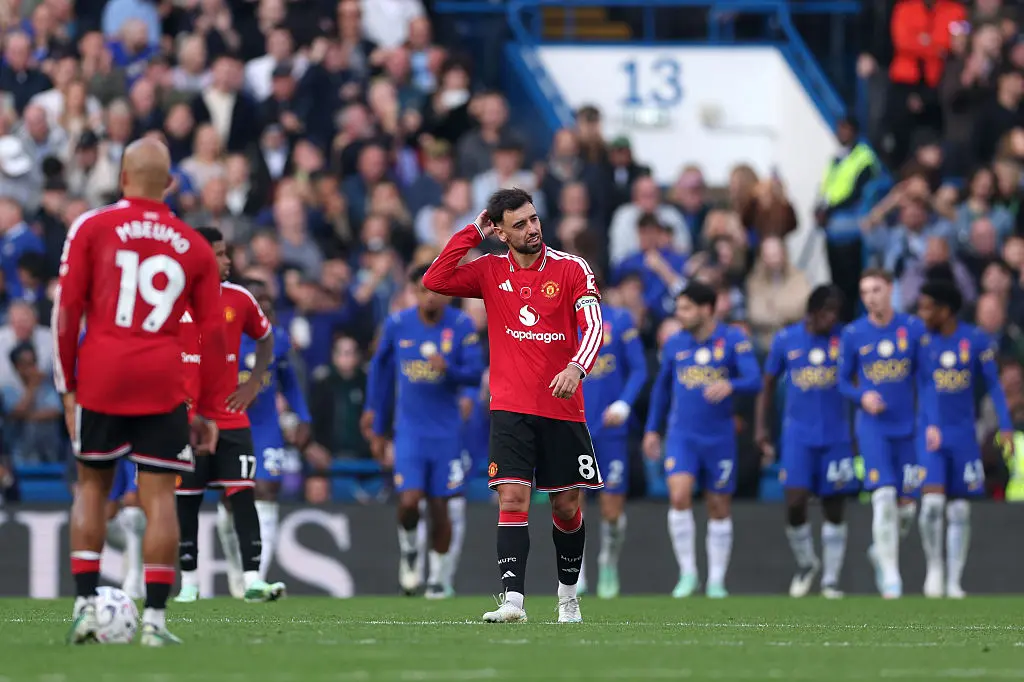
The precarious tenure of Michael Carrick as Manchester United manager appears to be reaching a definitive conclusion following a demoralizing 2-0 defeat to Chelsea at Stamford Bridge on Saturday afternoon. Despite surviving a wave of speculation regarding his job security earlier in the week, Carrick watched his side implode during a second-half collapse that left the 20-time English champions hovering just one point above the Premier League relegation zone. Goals from Morgan Rogers and Cole Palmer secured the three points for the London side, while United’s afternoon was further marred by a red card for defender Lisandro Martinez, whose disciplinary lapse effectively ended any hopes of a late comeback.
The result marks Manchester United’s ninth consecutive match without a victory across all competitions, a run of form that has seen the club plummet down the domestic table and struggle significantly in European competition. With a crucial Champions League fixture against Roma looming on Tuesday, the club’s hierarchy, led by the INEOS sporting department, now faces a pivotal decision regarding whether to allow Carrick to lead the team into another high-stakes encounter or to implement an emergency change in leadership to salvage what remains of a crumbling season.
A Tale of Two Halves: Wastefulness Followed by Collapse
The encounter at Stamford Bridge began with a surprising level of intensity from the visitors. Seeking to prove that he still commanded the respect and effort of his dressing room, Carrick recalled club captain Bruno Fernandes to the starting lineup. Fernandes had been notably omitted from the squad during last weekend’s 3-0 home defeat to Bournemouth, a decision that followed the Portuguese midfielder’s public criticism of Carrick’s tactical approach after a humiliating 4-1 loss to Como in the Champions League.
United’s early tactical setup seemed designed to catch Chelsea on the break, utilizing the pace of Amad Diallo and the delivery of Bryan Mbeumo. For much of the first 45 minutes, the strategy appeared to be working. Fernandes, eager to make amends for his recent exile, found himself with a golden opportunity to open the scoring when he met an inviting cross from Mbeumo. However, the captain’s composure failed him as he blazed his effort over the crossbar from close range.
The missed opportunities continued to mount for United. Mbeumo was inches away from connecting with a dangerous Fernandes delivery at the back post, and young winger Amad Diallo forced two impressive saves from Chelsea’s stand-in goalkeeper, Mike Penders. The frustration for the traveling supporters reached a peak when United briefly thought they had taken the lead; Matheus Cunha turned in a Harry Maguire header following a corner, but the celebrations were cut short by the assistant referee’s flag. A subsequent VAR review confirmed that the Brazilian forward had strayed into an offside position.
The Rogers Blow and the Martinez Meltdown
The optimism of the first half evaporated within five minutes of the restart. Morgan Rogers, the England international who previously worked under Carrick during a successful stint at Middlesbrough, proved to be the architect of his former mentor’s downfall. Collecting the ball in the center circle, Rogers was afforded an inexplicable amount of space by the United midfield. He drove directly at the heart of a retreating defense, weaving past two challenges before expertly dinking the ball over the advancing Senne Lammens to make it 1-0 in the 50th minute.
If the opening goal was a tactical failure, the events that followed were a complete breakdown in discipline. Lisandro Martinez, who has been vocal in the media recently regarding the club’s perceived lack of investment in the transfer market, endured a catastrophic ten-minute spell. Struggling to cope with the physicality and speed of Rogers, Martinez was first booked for a cynical pull-back on the Chelsea forward.
Shortly after, the Argentine international’s afternoon went from bad to worse. During a Chelsea free-kick, Martinez needlessly crashed into Wesley Fofana with a raised forearm. Referee Peter Banks was initially unmoved, but after a consultation with the VAR booth and a review of the pitchside monitor, he awarded Chelsea a penalty and brandished a second yellow card for Martinez. Cole Palmer, Chelsea’s talisman, stepped up to the spot. While Lammens managed to get a hand to the strike, the power was sufficient to carry the ball into the bottom corner, doubling the Blues’ lead and effectively ending the contest.
Statistical Breakdown: A Club in Freefall
The data surrounding Manchester United’s current campaign paints a bleak picture for a club of its stature. The defeat to Chelsea leaves them with a record that is statistically their worst start to a top-flight season in over four decades.
- Winless Streak: 9 games (6 losses, 3 draws).
- Defensive Frailty: United have conceded 14 goals in their last five Premier League outings.
- Goal Scarcity: Despite creating 1.8 Expected Goals (xG) in the first half against Chelsea, the team has failed to score in three of their last four league games.
- League Position: 17th place, just one point ahead of the bottom three.
The disciplinary record is equally concerning. Martinez’s red card is the fourth dismissal for a United player this season, suggesting a lack of composure and leadership on the pitch that mirrors the uncertainty in the dugout.
Tactical Context: The Xabi Alonso Influence
Chelsea, under the guidance of Xabi Alonso, demonstrated a level of tactical maturity that United lacked. Alonso, who has transformed the Blues into a possession-based juggernaut since his arrival, opted for a rotated squad, giving a rare start to the Brazilian sensation Estevao. The youngster thought he had added a third goal late in the game after a slick passing move involving Palmer, only for the goal to be ruled out for a marginal offside.
Alonso’s ability to integrate young talents like Rogers and Estevao contrasts sharply with Carrick’s struggles to find a settled XI. While Chelsea fans spent the final twenty minutes of the match chanting "sacked in the morning" toward the United bench, the home side toyed with their opponents, maintaining 72% possession in the final quarter of the match as United’s ten men chased shadows.
Internal Strife and Boardroom Dilemmas
The pressure on Carrick is not merely a result of on-field scores but also a reflection of a fractured dressing room. The public disagreements with senior figures like Bruno Fernandes and Lisandro Martinez suggest that the manager has lost the "buy-in" required to navigate a crisis. Martinez’s recent comments about the squad’s lack of depth were seen by many as a veiled shot at the recruitment strategy, yet his own performance at Stamford Bridge highlighted that the existing personnel are failing to meet basic standards.
The United hierarchy, led by Sir Jim Ratcliffe and the sporting directorate, now finds itself in a precarious position. The financial implications of the current trajectory are staggering. An exit from the Champions League group stage—which looks increasingly likely following two losses in three games—would result in a loss of approximately £40-50 million in projected revenue. Furthermore, the unthinkable prospect of a relegation battle would trigger various "fail-safe" clauses in sponsorship deals, particularly with Adidas and TeamViewer, further crippling the club’s ability to rebuild in the summer.
The Road Ahead: Roma and the "Old Trafford Ultimatum"
Manchester United return to the North West tonight with the shadow of the axe hanging over Michael Carrick. The club’s communications department has remained silent following the Chelsea defeat, a move often interpreted in footballing circles as a sign that internal deliberations are underway.
The immediate focus is the Tuesday night clash against Roma at Old Trafford. For United, it is a "must-win" in every sense of the word. A defeat would not only likely end their Champions League aspirations but would also solidify the feeling that the current coaching staff is incapable of arresting the slide.
Potential replacements have already been discussed in the media, with names like Graham Potter, Gareth Southgate, and Thomas Frank frequently linked to the role. However, the club’s leadership is reportedly hesitant to appoint an interim manager if a long-term target is not immediately available.
Conclusion: A Club at a Crossroads
The 2-0 loss at Chelsea was more than just a defeat; it was a symptom of a club that has lost its identity and tactical direction. Michael Carrick, a servant of the club who was initially hailed as a stabilizing force, now finds himself as the face of a historic decline. As the Chelsea fans’ chants echoed around Stamford Bridge, the reality became clear: Manchester United is a club in a state of emergency.
Whether Carrick is given the Roma game to save his career or is relieved of his duties in the coming hours, the systemic issues at Old Trafford—ranging from player indiscipline to recruitment failures—ensure that whoever occupies the dugout will face one of the most difficult rebuilding jobs in modern football history. For now, the 20-time champions sit precariously near the foot of the table, a giant of the game reduced to a cautionary tale of mismanagement and missed opportunities.
