

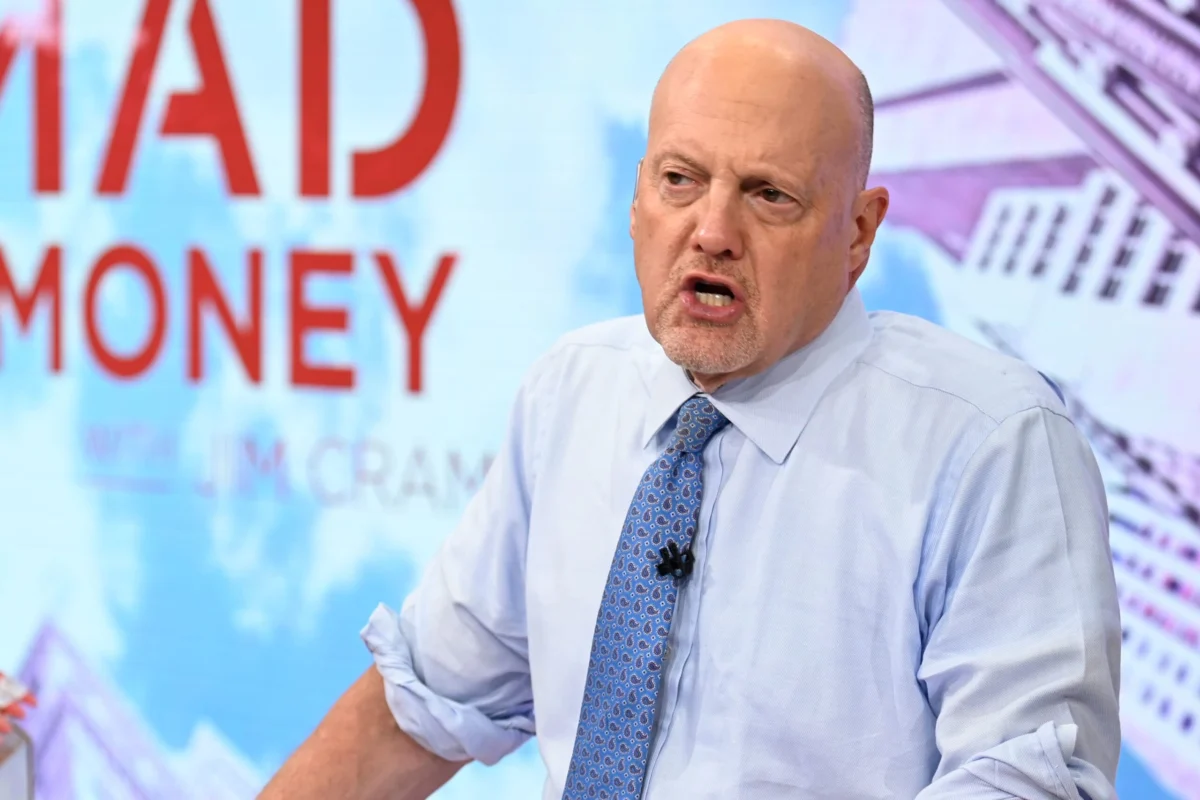
On a recent Wednesday, financial markets witnessed a significant downturn across all major indices, prompting CNBC’s Jim Cramer to articulate a pronounced shift in investor sentiment: a distinct movement away from the market’s riskier segments towards traditionally defensive assets. The day concluded with the Dow Jones Industrial Average plummeting 953 points, a 1.87% decline, while the S&P 500 and Nasdaq Composite followed suit, dropping 1.62% and 1.98% respectively. These broad market losses, however, belied a more fundamental re-evaluation of risk, as highlighted by Cramer, host of "Mad Money." His analysis pointed to a market grappling with an "appetite for danger" that has seemingly evaporated, signaling a profound rotation of capital.
The Day’s Market Performance: A Deeper Dive into Widespread Declines
The collective decline across the Dow, S&P 500, and Nasdaq underscored a pervasive sense of apprehension among investors. The Dow Jones Industrial Average, typically seen as a barometer for large, established industrial companies, experienced one of its more significant single-day point drops, reflecting concerns that extended beyond speculative growth sectors. The S&P 500, which encompasses a broader cross-section of the U.S. economy, mirrored this sentiment, indicating that the pressures were not isolated to a few industries but were systemic. Meanwhile, the Nasdaq Composite, heavily weighted towards technology and growth stocks, recorded the steepest percentage decline, a stark indicator of the cooling enthusiasm for high-valuation, future-oriented companies.
These movements were not arbitrary. They unfolded against a backdrop of mounting economic uncertainties, including persistent inflation, the specter of aggressive interest rate hikes by the Federal Reserve, and growing fears of a potential economic slowdown or recession. Such an environment naturally prompts a re-evaluation of investment portfolios, pushing capital away from assets sensitive to economic fluctuations and towards those perceived as more resilient.
Cramer’s "Flight to Safety" Thesis: A Market in Retreat
Jim Cramer’s pronouncement that "This is a market that’s lost its appetite for danger" encapsulates the prevailing mood. His observation goes beyond mere price movements, delving into the underlying psychology driving investment decisions. The "flight to safety" is a well-documented market phenomenon where investors, faced with increased uncertainty or perceived risk, reallocate their capital from volatile, high-growth assets to more stable, often lower-yielding, but secure investments. Cramer unequivocally stated, "This market’s in flight. It doesn’t want a lot of risk."
Historically, periods of economic stress, rising interest rates, or heightened geopolitical tensions have triggered such rotations. Investors typically seek refuge in assets that offer stable cash flows, consistent dividends, and businesses whose demand is less cyclical or sensitive to economic downturns. This contrasts sharply with the preceding years, where investors were rewarded for chasing aggressive growth stories, often prioritizing potential future earnings over current profitability or balance sheet strength.
Evidence from 52-Week Highs: A Sectoral Analysis Reveals the Shift
The most compelling evidence for Cramer’s thesis came from the composition of the S&P 500’s list of stocks hitting 52-week highs on that Wednesday. Far from being dominated by the innovative, high-flying technology firms that had led the market for years, this list was predominantly populated by sectors traditionally regarded as defensive.
Defensive Dominance: The Rise of Stability
- Real Estate Investment Trusts (REITs): REITs are companies that own, operate, or finance income-producing real estate. They are legally required to distribute at least 90% of their taxable income to shareholders annually in the form of dividends, making them attractive to income-seeking investors. In an uncertain economic climate, REITs often provide a measure of stability due to their tangible asset backing and consistent income streams, particularly those focused on essential services like healthcare facilities, data centers, or logistics properties. Their presence on the 52-week high list signals a preference for stable yield over speculative growth.
- Insurers: The insurance sector is another classic defensive play. Companies in this industry generate steady revenue from premiums and are often less impacted by economic cycles because demand for insurance products remains relatively constant. Their business model relies on careful risk assessment and consistent cash generation, making them appealing during periods of market volatility. Their inclusion on the list highlights a demand for robust, reliable businesses.
- Consumer Staples: These are companies that produce goods and services considered essential for daily living, regardless of the economic climate. Products like food, beverages, household goods, and personal care items see relatively stable demand, making companies like Procter & Gamble, Coca-Cola, or PepsiCo resilient during downturns. Their consistent earnings and dividend payouts offer a safe harbor for investors.
- Other Lower-Risk Businesses: This category broadly includes companies with mature business models, strong balance sheets, predictable earnings, and often a history of paying dividends. These businesses are typically less susceptible to sudden shifts in consumer trends or technological disruption, offering a sense of security.
Cramer specifically pointed to two stocks from his Charitable Trust, Linde (LIN) and TJX Companies (TJX), both appearing on the 52-week high list. Linde, a global industrial gas and engineering company, benefits from stable demand across various industries (healthcare, manufacturing, chemicals), providing consistent revenue. TJX Companies, the parent company of T.J. Maxx and Marshalls, operates in the off-price retail segment. This model often thrives even during economic slowdowns as consumers become more value-conscious, making it a resilient performer. Their inclusion further validated the defensive rotation.
Tech’s Retreat: Exceptions to the Rule
In stark contrast to the preceding years, technology-related companies were notably scarce on the 52-week high list. For over a decade, the tech sector, particularly giants in software, e-commerce, and cloud computing, had been the undisputed market leaders, driving significant returns for investors. Their valuations often hinged on future growth potential, sometimes with little current profitability, making them highly sensitive to changes in discount rates and economic outlook.
However, there were exceptions. Applied Materials (AMAT) and KLA Corp (KLAC), both semiconductor equipment makers, made the list. These companies are crucial suppliers to the semiconductor industry, which continues to benefit from robust, long-term demand for memory chips and advanced computing components across various applications, from artificial intelligence to data centers and consumer electronics. Their strength underscores a nuanced perspective within tech: while speculative, high-growth tech may be out of favor, foundational technology infrastructure providers with strong order books and critical roles in ongoing digital transformation remain attractive. This indicates that investors are not shunning all tech, but rather discerning between foundational, demand-driven segments and those with more speculative growth trajectories.
Historical Context: The Tech Boom and Its Fading Luster
To fully appreciate the significance of this market rotation, it’s essential to contextualize it within the broader history of market leadership. For much of the 2010s and into the early 2020s, technology stocks, often exemplified by the "FAANG" cohort (Facebook/Meta, Apple, Amazon, Netflix, Google/Alphabet), reigned supreme. This era was characterized by ultra-low interest rates, abundant liquidity, rapid technological innovation, and a global shift towards digital platforms. Investors flocked to companies promising exponential growth, disruptive technologies, and expanding market share, often prioritizing revenue growth over profitability, and accepting high valuation multiples.
The narrative was compelling: invest in the future, embrace innovation, and ride the wave of digital transformation. This environment fostered a "growth at any cost" mentality, where companies that could demonstrate hyper-growth, even if unprofitable, were handsomely rewarded. The low-interest-rate regime meant that future earnings were discounted less severely, boosting the present value of these growth stocks.

However, this dynamic began to shift as macroeconomic conditions evolved. Towards the latter half of the specified period, inflation, which had been dormant for years, began to surge. This prompted central banks, most notably the U.S. Federal Reserve, to signal and then implement a series of aggressive interest rate hikes. Higher interest rates fundamentally change the valuation landscape. They increase the cost of borrowing for companies, tightening financial conditions, and, crucially, they increase the discount rate applied to future earnings, thereby reducing the present value of growth stocks whose profits are often projected far into the future. This "stark departure" Cramer alluded to marks an end to an era where growth alone could command premium valuations, ushering in a new focus on profitability, stable cash flows, and value.
Economic Headwinds and the Search for Stability
The current market environment is heavily influenced by a confluence of significant economic headwinds, driving the investor pivot towards stability. These factors create an "uncertain economic environment" that makes defensive assets more appealing:
- Inflationary Pressures: Elevated inflation, fueled by supply chain disruptions, strong consumer demand, and geopolitical events (like the war in Ukraine impacting energy and commodity prices), erodes purchasing power and corporate profit margins. Companies in defensive sectors, often with strong pricing power or less volatile input costs, tend to weather inflationary periods better.
- Interest Rate Hikes: The Federal Reserve’s commitment to taming inflation through aggressive monetary tightening is a primary concern. Rising interest rates directly impact the cost of capital for businesses, reduce consumer spending power, and make "safer" fixed-income investments more attractive, drawing capital away from equities, particularly growth stocks. The expectation of further hikes creates ongoing uncertainty.
- Recession Fears: Many economic indicators, such as inverted yield curves (where short-term Treasury yields exceed long-term yields), slowing GDP growth forecasts, and declining consumer confidence, have stoked fears of a looming recession. In such scenarios, companies providing essential goods and services (consumer staples) or stable income streams (REITs, utilities) are generally more resilient than those tied to discretionary spending or cyclical industrial activity.
- Geopolitical Instability: Global events, including conflicts and trade tensions, introduce additional layers of risk, impacting supply chains, commodity prices, and overall market sentiment. This unpredictability encourages a more conservative investment approach.
These macro factors directly feed into Cramer’s observation that investors "want safety, they want yield, and maybe they’re just sick and tired of the data center and the fast growers that now grow more slowly and represent too much risk." The allure of stable dividends and businesses capable of holding up in a more challenging economic climate has become paramount.
Implications for Investors: Rebalancing and Strategic Shifts
The ongoing market rotation carries significant implications for various types of investors, necessitating a potential re-evaluation of portfolio construction and investment strategies.
- Portfolio Rebalancing: Investors whose portfolios have been heavily concentrated in high-growth technology stocks, which performed exceptionally well in the preceding low-interest-rate environment, may need to consider rebalancing. Diversification across sectors, particularly by increasing exposure to defensive industries, becomes crucial to mitigate risk and capture potential returns from the new market leadership.
- Investment Strategies: The shift favors value investing and income-generating strategies over pure growth. Value stocks, characterized by lower price-to-earnings ratios and often strong fundamentals, tend to outperform when interest rates rise and economic growth slows. Dividend-paying stocks, particularly those with a history of consistent payouts and strong balance sheets, become highly attractive for their income generation, which can provide a cushion against market volatility.
- Sectoral Performance Outlook: While some high-growth tech companies might continue to face headwinds due to valuation adjustments and tighter monetary policy, defensive sectors such as consumer staples, utilities, healthcare, and certain segments of real estate and financials could see continued strength. This doesn’t imply an end to innovation, but rather a more discerning market that prioritizes tangible earnings and resilience.
- Long-Term vs. Short-Term: The question remains whether this is a temporary rotation or a longer-term structural shift. Many analysts suggest that with inflation potentially remaining sticky and interest rates normalizing to higher levels than the post-2008 era, the market might be entering a prolonged period where value and defensive strategies hold an advantage over aggressive growth plays. This implies a need for a more fundamentally driven investment approach, focusing on profitability, free cash flow, and balance sheet strength rather than purely on revenue growth.
- Importance of Fundamentals: In an environment where the cost of capital is rising, companies with strong balance sheets, consistent earnings, and efficient operations are better positioned to weather economic storms. Investors are increasingly scrutinizing these fundamentals, moving away from speculative narratives towards businesses with proven resilience.
Analyst Consensus and Broader Market Sentiment
Jim Cramer’s observations resonate with a growing chorus of market strategists and institutional investors. Many financial analysts have echoed similar sentiments, noting a discernible shift in capital flows. Investment banks and asset management firms have been increasingly advising clients to diversify their portfolios, reduce exposure to speculative growth, and consider sectors known for their stability and dividend yields. Reports from institutional fund managers suggest a conscious effort to de-risk portfolios, reflecting a broad consensus that the market landscape has fundamentally changed. The narrative has indeed moved from celebrating disruptive innovation at any cost to valuing resilient business models capable of navigating economic turbulence.
Conclusion
The market’s recent movements, as keenly observed by Jim Cramer, underscore a significant pivot in investor behavior. The widespread decline in major indices, coupled with the surprising composition of stocks hitting 52-week highs, paints a clear picture of a market in "flight," actively seeking safety, yield, and stability. Driven by persistent inflation, rising interest rates, and mounting recession fears, investors are re-evaluating their appetite for risk, moving away from the high-growth, often unprofitable, technology darlings of yesteryear towards more conservative, fundamentally sound businesses in defensive sectors. This shift marks a stark departure from recent market leadership and suggests a potentially enduring change in investment priorities, where prudence, stable cash flows, and resilient business models are once again paramount in navigating an uncertain economic future. The market has spoken, demanding safety and yield, and investors are adapting to this new reality.
