

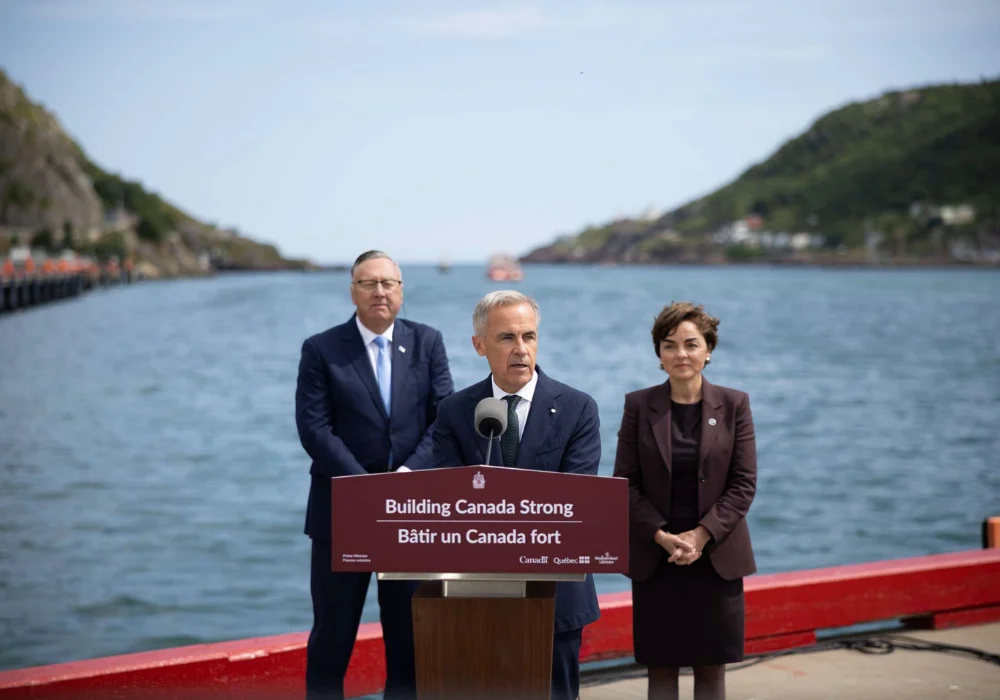
After eighteen months in office, the administration led by Prime Minister Mark Carney has begun to solidify its unique approach to Canada’s environmental and economic future, signaling a definitive departure from the policies of the previous Trudeau government. While the transition was initially characterized by broad rhetoric regarding "Forward Guidance" for the nation, the emergence of specific policy frameworks and bilateral agreements with provinces like Alberta has provided a clearer picture of the Carney climate doctrine. This strategy, which attempts to bridge the gap between traditional energy production and an aggressive transition to a low-carbon economy, now faces intense scrutiny as Parliament prepares to resume. The central question remains whether the government’s recalibrated commitments—ranging from industrial carbon market reforms to ambitious electric vehicle (EV) targets—are sufficient to meet Canada’s international obligations under the Paris Agreement and the domestic goal of net-zero emissions by 2050.
The Strategic Shift: From Intent to Implementation
Upon taking office, Prime Minister Carney sought to frame his climate policy not as a rejection of previous efforts, but as a necessary evolution. In several public addresses, Carney has acknowledged that while the Trudeau-era plans were well-suited for their time, the shifting global economic landscape and the accelerating pace of climate change necessitated a more "market-oriented and pragmatic" approach. This pivot is most visible in the government’s efforts to harmonize federal environmental goals with provincial economic interests, particularly in Western Canada.
The cornerstone of this new direction is a series of Memorandums of Understanding (MOUs) and bilateral partnerships. These agreements aim to de-escalate the jurisdictional friction that defined Canadian climate politics for the past decade. However, analysts from the Canadian Climate Institute and other policy observers note that this cooperative approach has come with trade-offs, specifically regarding the stringency of industrial regulations and the pace of the federal carbon pricing rollout.
Reforming the Industrial Carbon Market
A primary pillar of the Carney climate plan is the creation of what the Prime Minister describes as "a carbon market that actually works." This focus is central to the federal government’s current agreement with Alberta. Industrial carbon pricing is designed to incentivize heavy emitters to reduce their carbon footprint by placing a price on every tonne of greenhouse gas emitted above a certain threshold. When functioning correctly, this system allows companies that reduce emissions below the threshold to earn credits, which can then be sold to other emitters.
Data suggests that industrial carbon pricing can be highly effective, reducing substantial emissions at a minimal cost to the overall economy. In the oil sands, for instance, the cost of carbon pricing has been estimated to be less than the price of a coffee per barrel. Despite this potential, the Carney government’s reforms have met with mixed reviews. Multiple analyses indicate that the modifications made to Alberta’s industrial carbon market under the current MOU have not yet put the system on firm national footing. Since the signing of the agreement, the price of carbon credits in Alberta has actually experienced a decline, suggesting a surplus of credits or a lack of demand that undermines the incentive to decarbonize. Critics argue that while the Carney administration inherited a system in need of repair, the current adjustments have yet to provide the long-term price certainty required for large-scale capital investment in carbon capture and storage (CCS) and other abatement technologies.
The 75 Percent Electric Vehicle Target and Auto Sector Transformation
The Carney government has set one of the most ambitious automotive targets in the G7, aiming for a 75 percent electric vehicle adoption rate for new light-duty vehicle sales by 2030, rising to 90 percent by 2040. This commitment was the centerpiece of a new automotive strategy intended to transform Canada into a global hub for EV manufacturing and battery technology.
However, the path to these targets has been convoluted. Shortly after the election, the government moved to repeal existing EV mandates established by the previous administration, citing the need for a more flexible, "made-in-Canada" standard. This decision led to a period of policy vacuum that industry experts say has made the 75 percent goal significantly more difficult to achieve. The delay in implementing the new federal standard has caused uncertainty among automakers and consumers alike. Current projections from the Canadian Climate Institute suggest that the preliminary details of the new automotive strategy may not be robust enough to drive the necessary market shifts to meet the 2030 threshold. To reach these goals, Canada would require a massive expansion of charging infrastructure and more aggressive consumer incentives, areas where federal spending has yet to match the scale of the ambition.
Canada as a "Clean and Conventional" Energy Superpower
One of the most frequently used phrases in the Carney government’s lexicon is the goal of turning Canada into a "clean and conventional" energy superpower. This dual-track approach seeks to maintain Canada’s status as a leading exporter of oil and natural gas while simultaneously scaling up renewable energy production. In his "Forward Guidance" address, Carney invoked the legacy of Sir Adam Beck, the pioneer of Ontario’s hydroelectric power, calling for a build-out of clean energy on a scale that would "astound" the nation’s founders.
Significant progress was made in mid-2026 with the announcement of a landmark clean-energy agreement between the federal government, Quebec, and Newfoundland and Labrador regarding the Churchill Falls hydroelectric project. This agreement is seen as a vital step in creating a more integrated and carbon-free Atlantic power grid. However, while the "conventional" side of the energy equation continues to receive billions in public support and subsidies for decarbonization, the "clean" side remains unevenly developed across the country. The government faces the challenge of reconciling its support for expanded fossil fuel infrastructure with its commitment to a net-zero grid by 2035.
Sustainable Finance and the 2025 Budget Commitments
Recognizing that the transition to a low-carbon economy requires trillions of dollars in private capital, the Carney government made "Made-in-Canada sustainable investment guidelines" a central feature of Budget 2025. This initiative aims to create a clear taxonomy for what constitutes a "green" or "transition" investment, providing investors with the clarity needed to fund decarbonization projects without the risk of "greenwashing."
The federal government has tasked the Canadian Climate Institute and Business Future Pathways to develop these guidelines through a collaborative process involving the financial sector, industry, and environmental experts. A draft report published in July 2027 proposed a framework for action, with the final guidelines expected to be published and integrated into federal financial regulations by 2027. This framework is also expected to align with a new sustainable bond framework, allowing the federal government to issue debt specifically targeted at climate-resilient infrastructure. Proponents argue that these guidelines will solidify Canada’s position as a leader in sustainable finance, leveraging Carney’s own professional background in global banking to attract international investment.
The Net-Zero 2050 Mandate: A Reality Check
The ultimate benchmark for the Carney government is the legally binding commitment to achieve net-zero emissions by 2050. This goal was explicitly included in the final text of the MOU with Alberta, a symbolic victory for federal-provincial cooperation. However, the gap between policy commitments and emissions trajectories remains a point of contention.
Current data from the 440 Megatonnes project suggests that despite the flurry of announcements and new frameworks, Canada’s national emissions have not yet begun the steep decline required to meet the 2030 or 2050 targets. The impact of the 2026 and 2027 wildfire seasons—among the most destructive on record—has added a sense of physical urgency to the political debate. These wildfires have not only displaced tens of thousands of Canadians but have also released massive amounts of carbon dioxide, further complicating the government’s path to its net-zero goals.
Chronology of Key Climate Policy Milestones (2025–2027)
- November 2025: Prime Minister Carney announces a new partnership with the Government of Alberta, signaling a shift toward a cooperative industrial carbon pricing model.
- December 2025: The federal government releases "Budget 2025," which includes the first formal pledge for a Made-in-Canada sustainable investment taxonomy and new subsidies for clean technology.
- May 2026: Canada and Alberta sign a secondary agreement focused on diversifying energy exports and reducing the methane intensity of conventional oil and gas production.
- July 2026: At the First Ministers Meeting, Carney delivers a keynote address outlining the "Forward Guidance" strategy, emphasizing hydroelectricity and grid modernization.
- December 2026: The government officially repeals the 2023 Electric Vehicle Availability Standard, promising a replacement "Automotive Transformation Strategy" by mid-2027.
- July 2027: The Canadian Climate Institute and Business Future Pathways release the first draft of the sustainable finance taxonomy for public comment.
Implications and Outlook
The Carney government’s climate strategy represents a high-stakes gamble that a more collaborative, market-centric approach can succeed where previous, more interventionist policies faced political and legal hurdles. By focusing on sustainable finance and industrial carbon markets, the administration is attempting to use the tools of global capital to drive domestic environmental progress.
However, the reliance on provincial cooperation, particularly with Alberta, introduces significant political risk. If industrial carbon prices continue to stagnate or if the new EV standards fail to catalyze the market, the government may find itself unable to meet its 2030 interim targets. Furthermore, the "clean and conventional" strategy requires a delicate balancing act that may struggle to satisfy either the energy industry or environmental advocates.
As Parliament returns to Ottawa, the focus will shift from the "intent" of the Carney administration to the "impact" of its policies. With the 2030 deadline approaching, the government will be pressured to prove that its new course is more than just a change in tone—and that it can deliver the measurable emissions reductions that have eluded previous administrations. The coming year will likely determine whether the "Carney Doctrine" can provide a durable foundation for Canada’s economic and environmental future or if the country remains on a trajectory that falls short of its net-zero ambitions.
