

Mike Kesner, Partner, and Annie Chen, Consultant, at Pay Governance LLC, offer insights into the SEC’s proposed amendments to Non-Accelerated Filer (NAF) status and Emerging Growth Company (EGC) accommodations, based on their firm’s analysis of submitted public comments and the SEC’s Executive Compensation Disclosure Roundtable. The analysis reveals a clear investor preference for enhancing the usability and clarity of executive compensation disclosures rather than reducing them, particularly for smaller public companies.

The Securities and Exchange Commission’s (SEC) recent proposals aimed at expanding Non-Accelerated Filer (NAF) status and broadening accommodations for Emerging Growth Companies (EGCs) have elicited a nuanced response from the investment community. While the formal comment period for these proposed amendments, alongside discussions from the SEC Executive Compensation Disclosure Roundtable, has closed, the insights gleaned from the submissions paint a consistent picture: investors largely support modernization and simplification of disclosure, but not at the expense of transparency and robust governance oversight. This analysis, spearheaded by Pay Governance LLC’s experts Mike Kesner and Annie Chen, delves into the key themes emerging from these comments, highlighting a prevailing sentiment that favors enhanced, rather than diminished, information for informed investment decisions.
The SEC’s initiative to potentially redefine NAF status and expand EGC exemptions stems from a desire to reduce regulatory burdens and costs for smaller public companies. However, the investor feedback suggests that such broad-stroke deregulation might overlook the critical role these disclosures play in investor decision-making, particularly concerning executive compensation, a key determinant of corporate governance and performance.
The Quiet Before the Storm: A Notable Absence of Major Investor Voices
A striking observation from the comment process was the relative silence from some of the world’s largest asset managers and institutional investors. While the Investment Company Institute (ICI), a prominent association representing a vast segment of the asset management industry, did submit comments, its broad advocacy for reform while cautioning against the elimination of essential disclosures does not definitively represent the specific stances of all its influential members. This absence leaves a degree of uncertainty regarding the precise views of major index fund managers and institutional holders of U.S. equities, who collectively wield significant influence over corporate practices. Their lack of direct engagement could be interpreted in various ways, from implicit agreement with the ICI’s balanced approach to a strategic wait-and-see attitude, potentially reserving their influence for later stages of rule finalization or through direct engagement with portfolio companies.
A Unanimous Call for Transparency, Not Erosion
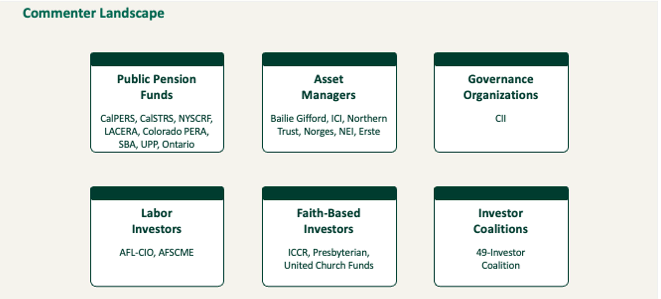
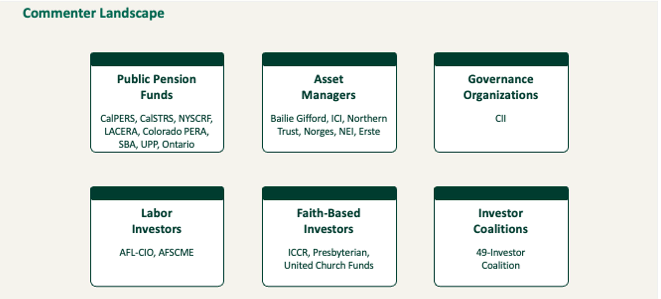
Despite the varied backgrounds of those who did submit comments—ranging from public pension funds and asset managers to labor-affiliated and faith-based investors, as well as international institutions—a powerful consensus emerged. Across the board, these respondents expressed a unified commitment to transparency, advocating for improvements rather than reductions in disclosure requirements. This collective voice underscores the fundamental importance investors place on having comprehensive and accessible information to fulfill their fiduciary duties and make sound investment decisions.
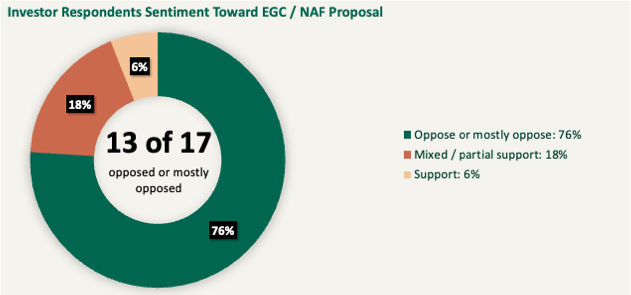
The comment letters, numbering 17 for the EGC proposal and 10 for the Roundtable submissions, consistently pointed towards a desire for simplification that enhances usability, not for the wholesale elimination of disclosures that are crucial for governance and voting decisions. This theme was particularly evident in the context of the Compensation Discussion and Analysis (CD&A), Say-on-Pay votes, perquisite disclosures, and auditor attestations, all of which were identified as vital tools for investors.
Key Investor Concerns and Recommendations
The analysis by Pay Governance LLC identified several critical themes that permeated the investor feedback:
Theme 1: The Nuance of Simplification – Modernization, Not Deregulation
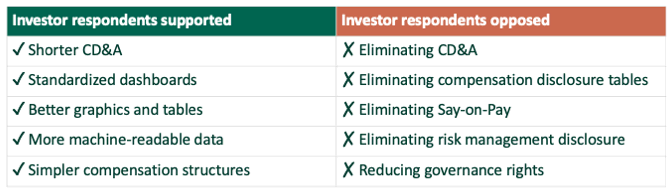
A central tenet of the investor response was the strong support for simplifying and modernizing executive compensation disclosures. However, this support was consistently coupled with a firm stance against deregulation that would diminish transparency. Investors are not opposed to making disclosures easier to understand and digest; in fact, they actively seek it. The challenge, as articulated by the commenters, lies in achieving this simplification without sacrificing the underlying information that enables robust oversight.
The Investment Company Institute (ICI) specifically highlighted the importance of retaining the CD&A for all Non-Accelerated Filers. They argued that this section "provides transparency and enables investors to understand and evaluate the potential effects of executive compensation arrangements on a company’s stock price." This sentiment was echoed by numerous other respondents who emphasized that while disclosures may need streamlining, their core purpose of informing investor judgment must be preserved.
Theme 2: Broad Resistance to Widespread NAF Status Expansion
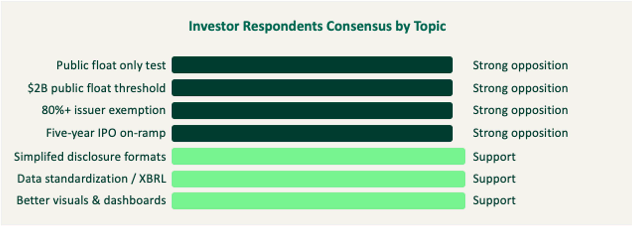
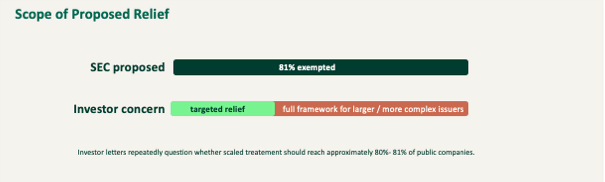
Perhaps the most vehemently expressed concern was the proposed expansion of NAF status, which could encompass approximately 80-81% of public companies. Investors overwhelmingly opposed this broad reclassification, fearing it would lead to a significant reduction in executive compensation disclosures, weaken the effectiveness of Say-on-Pay votes, and reduce the scope of SOX 404(b) auditor attestations. The prevailing view was that such a move would exacerbate information asymmetry, increase the risk of fraud, inflate investor costs, and potentially raise the cost of capital for companies.
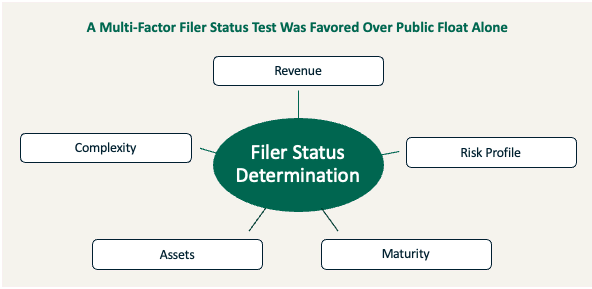
Commenters argued that relying solely on public float as the primary determinant for NAF status is an incomplete and potentially manipulable metric. They pointed out that public float can be influenced by capital structure choices rather than reflecting a company’s true size, complexity, maturity, or risk profile. This led to a consensus that a more comprehensive assessment of a company’s characteristics should be considered.
Theme 3: A Call for More Holistic Company Assessment
The critique of public float as the sole metric for NAF status was a recurring point. Organizations like CalPERS suggested incorporating revenue and assets into the assessment. The Council of Institutional Investors (CII) recommended including size, complexity, and maturity. Baillie Gifford advocated for a broader evaluation of company characteristics, while the University Pension Plan Ontario (UPP) supported relief being targeted only to genuinely smaller and less complex issuers. While the ICI did not object to the $2 billion public float threshold, their recommendation to retain certain disclosures for NAFs indicated a preference for a more nuanced approach than a simple size-based exemption.
Theme 4: Skepticism Around the $2 Billion Threshold
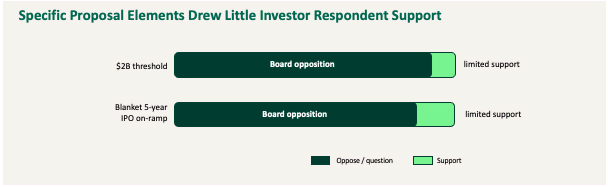
The proposed increase in the public float threshold from approximately $700 million to $2 billion for NAF status faced near-universal criticism from investor respondents. Many commenters argued that this significant jump lacked sufficient analytical justification and was too broad, extending relief beyond companies that genuinely require accommodation. The argument was that this threshold would permit many larger, more complex companies to shed essential disclosure requirements, contrary to investor needs.
Theme 5: The Five-Year IPO On-Ramp – A Point of Contention
Investor respondents generally expressed opposition to a blanket five-year accommodation period for newly public companies, regardless of their size or growth trajectory. The concern here was that large and rapidly growing issuers, even if recently IPO’d, would benefit from earlier entry into the full disclosure framework. This suggests a preference for size-based exit triggers that allow companies to transition out of EGC status and into more comprehensive disclosure requirements once they reach a certain scale or complexity.
Roundtable Insights: Enhancing Disclosure, Not Reducing It
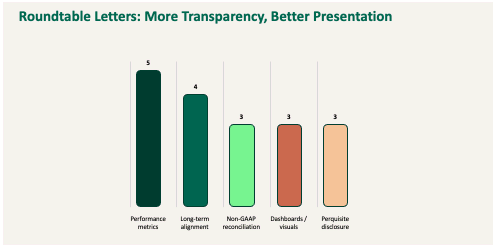
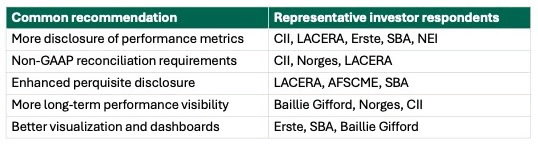
The submissions related to the SEC Executive Compensation Disclosure Roundtable provided further clarity. These comments frequently called for incremental disclosure enhancements, alongside a recognition of the need for more concise presentation. The dominant theme here was modernization, meaning making disclosures more effective and user-friendly, rather than deregulation.
Participants consistently advocated for improvements such as better dashboards, standardization of formats, the adoption of XBRL tagging for enhanced data analysis, improved visual representations of data, clearer metrics, and greater comparability across companies. These suggestions reflect a desire to make executive compensation information more accessible and actionable for investors. For instance, the idea of improved visuals and clearer metrics directly addresses the need for investors to quickly grasp complex compensation structures and their potential impact on company performance.
Who is Speaking and What it Means
The coalition of investors who submitted comments represents a formidable force in the financial markets. This group includes public pension funds, asset managers, governance organizations, labor-affiliated investors, faith-based investors, and various investor coalitions. Collectively, these entities manage and steward assets totaling trillions of dollars. Their unified voice, therefore, carries significant weight.
The absence of direct comments from some of the largest passive and active managers, even with the ICI’s input, remains a crucial caveat. While the ICI’s comments offer a general industry perspective, they may not encapsulate the specific priorities of every major player. These significant institutional investors might be strategizing to influence disclosure practices through other avenues, such as direct engagement with companies or by issuing their own policy guidelines. This could lead to a scenario where, even if the SEC enacts broad disclosure relief, these major investors will continue to demand comprehensive disclosure from their portfolio companies to maintain investor confidence and ensure accountability.
Pay Governance’s Perspective: A Call for Investor-Centric Disclosure
The analysis from Pay Governance LLC concludes that the comment record, despite its limitations, reveals a striking alignment among participating investors. The overarching message is clear: simplify presentation, improve comparability, and modernize disclosure, but crucially, preserve the fundamental transparency framework that investors rely on. This framework is essential for assessing executive compensation, evaluating governance quality, and holding boards accountable.
Broader Implications and the Path Forward
The SEC’s proposed rule changes are at a critical juncture. The investor feedback strongly suggests that a wholesale reduction in disclosure requirements, particularly for smaller public companies, is likely to face significant resistance and could undermine investor confidence. The SEC will need to carefully consider these comments as it moves towards finalizing any rule changes.
For companies, the implications are clear. Even if regulatory relief is granted, proactive investor outreach and engagement will be paramount. Understanding evolving investor expectations regarding executive compensation and other disclosures will be crucial for maintaining trust and minimizing friction in key areas such as Say-on-Pay votes, director elections, and broader corporate governance engagement. Companies that voluntarily maintain a high level of transparency, even beyond regulatory requirements, may find themselves better positioned to foster strong investor relationships and enhance their overall governance standing. The future of executive compensation disclosure appears to hinge on a delicate balance between regulatory efficiency and the enduring investor demand for clear, comprehensive, and actionable information.
