

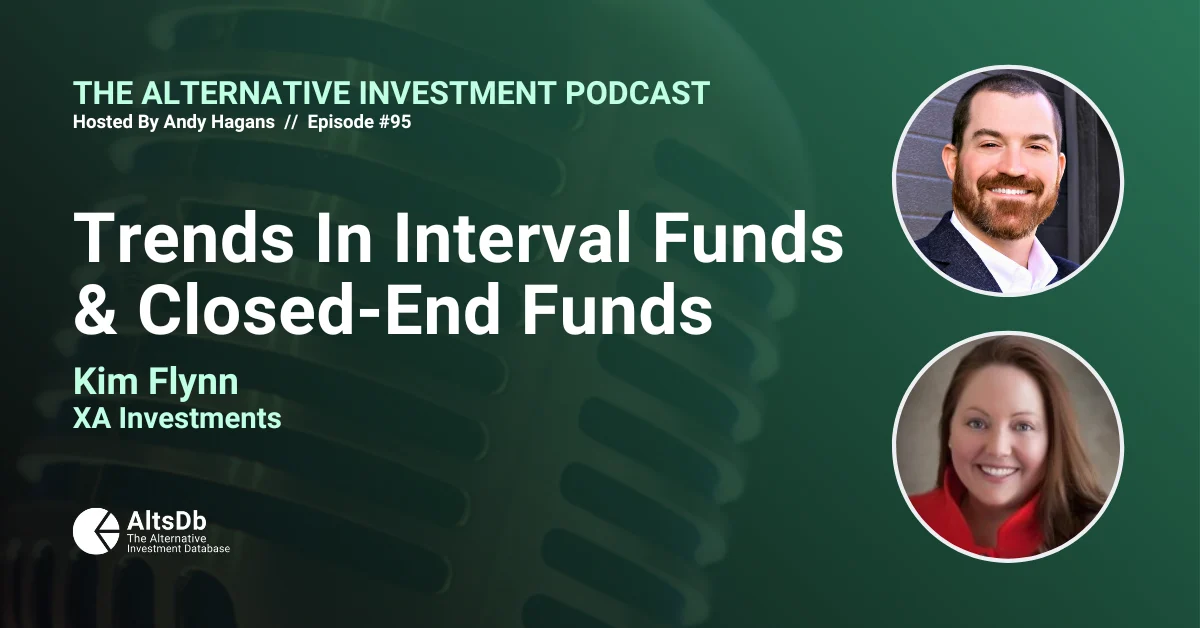
The financial industry has witnessed a remarkable surge in the popularity and growth of interval funds over the past five years, mirroring the broader expansion of the alternative investments sector. These unique investment vehicles, offering a hybrid structure between open-ended mutual funds and closed-end funds, have captured significant attention from both investors seeking diversified strategies and asset managers looking for innovative ways to package alternative assets. Kim Flynn, Managing Director at XA Investments, a firm specializing in alternative investment product development, recently shared her insights on the burgeoning success of interval funds, the inherent challenges faced by their sponsors, and the evolving opportunities within this dynamic market.
The Rise of Interval Funds: A Market Overview
Interval funds, a category of closed-end funds, have experienced exponential growth, becoming a cornerstone for accessing alternative asset classes for a wider range of investors. Unlike traditional open-ended mutual funds that allow for daily redemptions at net asset value (NAV), interval funds offer limited liquidity, typically through periodic tender offers, often quarterly. This structural feature allows fund managers to invest in less liquid assets, such as private equity, real estate, and private credit, which may not be suitable for the daily redemption structure of mutual funds.
The broader alternative investments industry has also seen robust expansion. Data from Preqin, a leading alternative assets data provider, indicates that global alternative assets under management reached $13.2 trillion in 2022, with continued growth projected in the coming years. This expansion is fueled by institutional investors and, increasingly, by financial advisors and their clients seeking enhanced diversification, potential for higher returns, and inflation hedging capabilities.
Kim Flynn, with extensive experience in product development, including over 40 closed-end funds launched during her tenure at Nuveen, highlighted the strategic appeal of interval funds. "These structures house alternatives in a way that makes them accessible for anyone, unlike a private fund, where you might have to meet certain suitability requirements," Flynn explained in a recent interview on The Alternative Investment Podcast. "These vehicles make alternatives more accessible."
Navigating the Nuances: Closed-End Funds vs. Interval Funds
To fully appreciate the role of interval funds, it’s crucial to distinguish them from traditional listed closed-end funds. Listed closed-end funds, like those historically popularized by Nuveen and BlackRock, are continuously offered on exchanges and share some similarities with exchange-traded funds (ETFs). However, they are "closed" to new capital after their initial public offering, leading to potential trading at premiums or discounts to their NAV. Historically, the average discount for listed closed-end funds has hovered around 4.5%, though current market dislocations have widened these discounts significantly, presenting potential opportunities for savvy secondary market investors.
"Listed closed-end funds are often used by investors who are looking for income," Flynn noted. "And in the last 10 years, that search for yield has driven a lot of people to the listed closed-end fund space." These funds often employ leverage to enhance income generation, a strategy particularly effective in low-yield environments.
Interval funds, while legally classified as a type of closed-end fund, operate differently. They are continuously offered, meaning new investors can subscribe and existing investors can redeem, albeit with restrictions. "The exit is typically gated or limited to 5% a quarter," Flynn elaborated. "And so, that’s what allows those funds to invest more heavily in illiquid securities, and frankly, generate attractive total returns in some of these assets that require a longer investment hold period." This controlled liquidity allows interval funds to hold a broader spectrum of alternative assets, including real estate, private equity, venture capital, and private credit.
The Evolution of the Closed-End Fund Market
Flynn’s career at Nuveen, a market leader in listed closed-end funds, provided her with a front-row seat to the evolution of this segment. "I was a member of Nuveen’s product development team for close to 12 years," she recalled. "And the entire time, I focused on launching new listed closed-end funds." During this period, from the early 2000s to around 2015, the listed closed-end fund market saw rapid expansion into new asset classes and strategies.
However, the market eventually became somewhat saturated. A notable pause in new IPOs for listed closed-end funds occurred after the volatility experienced by energy MLP (Master Limited Partnership) funds launched in 2015. This led sponsors to explore alternative structures, including non-listed closed-end funds like interval funds and tender offer funds.
"The shift that we’ve seen in the market in the last five years is much more focus and attention on the interval fund space," Flynn observed. This shift reflects a growing demand for structures that can accommodate the unique characteristics of alternative investments while providing a degree of liquidity to investors.
XA Investments: A Catalyst for Alternative Product Development
XA Investments, co-founded by Kim Flynn, has positioned itself as a key player in facilitating the growth of interval funds and other alternative investment products. The firm partners with asset managers, either as sub-advisors for their own funds or through a consulting practice that assists other firms in launching their proprietary platforms.
"We set up the practice where, because we do not have in-house wealth management, we partner externally with asset managers," Flynn explained. "We launched our first listed closed-end fund about five years ago, in partnership with an external sub-advisor. It’s an alternative credit strategy."
The firm’s expertise extends to advising asset managers on navigating the complexities of launching new fund structures, particularly interval funds. "Most of our clients are curious and most interested in the growing interval fund space," she stated, highlighting the significant demand and attention this product category is receiving.
Challenges and Opportunities in the Interval Fund Arena
Despite their growing popularity, interval fund sponsors face several challenges. One of the primary concerns is managing investor expectations regarding liquidity. "I do find that as we observe industry participants, a lot of them gloss over, and they frankly oversell the liquidity of an interval fund," Flynn cautioned. "These are not mutual funds, and they should not be sold in that fashion."
The potential for prorated redemptions, where investors may not receive their full requested redemption amount in a given quarter due to high demand, can be a source of frustration and concern for investors. This risk is amplified during periods of market stress, as seen in the fourth quarter of last year, when some investors experienced prorated liquidity. Flynn stressed the importance of clear communication and robust liquidity management plans.
"It really raises the question of what are fund sponsors doing on the front end to help people understand the appropriate investment horizon, and really the liquidity constraints that are there?" she questioned. "The market hasn’t been tested just yet" in terms of sustained market stress for these vehicles, she added, referencing the potential for prorated redemptions over multiple quarters, similar to scenarios during the 2008-2009 financial crisis.
The valuation of underlying illiquid assets also presents a complex challenge. While listed closed-end funds are protected from forced selling by market dislocations, interval funds, with their periodic redemption windows, can be impacted. "If there’s a stampede for the exits… it’s probably a sign that maybe the NAV is a little too optimistic," Flynn remarked. This raises questions about whether investors who remain in the fund might be disadvantaged if earlier redeemers exit at a higher, potentially overvalued, NAV.
However, opportunities abound. The current market environment, with wider discounts in listed closed-end funds, presents attractive entry points for secondary market buyers. Furthermore, the evolution of interval funds is enabling innovative strategies. "The buyer base for these funds initially is largely RIAs, but it’s still fairly concentrated," Flynn noted. "The RIA that understood real estate, or that had been buying BDCs, and so they were much more comfortable with alternatives." This suggests a need for greater education and broader adoption by financial advisors.
Emerging Trends and Best Practices in Interval Funds
Looking ahead, Flynn identified several emerging trends shaping the interval fund landscape. One significant trend is the rise of RIAs launching their own proprietary interval funds. "The RIA… has become acquainted with interval funds and says, ‘Hey, I’m gonna launch my own,’" she explained. This allows RIAs to leverage their existing client relationships and control their investment offerings.
Similarly, FinTech platforms are increasingly venturing into interval fund launches, targeting both accredited and, in some cases, non-accredited investors. Firms like Fundrise have demonstrated the potential for these platforms to raise substantial capital through innovative interval fund structures.
A third emerging trend is the development of "impact funds" within the private asset space, including interval funds. These funds focus on investments with positive social or environmental outcomes, offering a distinct alternative to traditional ESG-labeled ETFs and mutual funds. "Because these impact-oriented interval funds are investing in alternative or illiquid securities, you’re gonna get a different return profile," Flynn suggested, which could appeal to investors seeking both financial returns and societal impact.
When it comes to best practices for interval funds, Flynn emphasized a client-centric approach. "Many of them are launching with seed capital or lead capital, or even private funds that get contributed," she said. This ensures that new funds are not "subscale" at launch, making them more attractive to investors. Expense and management fee waivers are also common tactics to enhance appeal during the initial scaling phase.
"The fund sponsors that I think make a mistake, it, oftentimes they kind of just quickly get on file with the SEC, and they haven’t sorted through what the client wants, and how they’re gonna be able to compete," Flynn cautioned. With over 180 interval funds now in the market, competition is intensifying, particularly in areas like credit funds. Sponsors need to demonstrate a clear competitive edge and a deep understanding of their target market.
The Imperative of Education
A recurring theme throughout the discussion was the critical need for investor and advisor education. The complexity of alternative investments and the nuanced structures of vehicles like interval funds necessitate a thorough understanding of their risks, rewards, and liquidity profiles.
"The education is really what’s important, so that, you know, the right investors are getting into the product, and they understand it, and the advisors understand it," Andy Hagans, host of The Alternative Investment Podcast, emphasized. The proliferation of new products and strategies in the alternatives space underscores the ongoing challenge for financial professionals to stay informed and make suitable recommendations.
As the alternative investment industry continues to mature and innovate, interval funds are poised to remain a significant growth area. Their ability to bridge the gap between illiquid alternative assets and investor demand for accessible, yet diversified, strategies positions them as a crucial component of modern investment portfolios. However, the success and sustainability of these vehicles will ultimately hinge on clear communication, robust risk management, and a commitment to investor education.
