


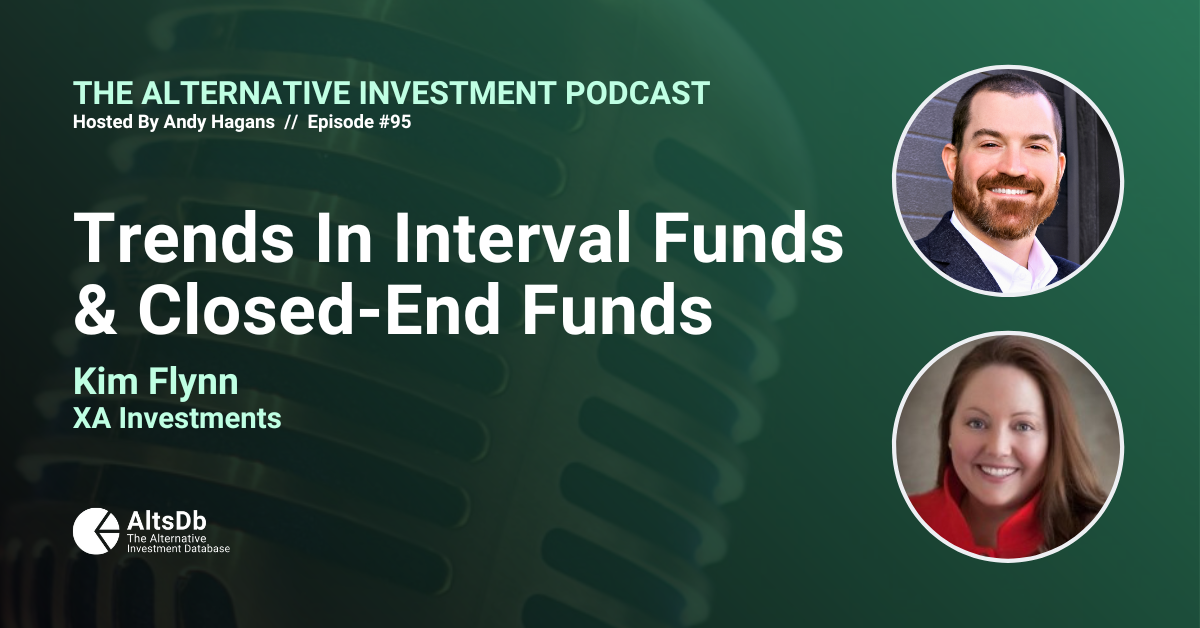
Interval funds have experienced remarkable growth over the past five years, mirroring the broader expansion of the alternatives industry. This surge in popularity has brought unique challenges and opportunities for sponsors seeking to navigate this evolving market. Kim Flynn, managing director at XA Investments, recently joined "The Alternative Investment Podcast" to offer her expert insights into the success story of interval funds, dissecting the current landscape for sponsors and investors alike.
The Rise of Interval Funds: A New Frontier in Alternatives
The financial services industry has witnessed a significant shift towards alternative investments, driven by investor demand for diversification, enhanced yields, and uncorrelated returns. Within this burgeoning sector, interval funds have emerged as a particularly compelling structure, offering a blend of accessibility and exposure to less liquid asset classes.
"Interval funds have seen incredible growth in the past five years, along with the growth in the broader alternatives industry," stated Kim Flynn, managing director at XA Investments, during her appearance on "The Alternative Investment Podcast." Her insights shed light on the factors propelling this trend and the strategic considerations for firms involved in their development and distribution.
A Deep Dive into Closed-End and Interval Funds with Kim Flynn
Kim Flynn’s extensive background in product development, particularly her tenure at Nuveen where she was instrumental in launching over 40 closed-end funds, provides a unique vantage point from which to analyze the current market. Nuveen, a recognized leader in the listed closed-end fund market, particularly in municipal bonds, offered Flynn invaluable experience in structuring complex financial products.
"I was a member of Nuveen’s product development team for close to 12 years," Flynn recounted. "The entire time, I focused on launching new listed closed-end funds. Nuveen is a market leader in the listed closed-end fund market, you know, really because of the municipal bond heritage that Nuveen is well-known for."
Her experience at Nuveen often involved strategic partnerships with external portfolio managers. This collaborative approach extended to her post-Nuveen career when she launched an asset management platform as part of an investment bank in Chicago. This venture was specifically designed to focus on alternative investments, again in collaboration with sub-advisors. This has led to extensive dialogue with a wide spectrum of asset managers, from small boutiques to global wealth management firms.
"These types of products, these closed-end funds, listed funds, interval funds, are really a very niche product category," Flynn explained. "So, people, they’re a bit of a mystery, and Nuveen is one of the firms that understands them well. There are a few other, a number of Chicago-based firms."
The appeal of these structures, Flynn noted, lies in their ability to house alternative investments in a manner that makes them accessible to a broader investor base, unlike private funds that often carry stringent suitability requirements.
Understanding the Mechanics: Closed-End Funds vs. Interval Funds
To fully appreciate the growth of interval funds, it’s crucial to understand their origins and how they differ from traditional closed-end funds. Listed closed-end funds, often sought by investors looking for income, are characterized by a fixed number of shares issued during an initial public offering, after which the fund is closed to new capital and trades on an exchange. This contrasts with Exchange Traded Funds (ETFs), which have creation and redemption mechanisms that allow for continuous adjustment of share supply, typically keeping their market price close to their Net Asset Value (NAV).
"So, listed closed-end funds are often used by investors who are looking for income," Flynn stated. "And in the last 10 years, that search for yield has driven a lot of people to the listed closed-end fund space."
A key distinction often arises in how these funds trade. While ETFs generally trade at or near NAV due to arbitrage mechanisms, closed-end funds can trade at a discount or premium to their NAV. Historically, the average discount for listed closed-end funds has been around 4.5%, often mirroring initial sales loads. However, current market conditions have seen these discounts widen.
"Right now, the listed market is a bit dislocated. So, the discounts are averaging eight-plus percent. So, that’s wide by historical standards," Flynn observed. This widening discount can present opportunities for secondary market investors.
Leverage and Income Enhancement: A Core Strategy
A common feature of closed-end funds, particularly those focused on income generation, is the strategic use of leverage. This typically involves borrowing money to invest in additional assets, thereby potentially amplifying returns and income distributions.
"Now, one of the main differences between a closed-end fund and the mutual fund is the use of leverage," Flynn explained. "And leverage is typical. It’s modest leverage, but it’s usually used with income enhancement in mind." For instance, in municipal bond funds, leverage can enhance yields by an additional percentage point compared to their mutual fund counterparts.
The Evolution of Closed-End Funds and the Emergence of Interval Funds
The listed closed-end fund market experienced rapid expansion from the early 2000s until around 2015, with a broad move into various asset classes and strategies. However, a pause in new IPOs occurred following the volatility associated with energy MLP (Master Limited Partnership) funds that came to market in 2015.
This led some fund sponsors to explore alternative closed-end structures, such as non-listed closed-end funds, including interval funds and tender offer funds. While still a form of closed-end structure, these are continuously offered, functioning more like open-ended funds that can grow over time.
"And so that’s really the shift that we’ve seen in the market in the last five years, is much more focus and attention on the interval fund space," Flynn highlighted.
XA Investments: Pioneering Solutions in the Interval Fund Space
XA Investments, co-founded by Kim Flynn, operates with a distinct model. Rather than managing assets in-house, the firm partners with external asset managers, either as sub-advisors or through a consulting practice that assists other asset managers in launching their own funds.
"We set up the practice where, because we do not have in-house wealth management, we partner externally with asset managers," Flynn elaborated. "We either hire firms as sub-advisors… We launched our first listed closed-end fund about five years ago, in partnership with an external sub-advisor. It’s an alternative credit strategy."
A significant portion of XA Investments’ work is now focused on the growing interval fund market. The firm advises asset managers on entering the listed closed-end fund market and also guides them on raising capital in the London-listed market.
Interval Funds: Bridging Liquidity Gaps
Interval funds, as a type of ’40 Act product, share similarities with mutual funds but offer a unique liquidity profile. While investors can typically invest on a daily basis, redemptions are usually limited, often to around 5% of the fund’s outstanding shares per quarter.
"So, let’s contrast the closed-end fund with a daily liquid mutual fund, where investors can get in and out at NAV on a daily basis," Flynn explained. "Most of the closed-end funds have different mechanisms for shareholder liquidity. And so, taking the interval fund as an example, you could invest on a daily basis, to the extent that that fund has a daily NAV. But the exit is typically gated or limited to 5% a quarter."
This controlled liquidity allows interval funds to invest more heavily in illiquid securities, such as real estate, private equity, venture capital, and credit strategies, which require longer investment horizons and may not be suitable for traditional daily-liquidity vehicles.
Navigating the Challenges: Valuation, Liquidity, and Investor Education
Despite their growing appeal, interval funds present inherent challenges, particularly concerning valuation and liquidity management. The potential for discounts to develop, especially when illiquid assets are involved, raises questions about how NAV is calculated and whether it accurately reflects market sentiment.
"If I’m in an illiquid investment, or if I’m in a REIT, I can sell my REIT that day. If I’m in an illiquid investment, like, I’m an LP in some Opportunity Zone funds, that’s a 10-year hold," Andy Hagans, host of The Alternative Investment Podcast, noted. "With intermittent liquidity, with interval funds, different investors can get in and out at different times."
Flynn echoed these concerns, emphasizing the importance of realistic liquidity expectations. "I do find that as we observe industry participants, a lot of them gloss over, and they frankly oversell the liquidity of an interval fund," she cautioned. "These are not mutual funds, and they should not be sold in that fashion." The potential for prorated redemptions, especially during market stress, necessitates a clear understanding of the investment horizon and liquidity constraints.
The integrity of valuation processes is also paramount. While third-party valuation firms are increasingly employed, the absence of real-time market pricing, as seen in publicly traded securities, can lead to discrepancies. "The only assurance I would offer about valuation is that the trend is that third-party valuation firms, which specialize… are providing daily marks," Flynn stated. However, she acknowledged that the "skin in the game" element, where managers invest their own capital, can provide a crucial layer of alignment and confidence.
Best Practices for Interval Fund Design and Marketing
As the interval fund market matures, certain best practices are emerging for sponsors aiming to create well-designed and investor-centric products. These include ensuring adequate seed or lead capital to establish scale, offering expense and management fee waivers to enhance attractiveness, and maintaining a disciplined approach to growth.
"The fund sponsors that we think go about it the wrong way, you know, you have to start with the client in mind, with the RIA in mind, and that’s really the heart of this market," Flynn emphasized. Focusing on Registered Investment Advisors (RIAs) as the primary distribution channel, and providing thorough education on liquidity limitations and investment horizons, is crucial.
Emerging Trends in the Alternatives Landscape
Looking ahead, Flynn identified several emerging trends poised to shape the alternatives industry:
- RIAs Launching Proprietary Interval Funds: A growing number of RIAs are opting to launch their own interval funds, leveraging their direct client relationships to build proprietary offerings rather than simply allocating to external managers.
- Direct-to-Consumer Fintech Platforms: Fintech companies are increasingly venturing into interval fund launches, targeting a broader investor base, including non-accredited investors, with a focus on proprietary fund development.
- Impact Investing Funds: Despite some ESG backlash in the U.S., there is a nascent trend of launching impact-focused interval funds, offering investors exposure to alternative and illiquid securities with a focus on positive social or environmental outcomes.
The continued growth and evolution of interval funds underscore their significance in the alternative investment landscape. As investors seek diversification and yield, and as managers innovate with new structures, the interval fund model is likely to remain a focal point of discussion and development in the years to come.
For those seeking further information on XA Investments and their expertise in interval funds, their website is xainvestments.com.
