

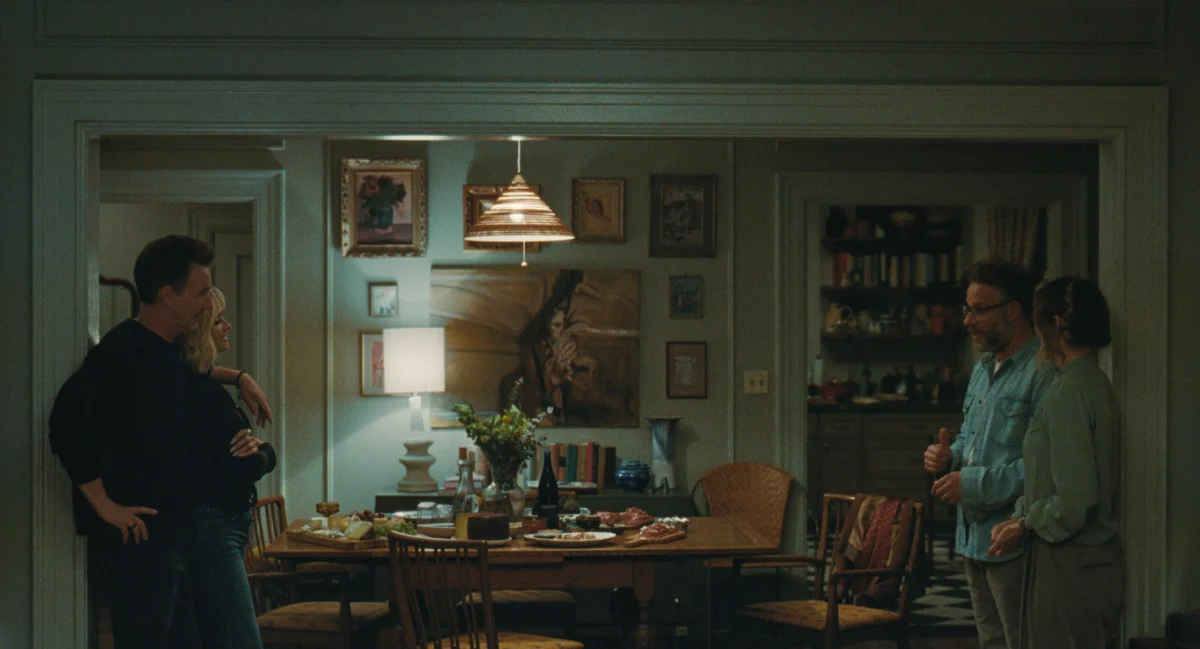
Olivia Wilde’s latest directorial effort, The Invite, presents a masterclass in atmospheric storytelling, where the physical environment serves as a visceral extension of the narrative’s psychological tension. Starring Wilde alongside Seth Rogen, Penélope Cruz, and Edward Norton, the film is largely a "bottle movie," a subgenre of cinema where the action is confined to a single location. In this instance, that location is a meticulously crafted San Francisco apartment belonging to a married couple, Angela (Wilde) and Joe (Rogen). The apartment is not merely a backdrop for the high-stakes dinner party involving their neighbors, Hawk (Norton) and Pina (Cruz), but a silent witness to the crumbling foundation of a decade-long marriage. To achieve this, Wilde collaborated with veteran production designer Jade Healy, known for her ability to imbue sets with a sense of lived-in history and emotional resonance.
The Architecture of Marital Discord
The creative genesis of the apartment set was rooted in a desire for authenticity and a rejection of the sanitized, "staged" look common in modern domestic dramas. Wilde and Healy sought to create a space that felt layered with the "tumultuous state" of Joe and Angela’s relationship. While the film features a few external scenes—notably Joe struggling through his workday and a comedic yet poignant moment involving a folded bicycle—the vast majority of the runtime is spent within the four walls of their home. This necessitated a set that could withstand intense visual scrutiny and provide enough geographical variety to keep the audience engaged for the duration of the film.

Wilde cited several cinematic "North Stars" for the project’s aesthetic, including Woody Allen’s Hannah and Her Sisters, Michael Haneke’s Amour, and Mike Nichols’s Who’s Afraid of Virginia Woolf?. These films are renowned for their use of domestic space to heighten interpersonal conflict. Like the sprawling, intellectual apartments of 1980s New York or the claustrophobic interiors of a deteriorating marriage in Virginia Woolf, the apartment in The Invite was designed to suggest a history that predates the first frame of the movie.
Engineering the Labyrinth: From San Francisco to Los Angeles
Despite the film’s setting in San Francisco, the apartment was entirely constructed on a soundstage at Sunset Las Palmas Studios in Los Angeles. This decision was driven by the logistical requirements of Wilde’s directing style, which favored complex camera movements and "frames within frames." Shooting in a real San Francisco pre-war unit would have been prohibitively restrictive for a production of this scale. However, Healy performed extensive location scouting in the Bay Area to capture the specific architectural vernacular of the region, including the unique moldings, high ceilings, and interconnected room layouts characteristic of the city’s historic residential stock.
The resulting set was an expansive, fully realized environment, complete with hallways and ceilings, allowing the actors to move through the space without the interruptions typically caused by "wild walls" (movable set pieces). Healy deliberately deviated from the modern trend of open-concept living. While the original script suggested a renovated open kitchen and dining area, Healy argued that a more "labyrinthine" layout would better serve the story. By creating a series of partitioned, interconnected rooms, the design emphasizes the couple’s feelings of being trapped. Joe, a former musician grappling with a creative rut, and Angela, who is obsessively attempting to bridge the emotional distance between them, are often seen in separate rooms or framed through doorways, highlighting their isolation even when sharing the same home.
.jpg)
Visual Metaphors: Frames, Mirrors, and Sound
Wilde and Healy developed a visual mantra for the film: "frames within frames." This technique uses the apartment’s architecture—doorframes, windows, and hallways—to create internal compositions that segment the characters. Mirrors also play a pivotal role, serving both practical editorial purposes and symbolic ones. According to Wilde, mirrors represent the way two people can exist in the same physical space while failing to truly "see" one another.
The sense of realism was further enhanced through sound design. Wilde integrated the sound of creaky wood floors into the audio mix, reinforcing the idea that the apartment is an old, breathing entity. The physical details of the renovation—mismatched doorknobs and varying molding styles—suggest a home that has been pieced together over time, reflecting the couple’s attempt to merge two separate units into a single cohesive dwelling, a metaphor for the difficult work of maintaining a long-term partnership.
Sourcing the "Angela Aesthetic"
The character of Angela is portrayed as a woman who uses décor as a shield against her internal anxieties. Wilde describes her aesthetic as "warm, maximalist, and classic." Healy’s approach to furnishing the set was grounded in the characters’ financial reality. Rather than filling the space with high-end designer furniture, she imagined Angela as a diligent hunter of deals, frequenting estate sales, thrift shops, and Facebook Marketplace.

Key pieces of the set include a Barbara Barry reeded base sofa, which Angela supposedly found secondhand. The walls are adorned with works by artists Susan Moss and Liz M. Phillips, while specific paintings attributed to Angela’s character were created by artist Tess Hurlburt. One of the film’s central set pieces is a vibrant vintage rug that Angela unfurls just moments before her guests arrive. The rug serves as a "statement piece," an attempt to project an image of stability and sophistication to Hawk and Pina. Healy chose a vintage rug over a new one to ensure it felt like something with "memory and a sense of time," fulfilling Angela’s desire to fill the emotional void in her life with tangible objects of value.
Color Theory: The Psychology of Drowning
The color palette of the apartment was carefully selected to evoke a specific emotional temperature. Healy utilized a range of bluish-greens from the Farrow & Ball collection, including "Blue Gray" and "Vale Mist." These hues were chosen to suggest a certain "coldness" between the couple and to provide a visual metaphor for the sensation of "drowning" under the weight of their marital expectations.
The color story becomes even more intense in Joe’s study, which is painted in "Oval Room Blue," a darker, more saturated shade. This choice represents Joe’s deeper immersion in his creative and personal depression. The synergy between the production design and other departments was absolute; costume designer Arianne Phillips selected a shirt for Wilde’s character that perfectly matched the wall paint, causing Angela to literally blend into her environment at times—a visual representation of how her identity has become inextricably linked to the domestic space she has curated.

The Bathroom and Bedroom: A Study in Contrast
Two rooms in the apartment serve as stark contrasts to the "public" face of the home. The bathroom, which Angela shows off as a recent renovation, was designed to look intentionally "old" to match the rest of the pre-war aesthetic. Interestingly, the production faced a real-world challenge when the chosen tiles did not arrive in time for the shoot. Healy’s team pivoted by using painted tileboard, a solution that mirrored the "fake it until you make it" energy of Angela’s character.
Conversely, the bedroom is the most honest room in the house. While the rest of the apartment is layered with books, photographs, and art, the bedroom is sparse and utilitarian. It features an Ikea bed and almost nothing on the walls except for a prominent crack. Healy noted that the bedroom represents the true state of the marriage—unadorned and fractured. Because it is a private space that guests do not see, Angela has put no effort into "decorating" over the problems there. The crack in the wall, though subtle, served as a powerful visual cue for the actors, symbolizing the irreparable split in the couple’s relationship.
Broader Impact and Narrative Implications
The meticulous production design of The Invite underscores a growing trend in contemporary cinema where the setting is treated with the same depth as the lead actors. By building a set that reflects the economic, psychological, and emotional realities of its characters, Wilde and Healy have created a film that feels both intimate and expansive.

The design choices in The Invite offer a compelling analysis of how physical environments influence human behavior. The "labyrinthine" layout forces the characters into uncomfortable proximity or isolating distance, driving the narrative forward without the need for excessive dialogue. This approach to "spatial storytelling" is particularly effective in the thriller and drama genres, where the tension is often derived from what is unsaid.
Furthermore, the film’s emphasis on "sensed history"—the creaky floors, the mismatched hardware, the thrifted furniture—challenges the glossy perfection often seen in Hollywood interiors. It presents a version of San Francisco living that is recognizable to those who inhabit the city’s aging architectural gems, where beauty and decay often coexist. As The Invite reaches audiences, its legacy will likely be defined by this uncompromising attention to detail, proving that in the world of cinema, the walls really can talk.
