

The Houthi declaration of intent to obstruct Saudi shipping and vessels destined for Saudi ports in the Red Sea represents far more than mere revolutionary rhetoric. It stands as Iran’s most recent and calculated endeavor to probe the boundaries of Saudi Arabia’s strategic patience, leveraging one of its most potent regional proxies. This constitutes a perilous gamble, especially given Riyadh’s consistent efforts over nearly a decade to circumvent the wider regional conflict that Tehran appears increasingly determined to instigate.
Saudi Arabia’s measured restraint throughout this period has never been indicative of military weakness. Instead, it has been a deliberate and deeply considered strategic choice, aimed at preserving regional stability while simultaneously enabling the Kingdom to concentrate its vast resources and national focus on an unprecedented and historic economic transformation, embodied by Vision 2030. Confronted with Saudi Arabia’s ascending regional trajectory, which Iran finds challenging to rival through conventional means, Tehran has increasingly resorted to a strategy characterized by proxy warfare, maritime coercion, and economic intimidation across the broader Middle East. Within this complex and volatile regional chessboard, the Houthis have emerged as the primary and most active instrument of this overarching Iranian strategy.
The Threat Unveiled: Maritime Coercion in the Red Sea
The Houthi threat specifically targets critical maritime arteries that are vital not only for Saudi Arabia but also for global trade and energy security. By menacing shipping lanes in both the Strait of Hormuz, at the eastern mouth of the Persian Gulf, and the Bab al-Mandeb Strait, a narrow passage connecting the Red Sea to the Gulf of Aden, Tehran seeks to exert immense pressure on Saudi Arabia from its eastern and western maritime gateways simultaneously. This dual-front maritime strategy aims to significantly escalate the perceived cost of maintaining regional stability. The ultimate objective is not necessarily a direct military victory, which remains largely out of reach for Iran’s proxies against a well-equipped conventional force, but rather profound economic disruption. This disruption is designed to undermine investor confidence in the region, threaten the uninterrupted flow of global energy exports, and project an image of pervasive instability onto the Middle East’s largest and most influential economy.
The Bab al-Mandeb Strait, often referred to as the "Gate of Tears," is one of the world’s most critical maritime chokepoints. Approximately 12% of global trade and a significant portion of the world’s oil supply, estimated at around 6.2 million barrels per day, passes through this narrow waterway. Any sustained disruption here would have immediate and severe repercussions on global shipping routes, insurance markets, and ultimately, consumer prices worldwide. For Saudi Arabia, whose western ports rely heavily on Red Sea access for trade and pilgrimage, the threat is existential to its economic diversification efforts and its role as a regional economic hub.
Saudi Arabia’s Strategic Calculus: Restraint Amidst Provocation
The Saudi Arabian government’s long-standing policy of strategic patience is deeply rooted in its national interests, particularly its ambitious Vision 2030 plan. Launched in 2016, Vision 2030 is an overarching framework designed to reduce the Kingdom’s dependence on oil, diversify its economy, and develop public service sectors such as health, education, infrastructure, recreation, and tourism. This transformative agenda requires a stable regional environment and uninterrupted global trade routes to attract foreign investment, foster domestic growth, and build a vibrant society. Engaging in an extensive regional conflict, even one provoked by adversaries, would divert critical resources, deter investors, and significantly impede the progress of these national development goals.
Saudi Arabia’s position as the world’s largest crude oil exporter, accounting for approximately 17% of global crude oil exports, and OPEC’s leading producer, further underscores its commitment to global energy market stability. The Kingdom possesses the world’s only substantial spare oil production capacity, a critical buffer that allows it to stabilize global energy markets during periods of crisis. This was vividly demonstrated during the initial phase of the Iran-Iraq war in the 1980s, when Saudi Arabia effectively used its 7 million barrels per day East-West Pipeline (Petroline) to bypass the Strait of Hormuz and maintain crucial oil supplies to international markets. Sustained disruption of Saudi exports, whether through the Red Sea or the Persian Gulf, would inevitably ripple through international shipping, inflate insurance premiums, exacerbate global inflation, and pose a significant threat to the fragile global economy, which has already weathered numerous shocks in recent years.
The Global Economic Ripple Effect
The potential for economic fallout from intensified Houthi maritime aggression is substantial and far-reaching. Global crude oil prices are highly sensitive to geopolitical tensions in the Middle East. Even the perception of a threat to major shipping lanes can trigger speculative buying and drive up prices, impacting everything from transportation costs to manufacturing inputs. For instance, following the 2019 drone and missile attacks on Saudi Aramco’s Abqaiq and Khurais oil facilities, global oil prices saw their largest intra-day jump in decades, highlighting the immediate and significant market reaction to disruptions in Saudi energy infrastructure.
Beyond crude oil, the Red Sea and Suez Canal corridor are critical for container shipping, connecting Asia and Europe. Disruptions could force ships to take the much longer and more expensive route around the Cape of Good Hope, increasing transit times by weeks and adding millions of dollars in fuel and operational costs. This would inevitably lead to higher shipping rates, delays in supply chains, and ultimately, increased costs for consumers globally. Marine insurance premiums for vessels operating in designated high-risk areas, such as the Bab al-Mandeb, would also surge, adding another layer of cost to international trade. The cumulative effect would be a drag on global economic growth, at a time when many economies are still recovering from the impacts of the COVID-19 pandemic and inflationary pressures.
Iran’s Logistical Ambitions and Saudi Counter-Measures
The attempt by Iran to re-establish the Tehran-Sana’a air bridge was a crucial component of its strategy to bolster Houthi capabilities. These flights were never merely about reconnecting two capitals in a civilian capacity. They were designed to provide a direct and unimpeded logistical corridor through which a continuous rotation of operational planning advisors, advanced missile specialists, drone technicians, and high-level intelligence officers could be seamlessly moved into Houthi-controlled territory in Yemen. Such an air corridor would have significantly enhanced Tehran’s ability to transfer not only sophisticated military equipment, including components for missiles and drones, but also critical operational expertise, advanced training, and direct command-and-control capabilities to its proxy. This would have transformed the Houthis from an insurgent force, albeit a formidable one, into an even more capable and integrated arm of Iran’s regional military strategy.
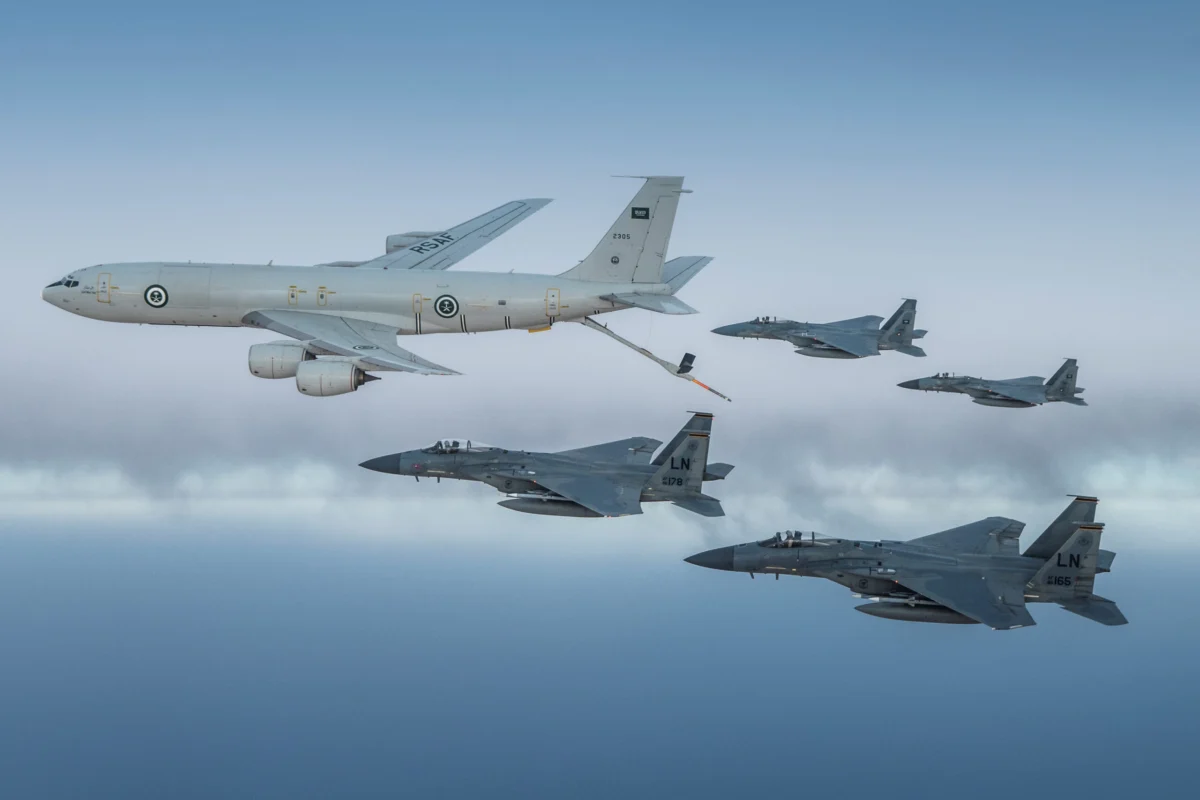
This strategic imperative explains the profound significance of the Royal Saudi Air Force (RSAF) strike on Sana’a International Airport. The objective of this precision strike extended far beyond merely denying a specific aircraft permission to land or preventing a single delivery. The primary goal was to decisively prevent Iran from establishing a permanent and robust logistical architecture capable of sustaining a more sophisticated, long-term proxy campaign against Saudi Arabia’s vital maritime and economic interests. By degrading the airport’s capacity to serve as a hub for Iranian resupply and personnel rotation, Saudi Arabia sought to sever a critical lifeline for the Houthis, thereby limiting their ability to launch more complex and frequent attacks.
The Evolution of Saudi Military Capability
Tehran’s calculations, it appears, increasingly rely on outdated assumptions regarding Saudi military capability. The Saudi-led Joint Forces Command (JFC) bears little resemblance to the force that initially intervened in Yemen nearly a decade ago. Years of hard-learned lessons gleaned from past mistakes, coupled with extensive operational experience in a demanding combat environment, have profoundly transformed it. The JFC has evolved into a highly integrated and sophisticated coalition, meticulously built around persistent intelligence gathering, fused command-and-control systems, precision strike capabilities, advanced air and missile defense networks, and robust cyber operations.
Rather than functioning as disparate military combatant commands operating in silos, these capabilities now operate within a single, cohesive decision-making architecture. This integration allows for the compression of the critical time gap between intelligence collection and the swift, decisive execution of operational responses. This transformation is not limited to the Saudi armed forces alone. The Saudi-led JFC now encompasses a formidable force of over 650,000 personnel, drawn from Saudi Arabia and its key allies, including Yemeni factions, Pakistan, Sudan, and strategically significant, albeit numerically limited, Gulf Cooperation Council (GCC) formations, all operating within a unified operational framework. Its principal advantage lies not merely in its impressive numerical strength but, crucially, in its enhanced ability to synchronize military effects across multiple domains—air, land, sea, and cyber—while maintaining a high operational tempo and, critically, centralized escalation control.
The maturity and efficacy of the JFC became unequivocally evident during the RSAF’s swift and decisive campaign that restored control over southern Yemen in less than a week in January (though the specific year would be critical for precise chronology, assuming it refers to a recent, well-documented operation). This campaign, underpinned by an advanced Command and Control (C2) fused architecture supporting persistent intelligence, sophisticated electronic warfare, precision targeting, and synchronized ground maneuvers, showcased a level of operational sequencing and command integration previously unseen in earlier phases of the Yemen conflict.
This same C2 maturity and operational sophistication were demonstrably evident during Iran’s coordinated missile and drone attacks, launched from both Iranian territory and allied formations in Iraq. In response, the RSAF executed synchronised precision strikes across multiple theatres, effectively neutralizing threats while meticulously maintaining centralized escalation control, preventing the conflict from spiraling out of control. These instances underscore a fundamental shift in Saudi Arabia’s military posture and capability.
The broader consequences of this enhanced operational performance extended far beyond the immediate battlefield. Saudi operational success helped create the necessary conditions under which Pakistan was able to broker an unofficial ceasefire between the Saudis and Iranians. Crucially, it also reinforced a new deterrence equation in the region, one in which any further direct Iranian military pressure now carries significantly greater operational and political risk. Tehran’s subsequent caution, therefore, reflected not solely the outcome of diplomatic efforts but also a clear recognition that the Kingdom had entered a fundamentally different stage of military maturity and readiness. The term "C6ISR architecture" mentioned in the original text refers to Command, Control, Communications, Computers, Cyber, Intelligence, Surveillance, and Reconnaissance, representing a highly advanced, integrated system designed for superior battlespace awareness and rapid decision-making, a capability Riyadh has invested heavily in.
The Limits of Houthi Disruption and the Prospect of Decisive Action
None of this implies that the Houthis are incapable of imposing costs. Their arsenal of missiles, drones, their capacity for maritime attacks, and their well-developed psychological operations remain capable of generating disruption disproportionate to their actual size and conventional military strength. They have demonstrated this repeatedly through attacks on Saudi oil infrastructure, airports, and shipping. However, "disruption" is fundamentally different from sustaining a prolonged, high-intensity confrontation against an opponent that possesses overwhelming advantages in intelligence gathering, air power, maritime control, and operational endurance. The Houthis, despite their resilience and Iranian backing, cannot match the Saudi-led coalition’s integrated military might and logistical depth over an extended period.
Therefore, every act of escalation by the Houthis, particularly those directly threatening international shipping and Saudi economic interests, significantly increases the likelihood of a comprehensive and decisive Saudi response. Such a campaign would not merely be limited to targeting mobile missile launchers or drone facilities, which are often elusive and quickly relocated. Instead, it would be designed to systematically dismantle the entire ecosystem that enables Houthi military operations. This would entail targeting their command-and-control networks, their logistics infrastructure, communications systems, intelligence apparatus, and all forms of operational support, aiming to cripple their ability to wage war effectively. This strategic shift reflects a move from reactive defense to proactive incapacitation of the threat.
Geopolitical Implications and the Road Ahead
The current trajectory, marked by escalating Houthi threats and the underlying Iranian strategy, is profoundly dangerous. Saudi Arabia has consistently demonstrated a clear preference for stability over confrontation, primarily because its overriding strategic priority remains the successful execution of its ambitious economic transformation and long-term national development goals. These goals are predicated on a secure and predictable regional environment. However, no sovereign state can indefinitely tolerate an Iranian-backed proxy continuously threatening its core economy, its critical energy infrastructure, and its vital maritime lifelines. The geopolitical stakes are immense, not only for regional powers but for the global economy. The United States and other international actors have repeatedly expressed concern over Red Sea security and freedom of navigation, recognizing the broader implications of any sustained disruption.
Ultimately, the Houthis, in acting as Iran’s proxy, are not truly testing Saudi military capability. Years of operational adaptation, modernization, and coalition integration have already provided a definitive answer to that question. They are, instead, testing the very limits of Saudi Arabia’s strategic patience. History unequivocally suggests that even the greatest strategic patience has its breaking point. If Tehran persists in utilizing the Houthis as an instrument of coercion and destabilization against the Kingdom, Riyadh may well conclude that the accumulated costs of continued restraint have finally exceeded the costs of decisive and comprehensive action. Should that critical moment arrive, the military campaign that would ensue will bear little resemblance to the Yemen war of a decade ago. It would be a reflection of years of sophisticated coalition integration, leveraging an elaborate C6ISR architecture, meticulously designed and strategically prepared for precisely such a high-stakes conflict. Iran, and by extension, the Houthis, may then find themselves regretting their decision to test the formidable limits of Saudi Arabia’s strategic patience. The consequences could fundamentally reshape the regional power dynamics and the future of maritime security in one of the world’s most vital waterways.
