

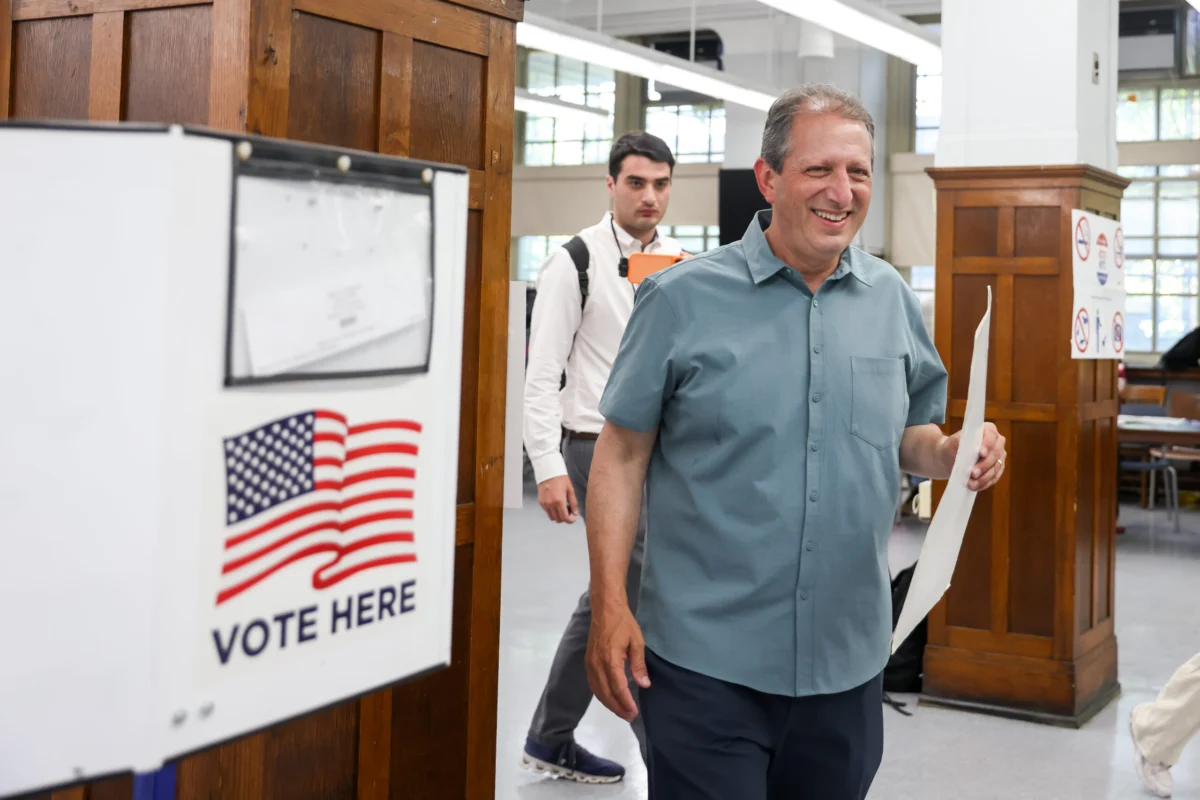
New York’s 10th congressional district, a vibrant and politically engaged swath of Brooklyn and Lower Manhattan, stands on the precipice of a pivotal Democratic primary election on Tuesday, June 23, 2026. What was once anticipated to be a routine re-nomination for two-term incumbent Representative Dan Goldman has devolved into an unexpectedly brutal and contentious battle for political survival against former New York City Comptroller Brad Lander. The contest has become a microcosm of broader ideological fissures within the Democratic Party, testing the limits of progressive influence, highlighting deep divisions within organized labor, and bringing a critical state housing tax law into the national spotlight.
The Unforeseen Challenge to an Incumbent
Conventional wisdom in political circles typically dictates a smooth path to re-nomination for an incumbent like Dan Goldman. With two terms under his belt, Goldman has maintained a largely scandal-free record, cultivated a consistent community presence, and generally avoided the kind of national media controversy that can invite internal party challenges. His voting record aligns closely with the Democratic Party’s mainstream, suggesting a stable and secure electoral footing. Yet, the current political climate, characterized by a potent anti-establishment sentiment sweeping through Democratic primaries nationwide, has made the 2026 cycle anything but conventional.
Brad Lander, a seasoned figure in New York City politics with a strong progressive pedigree, has emerged as Goldman’s formidable challenger. Lander, who finished a distant third in the Democratic primary for city mayor just last year despite a strategic cross-endorsement with then-candidate Zohran Mamdani that aimed to consolidate progressive votes, is now seeking to capitalize on this prevailing anti-establishment mood. His campaign has garnered significant endorsements from influential progressive figures, including the newly installed New York Mayor Zohran Mamdani and U.S. Senator Bernie Sanders (I-Vt.), alongside powerful organizations like the New York Working Families Party. These endorsements have allowed Lander to strategically position himself as the unequivocal progressive alternative to Goldman.
The stakes of this primary extend beyond the individual careers of Goldman and Lander; they represent a crucial test of Mayor Mamdani’s burgeoning political influence and a high-profile benchmark for how deeply the contentious issue of division over Israel impacts election outcomes among Democratic voters. Lander wasted no time securing Mamdani’s backing, announcing the endorsement on the very first day of his candidacy in December 2025, even before Mamdani was sworn into office. "Brad has been a trusted ally and partner of mine, and I’m proud to support him," Mamdani stated at the time, underscoring Lander’s commitment to "delivering for those who need government to show up for them the most."
This message appears to resonate powerfully within New York’s 10th congressional district, which holds the distinction of being the 12th-most leftward-leaning congressional district in the entire country. The district overwhelmingly backed Mamdani in November’s mayoral general election, granting him a nearly 25-percentage-point lead. While polling data for the race remains limited and somewhat varied, a recent Emerson College poll delivered a stunning blow to Goldman’s campaign, showing Lander holding a commanding 34-point lead. Further bolstering Lander’s perceived momentum, prediction markets, often seen as indicators of informed sentiment, have all but declared the race decided in his favor, with his odds on platforms like Kalshi nearing 100%.
The Financial Battle and Strategic Pivots
As the primary race intensified and Lander’s unexpected surge became undeniable, Congressman Goldman, an heir to the Levi Strauss fortune and one of the wealthier members of Congress, responded by pledging to match up to $1 million in campaign donations. This significant financial commitment underscored the gravity of the challenge he faced and his determination to claw back lost ground against a surging progressive tide.
Beyond financial maneuvers, Goldman also pivoted his campaign strategy to focus on an issue historically central to American progressivism: a strong alliance with organized labor. New York City boasts a robust union presence, with approximately 20% of its workforce affiliated with unions, double the national rate. This makes unions indispensable electoral allies in political contests across the city, often leading to a fierce competition among candidates to demonstrate the deepest appreciation for labor’s concerns and priorities. Goldman’s campaign aimed to leverage his incumbency and legislative record to secure the loyalty of this powerful voting bloc, presenting himself as the steadfast champion of the working class.
Section 485-x: A Focal Point for Labor and Housing Debate
Over the past month, a specific labor concern has emerged as a central point of contention in the race: Brad Lander’s outspoken opposition to Section 485-x of the New York State Real Property Tax Law. This complex statute, which replaced the long-standing Section 421-a in April 2024, is designed to incentivize developers to construct affordable housing by offering tax breaks for up to 40 years. Crucially, it also includes provisions for strict wage floors and mandatory annual wage increases for construction workers on these projects.
Under Section 485-x, construction work on eligible sites with at least 100 units must offer a minimum wage of $40 per hour. For buildings exceeding 150 units, the minimum wage is even higher, set at either $63 or $72.45 per hour, depending on the construction zone, or a relative percentage of the zone’s greatest prevailing wage. These wages are further subject to a 2.5% annual increase, aiming to ensure fair compensation and maintain living standards for workers.
However, a significant loophole exists: none of these stringent requirements apply to sites with fewer than 100 units. This exemption has created a powerful incentive for developers to construct housing developments of 99 units or less, potentially undermining the program’s dual goals of increasing affordable housing and protecting construction worker wages.
Lander has been a vocal critic of this aspect of the law. In a forum last month with New York Law School, he articulated his concerns: "I think that the governor gave in to the building trades, and, as a result, no new housing is being produced under that program." He further characterized the 485-x approach as "cockamamie," criticizing its "different zones and a made-up wage level" for creating "a whole new bureaucracy in order for the governor to satisfy the building trades, and now no new housing is being built."
Goldman seized upon Lander’s critique, attempting to frame his opponent as anti-labor. In a late May Facebook post, the congressman noted, "My opponent says he’s the true progressive in this race, which is interesting, because he clearly has a problem with our city’s labor unions." He continued, "Last week in a forum, he blamed the building trades for… our housing crisis in New York City. That doesn’t seem very much like pro-labor to me; that doesn’t seem very progressive."
Lander’s campaign, in turn, has doubled down on its position, arguing that the loophole in 485-x has demonstrably failed to produce affordable housing and has simultaneously devalued construction work standards. A spokesperson for Lander told Spectrum News 1, "Brad has criticized the 485x program because it’s just not working to build affordable housing or to protect workers and everyone knows it. It’s strange for elected officials or labor union officials to be defending a program in which 99% of the developments have taken advantage of a loophole that requires zero affordable housing or good jobs."
Union Reactions and the Fissures in Labor Support
The building trades unions, representing the very workers engaged in 485-x construction projects, have reacted with considerable vehemence to Lander’s criticisms. Kevin Elkins, the NYC District Council of Carpenters’ director of political action, publicly labeled Lander "Scab Lander" in a May X post – a particularly harsh line of attack in labor circles, equating Lander’s stance to crossing a strike picket line. Later that same month, members of the NYCDCC demonstrated outside Lander’s Brooklyn office, chanting "Who’s the rat? Lander!" These actions underscore the deep resentment felt by some segments of organized labor toward Lander’s position on the housing law. The Lander campaign did not provide a comment to CNBC regarding these specific union reactions.
Goldman has strategically leaned into the support from unions like the NYCDCC, frequently rallying with carpenters, touting their endorsements, and relentlessly attacking his opponent as inconsistent on labor issues. In a statement shared with CNBC, Goldman affirmed, "New York’s working families and organized labor have been my North Star throughout my time in office, and I’m deeply honored that the overwhelming majority of unions representing the hard-working men and women who keep New York City running are supporting me in this race." He added, "I will always fight for organized labor – the heart and soul of our city."
However, Goldman’s attempt to position himself as the singular champion of labor in the race is complicated by the fact that union support is far more splintered than is typical for an incumbent in his position. For context, in a similarly precarious electoral situation, Representative Adriano Espaillat (D-N.Y.), facing a challenge from his left in a district north of Goldman’s, has seen organized labor line up nearly unanimously behind his candidacy, despite his opponent being a current union member. Similarly, past progressive insurgencies, such as Alexandria Ocasio-Cortez’s upset victory in the 2018 NY-14 Democratic primary and Jamaal Bowman’s 2020 win in NY-16, saw NYC unions largely united in support of the incumbent representatives. This year in NY-10, the consensus is absent.
While twenty New York City-based labor unions have endorsed Goldman’s re-election bid, including the powerful New York State AFL-CIO, their statements reflect a focus on his legislative record. Mario Cilento, president of the New York State AFL-CIO, cited Goldman’s fight "to create thousands of family-sustaining construction jobs in Brooklyn" and his co-sponsorship of a bill to tax corporations that pay executives significantly more than their workers. Janella Hinds, vice president for academic high schools at the United Federation of Teachers, stated at a June campaign rally, "We need Dan Goldman to make sure that the voices of working people are always heard, that unionized workers have a voice in Congress and in our government."
Yet, a significant number of high-profile unions, including the United Auto Workers (UAW), the New York State Nurses Association (NYSNA), and the Communications Workers of America (CWA), have enthusiastically thrown their weight behind Brad Lander. A CWA spokesperson lauded Lander, stating, "There really is no legislator who has been a greater friend to CWA than Brad Lander." They highlighted his dedication to public service and his consistent advocacy for working people, noting, "He’s devoted his entire career to public service, and in every elected office he’s held, he’s used his position to advocate for working people and has really walked the walk in terms of prioritizing working families and the middle class." The CWA specifically cited Lander’s potential to push for crucial pro-labor legislation, such as the Protecting the Right to Organize (PRO) Act, as a key factor in their endorsement.
This sentiment reflects a broader national frustration among labor leaders regarding the persistent gridlock that has stalled major labor reforms under previous Democratic administrations. As a result, the focus of reform efforts has increasingly shifted from the federal level to state and municipal scales, where figures like Lander have demonstrated legislative effectiveness. Manny Pastreich, President of 32BJ SEIU, also endorsed Lander, citing a close working relationship and Lander’s record as NYC Comptroller, where he "worked furiously to enforce our city’s worker protection laws and helped win justice and overdue wages for thousands of wronged workers." Pastreich also lauded Lander’s work in the City Council, where he "passed new labor standards like the Fair Workweek Law to help bring stability to working peoples’ lives, legislation that was a 32BJ top-priority."
Chronology of a Contentious Primary Battle
The battle for NY-10 has unfolded over several critical months:
- December 2025: Brad Lander officially launches his congressional candidacy, immediately securing the high-profile endorsement of Mayor Zohran Mamdani, who had not yet been sworn into office.
- April 2024: Section 485-x of the New York State Real Property Tax Law is enacted, replacing the long-standing Section 421-a, setting the stage for future debate.
- April 2026: Facing an increasingly competitive primary, Congressman Dan Goldman pledges to match up to $1 million in campaign donations, signaling his intent to aggressively defend his seat.
- May 2026: During a forum with New York Law School, Lander publicly criticizes Section 485-x, sparking immediate backlash from building trades unions. Goldman seizes on these comments, using a Facebook post to attack Lander as anti-labor. Later that month, members of the NYC District Council of Carpenters protest outside Lander’s Brooklyn office.
- June 18, 2026: A high-profile "Our Team, Our Year" Get Out The Vote (GOTV) rally is held at the Kings Theatre in Brooklyn, featuring U.S. Senator Bernie Sanders, Mayor Zohran Mamdani, Brad Lander, and fellow progressive candidate Claire Valdez, signaling a united progressive front.
- June 19, 2026: Congressman Dan Goldman is seen voting with his family in lower Manhattan, fulfilling his civic duty as the primary election approaches.
- June 21, 2026: Brad Lander casts his ballot at a polling location inside John Jay High School during early voting in Brooklyn, demonstrating his engagement with the electoral process.
- June 23, 2026: Primary Election Day. Voters in New York’s 10th congressional district head to the polls to decide the Democratic nominee.
Implications and the Road Ahead
For organized labor, the Goldman vs. Lander contest presents a rare and intriguing strategic dilemma: do unions preserve institutional power and back a labor-friendly incumbent with an established track record, or do they go all-in for an upstart progressive who they believe offers a more effective legislative path for their priorities? The splintered endorsements reflect this internal tension, showcasing a growing divergence in strategies among different union factions in an era of heightened political polarization and legislative gridlock.
The outcome of Tuesday’s primary will reverberate far beyond the borders of NY-10. For the Democratic Party, it will serve as a crucial barometer of the strength of the progressive movement against established incumbents, particularly in deep-blue urban districts. A Lander victory would further empower Mayor Mamdani and solidify the influence of the city’s progressive wing, potentially signaling a broader shift in local and even national Democratic politics. Conversely, a Goldman victory would demonstrate the resilience of mainstream Democratic power, even amidst significant progressive challenges.
For housing policy in New York State, the debate over Section 485-x is unlikely to conclude with the primary. Lander’s critique, amplified by his campaign, has brought renewed scrutiny to the law’s effectiveness in delivering affordable housing and protecting workers, particularly concerning the under-100-unit loophole. Regardless of the election’s outcome, legislative adjustments or further advocacy around this complex tax incentive program are highly probable.
As pundits analyze and prediction markets forecast, the ultimate decision rests with the voters of New York’s 10th congressional district. What is certain is that this New York City congressional race has become a high-profile, multi-faceted contest with the potential to emerge as a key answer to fundamental questions about the future trajectory of the Democratic Party, the evolving role of labor, and the efficacy of progressive policy in urban America. The results on Tuesday night will undoubtedly send a powerful message across the political landscape.
