

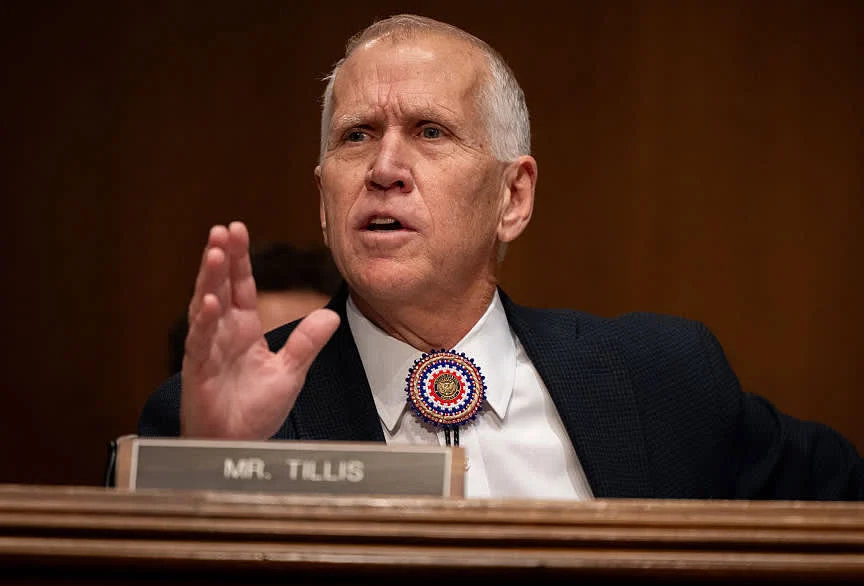
Republican Senator Thom Tillis of North Carolina on Wednesday delivered a searing critique of President Donald Trump’s selection of Bill Pulte to serve as the acting Director of National Intelligence (DNI), labeling him an "incendiary attack dog" with no viable path to Senate confirmation. Speaking on CNBC’s "Squawk Box," the retiring senator amplified a growing chorus of bipartisan backlash against Pulte, who currently heads the Federal Housing Finance Agency (FHFA) and was appointed to the top intelligence post on an acting basis on Tuesday, in addition to his existing housing responsibilities. Tillis emphatically stated, "I don’t think he has a prayer" of navigating the Senate confirmation process to become the permanent DNI.
The Controversial Appointment and the Gravity of the DNI Role
President Trump’s decision to tap Bill Pulte as acting DNI, announced via Truth Social, has ignited a firestorm across Washington, DC. The move sees Pulte, a figure with no known prior experience in intelligence, simultaneously holding one of the nation’s most sensitive national security positions while continuing his leadership roles at the FHFA and as chairman of mortgage giants Fannie Mae and Freddie Mac. Pulte is set to succeed outgoing DNI Tulsi Gabbard, whose resignation is effective June 30.
The Director of National Intelligence serves as the principal advisor to the President, the National Security Council, and the Homeland Security Council on intelligence matters related to national security. Established in the wake of the 9/11 attacks by the Intelligence Reform and Terrorism Prevention Act of 2004, the DNI’s primary mandate is to integrate foreign, military, and domestic intelligence information from the 18 agencies comprising the U.S. Intelligence Community (IC). This includes overseeing the National Intelligence Program and ensuring effective coordination and information sharing to protect the nation from complex and evolving threats. The position demands a leader with deep expertise in national security, extensive geopolitical understanding, a proven record of non-partisanship, and the trust of both the intelligence community and Congress. Critics argue Pulte lacks virtually all these essential qualifications.
Senator Tillis’s Scathing Assessment
Senator Tillis’s remarks were not merely critical but bordered on an indictment of the White House’s judgment. He lambasted the decision-making process, asserting, "Whoever told the president to go ahead and commit to this publicly before vetting it should lose their jobs, because they should know that the math just works against Pulte being confirmed." The senator further expressed his exasperation with what he termed "amateur hour" in the White House, adding pointedly, "Whoever these people are in the White House need to get the hell out of the White House."
Tillis meticulously outlined his concerns regarding Pulte’s suitability for the DNI role. "I don’t believe he’s ever had a security clearance. He clearly has no experience in intelligence, he has no geopolitical experience, no international connections – the sorts of things you would look for" in a DNI, Tillis articulated. This stark absence of traditional qualifications, Tillis argued, presents a "structural problem" that makes Senate confirmation a near impossibility. "He simply doesn’t have 51 votes on the Senate floor, and he may not even have the votes in [the Senate Intelligence] committee, and we just need to tell the president that clearly," he concluded, underscoring the political reality facing Pulte.
Beyond the lack of experience, Tillis also raised questions about Pulte’s temperament. He referenced reports that Pulte, a scion of the founder of homebuilding giant PulteGroup, was removed from the company’s board in 2020 amid disagreements with other directors after the family’s ownership stake fell below 51%. The senator also cited a public statement from the Pulte Family Charitable Foundation clarifying that Bill Pulte, known for his highly active and often controversial social media presence, "does not speak for his family in any capacity" and that his father and aunt had disavowed any association with their family trust due to his critical statements. "Why do I bring that up? I bring it up because it suggests a temperament that’s probably not right for the DNI role," Tillis explained, hinting at concerns over judgment and ability to manage complex, sensitive relationships crucial to intelligence work.
Bipartisan Alarm Bells Ring Across Capitol Hill
Tillis is far from alone in his opposition. The appointment has united an unusual coalition of lawmakers from both sides of the aisle, all expressing profound concerns.
Republican Opposition:
Senate Majority Leader John Thune (R-S.D.), a key figure in the Republican leadership, voiced strong reservations, telling reporters on Capitol Hill, "We don’t need a weaponized DNI, we need professionals there." This statement directly echoed concerns that Pulte has previously used his federal position to target political opponents. Senator Bill Cassidy (R-La.), who recently lost his primary election despite Trump’s endorsement of a rival, flatly stated during a CNBC CEO Council Summit interview that Pulte does not appear "competent" to serve as acting DNI. These remarks from influential Republicans signal a significant breach with the White House, suggesting that the customary deference to presidential appointments, particularly for an "acting" role, is being overridden by serious concerns about national security and the integrity of the intelligence apparatus.
Democratic Opposition:
The most forceful Democratic opposition has come from Senate Intelligence Committee Vice Chairman Mark Warner (D-Va.), who urged Leader Thune to help convince Trump to reverse Pulte’s appointment, according to sources familiar with the matter. Warner on Tuesday articulated his "pause" regarding the appointment, stating, "The idea that you put in somebody unqualified, who also has a record of weaponizing confidential information, and I’m supposed to ask, ‘just trust us?’" Warner’s concerns extend beyond mere apprehension, escalating to a direct threat: if the reversal doesn’t happen, "all options are on the table," including scuttling a crucial bipartisan deal to extend Section 702 of the Foreign Intelligence Surveillance Act (FISA). This threat highlights the deep mistrust Pulte’s appointment has engendered and the potential for it to derail critical legislative priorities.

Pulte’s Record at FHFA: A Precedent for Controversy
Pulte’s tenure as head of the Federal Housing Finance Agency has been marked by a series of controversies that now fuel the widespread opposition to his intelligence appointment. Critics point to his alleged use of access to mortgage records within the federal housing apparatus to target individuals perceived as political enemies of the President, referring them for prosecution. This history has particularly alarmed intelligence analysts and lawmakers who fear that Pulte, now holding the keys to the nation’s most sensitive secrets, could politicize the intelligence community.
Among the high-profile targets of Pulte’s alleged mortgage-related investigations were Federal Reserve Governor Lisa Cook and New York Attorney General Letitia James. While no charges or official findings of wrongdoing have been publicly confirmed in relation to Pulte’s referrals, the accusations themselves have painted a picture of an official willing to leverage his office for political ends. Such actions are seen as anathema to the principles of an independent and apolitical intelligence community.
Further underscoring concerns about Pulte’s temperament and ability to foster collaborative working relationships, the article notes a particularly acrimonious incident involving Treasury Secretary Scott Bessent. In a Senate Finance Committee hearing on Wednesday, when Tillis directly asked Bessent if he had threatened to punch Pulte, Bessent candidly replied, "I actually said I was going to kick his ass." While Bessent attempted to downplay the incident as "locker room" friction, the public admission of such a severe personal threat between two high-ranking administration officials speaks volumes about Pulte’s capacity to rub colleagues the wrong way and create internal discord. This anecdote further reinforces Tillis’s concerns about the "temperament" required for the DNI role, which necessitates seamless cooperation across numerous agencies and with international partners.
Implications for National Security and the Legislative Agenda
The ramifications of Pulte’s appointment extend far beyond internal White House politics, threatening to destabilize crucial national security operations and legislative efforts.
The Fate of FISA Section 702:
One of the most immediate and critical implications is the potential collapse of efforts to reauthorize Section 702 of the Foreign Intelligence Surveillance Act. Section 702 is a vital intelligence tool that allows the U.S. government to conduct warrantless surveillance of non-U.S. persons located outside the United States to collect foreign intelligence information. While controversial due to the incidental collection of data on U.S. persons, it is widely considered indispensable by intelligence agencies for preventing terrorist attacks, thwarting cyber threats, and countering foreign adversaries. Congress has been deadlocked on its reauthorization for weeks, with a looming deadline. Senator Warner’s explicit warning that Pulte’s appointment could tank a bipartisan deal underscores the high stakes. Failure to reauthorize FISA 702 would create significant intelligence gaps, potentially leaving the nation vulnerable at a time of heightened global instability. The appointment of a DNI perceived as unqualified and politically compromised could erode the trust necessary to pass such sensitive legislation.
Executive-Legislative Relations and the "Acting" Loophole:
Pulte’s appointment exacerbates a simmering rift between the White House and the Senate, which has been repeatedly angered by a series of moves from the executive branch. President Trump has a history of appointing "acting" officials to high-level positions, often circumventing the Senate’s constitutional "advice and consent" role for permanent appointments. While an acting DNI can serve for a limited period, the administration could theoretically keep Pulte in the acting capacity indefinitely, avoiding a likely defeat in a confirmation vote. This tactic, however, typically fuels further animosity with Congress, undermines the stability of agencies, and raises questions about accountability and transparency. The DNI position, designed to be a non-partisan coordinator, requires the full trust and confidence of both the executive and legislative branches, which an "acting" official under a cloud of controversy struggles to command.
Integrity of the Intelligence Community:
Perhaps most significantly, Pulte’s appointment raises serious concerns about the politicization of the U.S. Intelligence Community. The DNI is tasked with ensuring objective, unbiased intelligence analysis. Placing an individual with a perceived history of "weaponizing" federal resources and lacking intelligence experience at the helm risks eroding the IC’s independence, morale, and global reputation for impartiality. Intelligence professionals rely on a DNI who commands respect, understands the nuances of complex global threats, and prioritizes national security over political agendas. A DNI seen as an "attack dog" could jeopardize the IC’s ability to provide truthful assessments to policymakers, potentially undermining critical decision-making processes during national security crises.
The Path Forward: Confirmation Battle or Prolonged Acting Status?
The White House, when asked about Tillis’s comments, reiterated a statement from Tuesday, with spokesman Davis Ingle asserting via email, "The President chooses the best and most talented people to serve in his Cabinet. Bill Pulte is a great selection and he will do a great job on behalf of the American people." This official response suggests the administration is standing by its controversial pick, at least publicly.
However, the political reality, as articulated by Senator Tillis, points to a clear dilemma for the Trump administration. Pushing for Pulte’s full confirmation appears to be an uphill, if not impossible, battle given the widespread bipartisan opposition. The alternative – leaving Pulte in place with the "acting" title – would allow the administration to skirt a Senate vote but would likely perpetuate the controversy, further strain relations with Congress, and potentially create ongoing instability within the intelligence community. The DNI position requires a leader who can build consensus and foster trust across political divides, a task made exponentially more difficult by the circumstances of Pulte’s appointment and his contentious past. As the legislative calendar progresses and critical issues like FISA 702 reauthorization hang in the balance, the White House faces tough choices regarding the leadership of the nation’s intelligence apparatus, with potential profound implications for national security and governmental function.
