

The first half of 2026 has been a crucible for global business leaders, marked by a volatile cocktail of escalating geopolitical conflicts, pervasive trade disruptions, and abrupt policy shifts. This period of significant uncertainty has forced a recalibration of corporate strategies, with Chief Executive Officers (CEOs) now signaling a decisive pivot towards revenue and market-share growth for the remainder of the year. A recent survey by Chief Executive reveals a marked shift in focus from the ambitious, multi-faceted agendas that characterized the start of the year to a more concentrated drive for tangible business expansion.
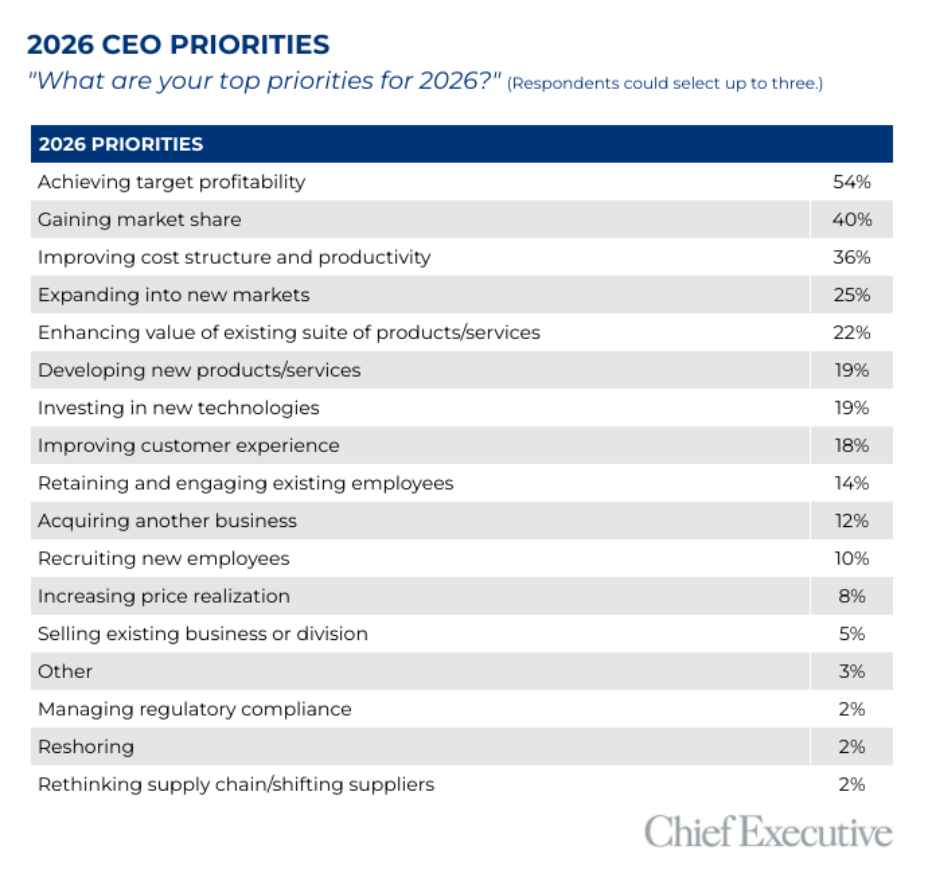
At the dawn of 2026, a survey conducted by Chief Executive painted a picture of proactive ambition. CEOs articulated a broad spectrum of priorities, including aggressive market entry into new territories, robust product development, enhancement of existing offerings, substantial investments in cutting-edge technology, a deep commitment to improving customer experiences, and a sustained effort to drive operational productivity. This initial outlook suggested a business landscape poised for innovation and expansion, fueled by a generally optimistic outlook.
However, the ensuing eight months have delivered a relentless barrage of geopolitical and policy surprises. These unforeseen events have fundamentally altered the operating environment, compelling leaders to reassess their strategic allocations. When Chief Executive revisited CEOs in August 2026 to gauge their focus for the latter half of the year, the responses indicated a more streamlined and urgent set of priorities.
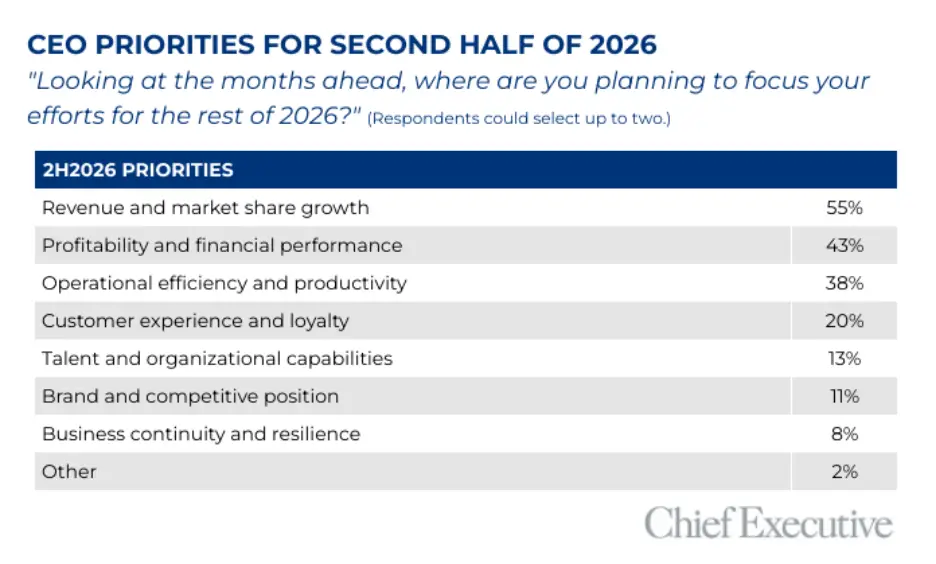
The latest findings from the Chief Executive CEO Confidence Index, conducted on August 4-5, 2026, with responses from 285 CEOs, underscore this strategic realignment. Revenue and market-share growth have emerged as the paramount objectives, cited by 55 percent of respondents as their primary focus. Following closely are profitability and financial performance, prioritized by 43 percent of CEOs, and operational efficiency and productivity, a key concern for 38 percent. Other strategic considerations, while still important, have receded in immediate emphasis.
The Ascendancy of AI as a Growth Catalyst
While direct comparisons between the January and August surveys require careful consideration due to differing methodologies—the earlier survey allowed for up to three priorities from a broader list, whereas the latter requested just two overarching areas—the aggregate results strongly suggest a strategic conversion of initial groundwork into concrete actions. Artificial Intelligence (AI) has notably emerged as a pivotal tool in this accelerated push for growth.
Numerous CEOs highlighted the critical need for robust organizational frameworks to underpin this intensified pursuit of growth. One executive described the challenge as "managing growth pace against operational structures and consistencies," a sentiment that underscores the complex balancing act required to scale effectively in a dynamic environment.
For a significant segment of these leaders, AI is not merely a technological upgrade but an integral component of their growth strategy. As one CEO, keenly focused on revenue growth and operational efficiency in the latter half of 2026, explained, the imperative is to "spin up new business lines in AI to make up for legacy product stagnation." This sentiment reflects a broader industry trend where established revenue streams are being supplemented or revitalized through AI-driven innovation.
Bill Estes, president of Geokon, a manufacturer specializing in geotechnical and structural instrumentation, has witnessed this transformation firsthand. "Adoption of AI is significantly improving efficiency and data intelligence," he commented, underscoring the tangible benefits derived from integrating AI into core operations. This sentiment is echoed by Jim Donnelly, CEO of Wayne Bank in Honesdale, Pennsylvania. He is actively working to "make the business more efficient" through the implementation and scaling of new technologies, aiming to "minimize operational constraints." These examples illustrate how AI is being leveraged not just for future-forward initiatives but also to optimize existing processes and mitigate current operational bottlenecks.
This intensified focus on AI builds directly upon the foundational priorities identified at the beginning of the year: entering new markets, enhancing existing products and services, developing new offerings, investing in new technologies, and improving customer experience. Paul Riedl, Jr., CEO of River Run, a managed IT and cybersecurity services firm based in Glendale, Wisconsin, emphasizes the necessity for companies to learn to use AI judiciously to accelerate growth. "Our business is affected by AI," he stated, cautioning other leaders about the escalating pressure to adapt. His personal focus for the coming months is clear: "AI Implementation and getting people to use it as a tool to leap forward." This perspective highlights that the strategic adoption of AI is not solely a technological challenge but also a significant organizational and cultural one, requiring active engagement and adaptation from the workforce.
The Overlooked Imperatives: Talent and Resilience
Perhaps one of the most striking revelations from the Chief Executive survey lies at the bottom of the priority list. Talent and organizational capabilities, despite ongoing workforce challenges, were selected by only 13 percent of CEOs as one of their top two areas of focus for the remainder of 2026. This stands in stark contrast to the pervasive visibility of workforce issues elsewhere in the survey.
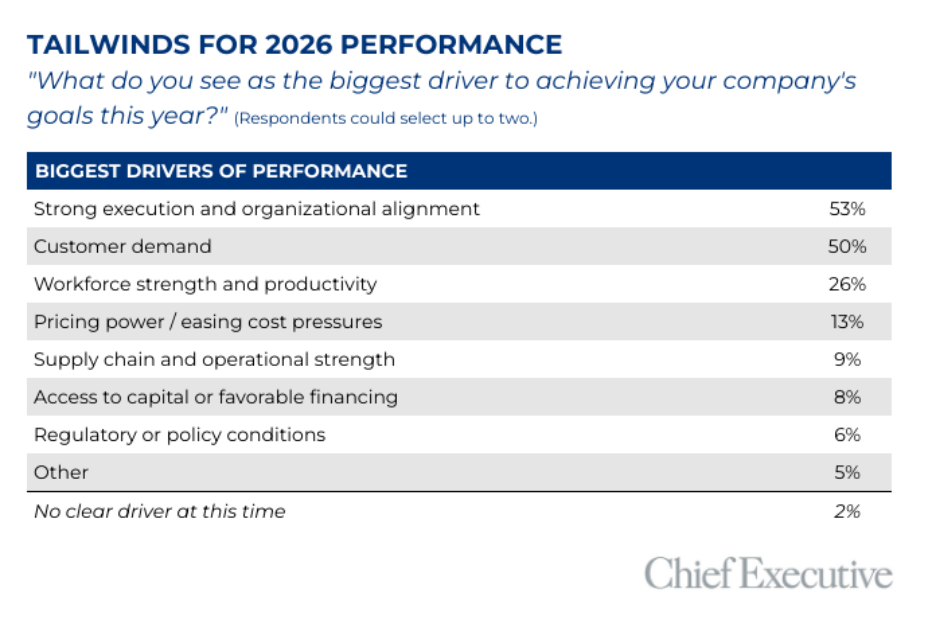
A significant 27 percent of CEOs identified talent shortages or workforce constraints as one of the most substantial obstacles to achieving their goals. Furthermore, 26 percent acknowledged workforce strength and productivity as a key driver of success, while 22 percent pointed to workforce availability and labor costs as a major external risk. This disconnect suggests a potential strategic blind spot, where the critical human element is being sidelined in the immediate pursuit of growth.
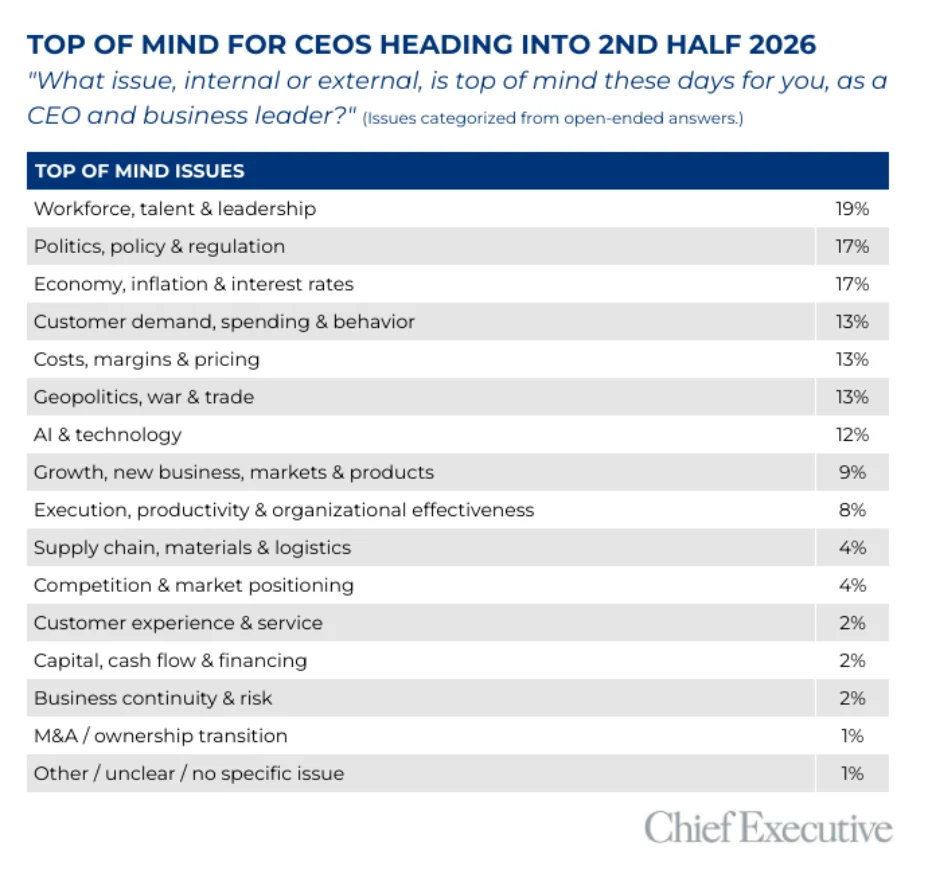
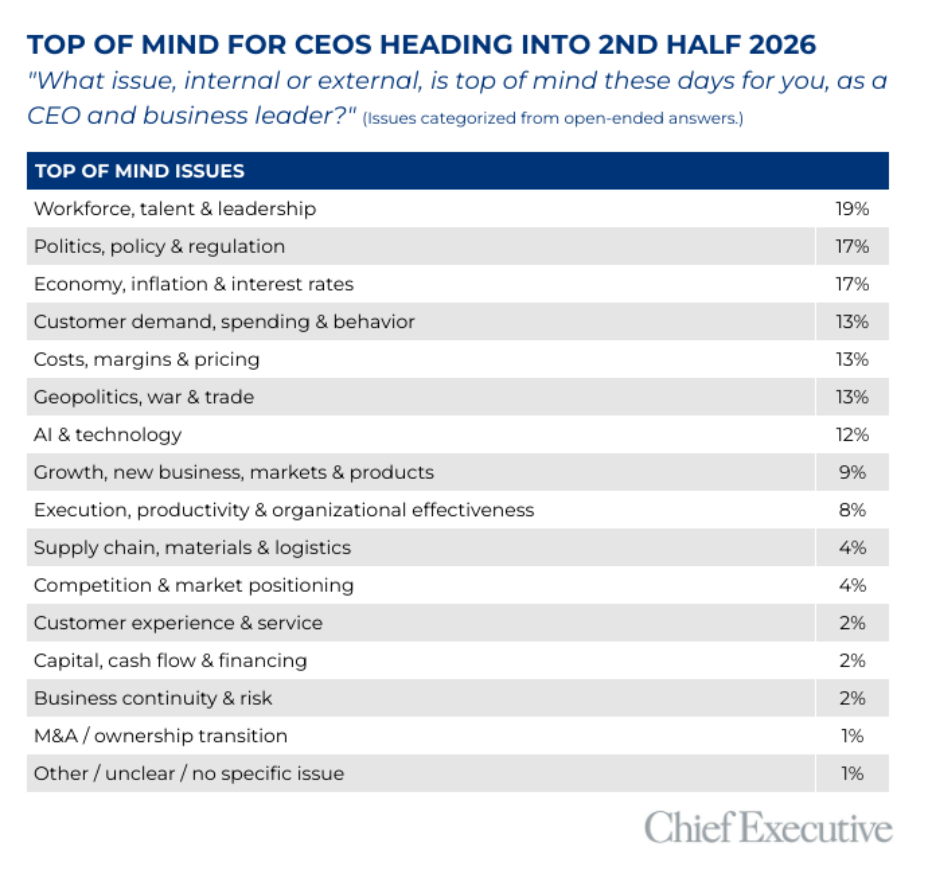
The divergence becomes even more pronounced when CEOs are given the opportunity to articulate their concerns in their own words. When asked to identify the single most pressing internal or external issue, "workforce," "talent," and "leadership" emerged as the most frequently cited themes, appearing in 19 percent of unprompted responses. This indicates that while explicit prioritization may be low, the underlying concerns about human capital remain a significant preoccupation for many leaders.
Gladiola Unzueta, founder and CEO of MultiGla Strategies, a provider of integrated financial services and business consulting, views talent as a crucial differentiator for future success. "The companies that will lead in the coming years will not simply adopt new technology; they will build strong cultures, invest in their people, and remain adaptable," she asserted. "AI is transforming business, but trust, leadership, and execution will continue to be the true competitive advantages." This viewpoint emphasizes that technological advancement alone is insufficient; it must be complemented by strong organizational culture and human leadership.
Chris Burkhard, president and founder of Placers Staffing & Recruitment, observes an acceleration in the pace of hiring and firing, noting, "There is a normalization to the market churn that is just beginning." He adds that labor shortages and skill gaps are making workforce strategy acutely relevant once again, stating, "AI falls short in replacing humans." This perspective highlights the enduring importance of human skills and the limitations of current AI capabilities in fully replicating complex human attributes.
Interestingly, CEOs who are explicitly prioritizing talent appear to be those with more optimistic growth projections. Nearly 90 percent of these leaders expect revenue to increase this year, compared to 73 percent among those who did not select talent as a top priority. Similarly, 63 percent anticipate adding headcount, a figure significantly higher than the 44 percent among their counterparts who are not prioritizing talent. This correlation suggests that a proactive approach to talent management may be a precursor to, or a facilitator of, stronger business performance.
A similar disconnect emerges concerning business continuity and resilience. Only 8 percent of CEOs designated this as a top area of focus. This is noteworthy given that 45 percent of respondents identified inflation and economic conditions as major external risks, and 39 percent cited geopolitical conflict or trade disruption. The under-prioritization of resilience, despite significant external threats, raises questions about long-term strategic planning versus immediate operational imperatives.
Navigating Competitive Landscapes and Evolving Risks
Another area revealing a strategic tension is competitive positioning. Merely 11 percent of CEOs selected brand and competitive position as a top focus. Yet, a substantial 25 percent identified competition and market disruption as a major external risk. When CEOs were asked, without predefined options, about their top concerns, AI and technology were independently raised by 12 percent. Their comments frequently alluded to anxieties surrounding AI-driven disruption, the imperative to adapt business models rapidly, and the need to stay ahead in an increasingly technologically advanced marketplace. This suggests that while leaders recognize the competitive threat and opportunities presented by AI, it is not consistently translating into explicit strategic prioritization of brand and competitive positioning itself.
Persistent Challenges and Emerging Headwinds
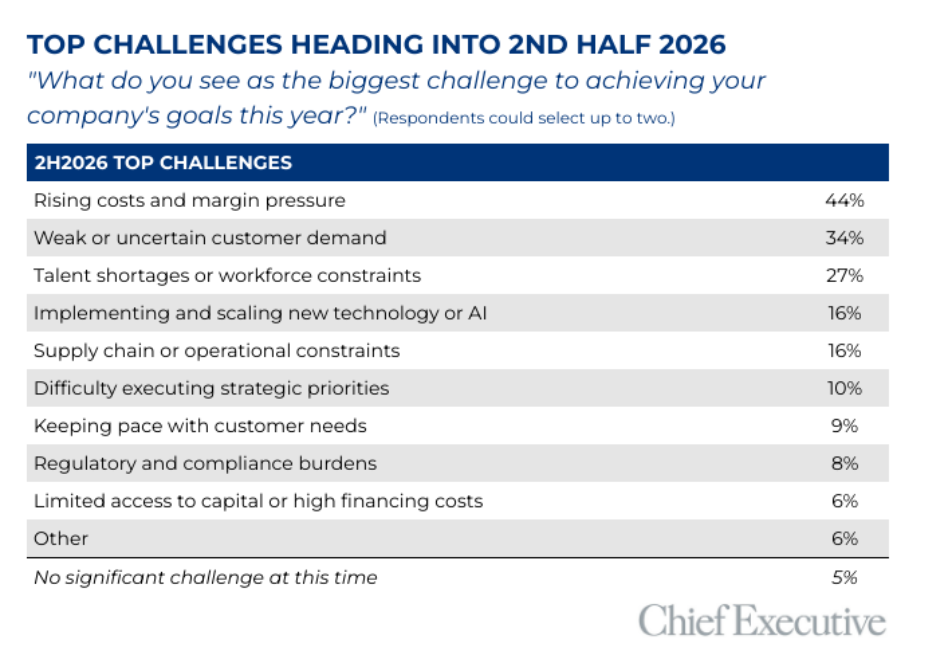
Despite the clear focus on growth and the integration of AI, several persistent challenges threaten to impede progress. Rising costs and margin pressure remain the most commonly cited hurdle to achieving company goals, affecting 44 percent of CEOs. Weak or uncertain customer demand follows closely, identified by 34 percent. Talent shortages or workforce constraints are also a significant concern for 27 percent of leaders.
The perception of customer demand is notably divided. Exactly half of the polled CEOs identified it as a major tailwind, fueling their growth ambitions. Conversely, roughly a third perceive weak or uncertain demand as a significant challenge. For some businesses, demand is indeed a powerful engine for expansion. As one CEO noted, "Demand is accelerating," while another observed that "the market has remained stronger than expected for longer than expected." However, for others, the economic reality is starkly different. One respondent lamented that "high costs/inflation is finally shrinking consumer demand," illustrating the bifurcated economic landscape.
External risks continue to loom large. Inflation and economic conditions sit at the forefront, followed by geopolitical conflict or trade disruption, competition and market disruption, workforce availability and labor costs, and evolving customer behavior. These multifaceted risks underscore the complex and unpredictable environment in which businesses are operating.
The Path Forward: Execution and Alignment Amidst Volatility
Despite these potential hurdles and the acknowledged risks, the dominant sentiment among CEOs for the remainder of 2026 is a resolute commitment to growth. Fifty-five percent of leaders are directing their primary efforts toward revenue and market-share expansion. Crucially, 53 percent also cite strong execution and organizational alignment as one of the most significant drivers enabling them to achieve their goals. This suggests that while the external environment is challenging, a strong internal focus on efficient execution and cohesive strategic direction is seen as the most effective means to navigate uncertainty and capitalize on opportunities. The interplay between ambitious growth targets and the pragmatic need for robust execution, particularly in the context of AI integration and ongoing talent considerations, will define the corporate landscape for the remainder of this turbulent year.
