

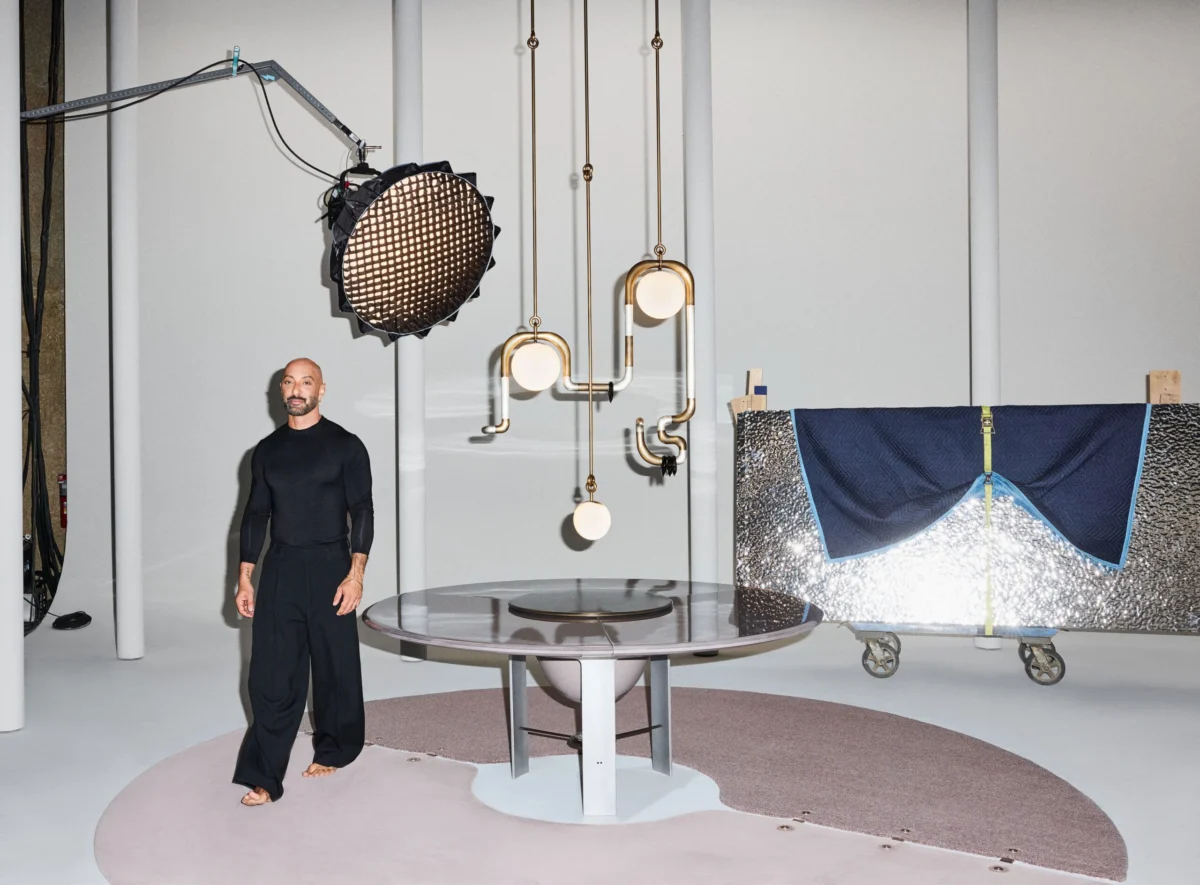
Gabriel Hendifar, the artistic director and CEO of the New York-based design studio Apparatus, has officially debuted his latest body of work, titled Act V: Afsaneh. The collection, which spans lighting, furniture, and textiles, represents a significant departure from the studio’s previous iterations by grounding its aesthetic in Hendifar’s personal lineage and Iranian-American identity. Named after his mother—whose name, Afsaneh, translates to "fable" in Persian—the collection explores themes of the divine feminine, the transmission of cultural knowledge, and the resilience of civilizations during periods of intense artistic flowering. This release follows a four-year development period during which Hendifar sought to reconcile his heritage with the modernist, high-luxury language that has defined Apparatus since its founding in 2012.
The genesis of Act V: Afsaneh can be traced to a specific cultural moment in March 2023. During a Persian New Year (Nowruz) celebration cohosted with chef Andy Baraghani, Hendifar engaged in a musical performance with his mother and his sister, Nic. As his mother sang and his sister played the tombak, a traditional Persian hand drum, Hendifar found himself at the piano, realizing that they had sonically re-created the atmosphere of his childhood home in Los Angeles. For Hendifar, whose mother immigrated to the United States from Tehran, this realization served as a catalyst for a new design direction. He described the experience as a "cornerstone" of his identity slipping back into place, prompting a desire to translate that sense of domestic and cultural belonging into physical forms.
A Chronology of Development and Design Evolution
The development of Act V: Afsaneh occurred alongside Hendifar’s personal relocation to a new loft in New York City’s SoHo district. This dual process of designing a commercial collection while simultaneously curating a private living space allowed for a rigorous exploration of how objects facilitate human interaction and "honor the guest." The timeline of the collection’s creation reflects a move toward slower, more contemplative production cycles within the luxury design industry.

- 2012–2020: Apparatus establishes itself as a premier New York design house, known for its moody, cinematic interiors and use of patinated metals and horsehair.
- 2020–2023: Hendifar begins researching the "divine feminine" and the matriarchal influences in his family. He starts assembling mood boards that look beyond the Western canon, focusing on Iranian history and global cultural peaks.
- March 2023: The Nowruz party provides the emotional and narrative breakthrough required to finalize the collection’s themes.
- 2023–2024: Prototype development commences, involving experiments with large-scale fiberglass casting and the integration of semiprecious stones.
- Late 2024: The collection is unveiled, marking the studio’s 14th year of operation and the fifth major "Act" in its narrative-driven portfolio.
Throughout this period, Hendifar sought to move beyond mere aesthetic appropriation of Persian motifs. Instead, he utilized "universal forms" to tell a story about the lifecycle of knowledge. This approach resulted in four distinct design pillars within the collection: the seed, the flower, the serpent, and the world.
The Four Pillars: Symbolism and Form
The collection is structured around a quartet of symbolic entities, each rendered through specific materials and typologies. These pieces function as both functional objects and narrative vessels.
Esfand: The Seed
The Esfand series consists of ovoid lamps and incense holders. In Persian culture, the burning of wild rue (esfand) seeds is a ritual used to ward off the "evil eye" and cleanse a space. Hendifar translates this ritualistic element into hardware and lighting that mimics the shape of the seed, utilizing materials such as aged aluminum and custom speckled lacquer.
Gol: The Bloom
The Gol series (meaning "flower") features diaphanous pendants. To achieve a sense of floral delicacy at a grand scale, the studio employed fiberglass. This material allowed for the creation of 40-inch-wide shades that remain lightweight yet structurally sound. These shades encase glowing orbs of cast glass, creating a soft, diffused light that Hendifar associates with the "goddess" figures of his family.

Rahvi: The Serpent
Representing the "collector of knowledge," the Rahvi series introduces segmented light fixtures that mimic the undulating movement of a serpent. These fixtures are notable for their inclusion of jewelry-like amulets made from semiprecious stones. The Rahvi line also extends into furniture, including a custom canopied divan that utilizes the lighting hardware as a structural element, blurring the line between utility and sculpture.
Jahaan: The World
The Jahaan series (meaning "world" or "universe") comprises globe-like tables. The cocktail and dining tables feature shimmering cast-glass tops designed to resemble the cosmos. The form of the Jahaan table is a direct homage to the tombak drum played by Hendifar’s father, further cementing the connection between the collection and the designer’s personal history.
Technical Innovation and Materiality
Act V: Afsaneh introduces several new materials to the Apparatus lexicon, expanding the studio’s technical capabilities. The use of fiberglass is a particularly significant shift, as it allows the studio to produce larger, more organic shapes that would be prohibitively heavy in metal or traditional glass. This material choice enables the "constellation" effect of the Gol pendants, which can be grouped to fill expansive architectural volumes.
The color palette of the collection is equally intentional, designed to evoke what Hendifar calls a "garden of earthly delights." The speckled-lacquer finishes are available in a range of hues:

- Pomegranate: A deep, rich red synonymous with Iranian heritage.
- Sky and Night: Contrasting blues representing the progression of time.
- Honey and Milk: Warm, creamy tones that emphasize the tactile nature of the materials.
- Dusk: A muted transitional shade.
In addition to lighting and furniture, the collection includes modular rugs updated with wool bouclé. This addition provides a high-texture counterpoint to the smooth surfaces of the cast glass and lacquered metal, contributing to a "total environment" approach to interior design.
Historical Context and the "Cycles of Flowering"
A significant portion of Hendifar’s research for Afsaneh involved studying periods of intense cultural production that were ultimately truncated by political or social upheaval. His mood boards included references to Weimar-era Germany, pre-Revolutionary Iran in the 1970s, Cuba in the 1950s, and the creative scene in New York City prior to the 1980s AIDS crisis.
From a journalistic perspective, this context is vital for understanding the collection’s emotional weight. Rather than viewing these historical periods as tragedies, Hendifar interprets them as evidence of a recurring cycle. His work posits that even when a "flowering" is cut short, the knowledge and aesthetic spirit of that era are preserved and passed down. This philosophy informs the "fable" aspect of the collection—the idea that stories and identities survive through the objects we create and the spaces we inhabit.
Market Implications and Industry Reception
The launch of Act V: Afsaneh reflects a broader trend in the luxury design market toward "autobiographical design." As consumers increasingly seek authenticity and narrative depth, designers like Hendifar are moving away from anonymous modernism in favor of work that reflects specific cultural identities.

Industry analysts suggest that Apparatus’s ability to maintain a high-end, "New York" aesthetic while integrating deeply personal Persian influences may set a precedent for other diasporic designers. By centering his mother and the "divine feminine," Hendifar also engages with contemporary dialogues regarding gender and heritage in the arts.
The collection has been met with positive early responses from the design community, particularly for its refusal to rely on cliché. Instead of using traditional Persian patterns in a superficial manner, Hendifar has distilled the feeling of his heritage into a modern vocabulary. This ensures that while the pieces are rooted in a specific story, they remain legible and desirable to a global audience of collectors and architects.
Broader Impact: Design as a Tool for Preservation
Ultimately, Act V: Afsaneh serves as an argument for the role of design in cultural preservation. By naming the collection after his mother and drawing inspiration from the sounds and rituals of his childhood, Hendifar has created a living archive of the Iranian-American experience.
As the design world continues to grapple with issues of representation and the ethics of inspiration, Hendifar’s approach offers a model for how a creator can honor their roots without being confined by them. The collection suggests that the most resonant designs are those that acknowledge where they come from while looking toward an imagined future. In Hendifar’s view, the "cornerstone" that slipped back into place during a family party has now become the foundation for a body of work that is as much about the future of the Apparatus studio as it is about the history of the Hendifar family.
