

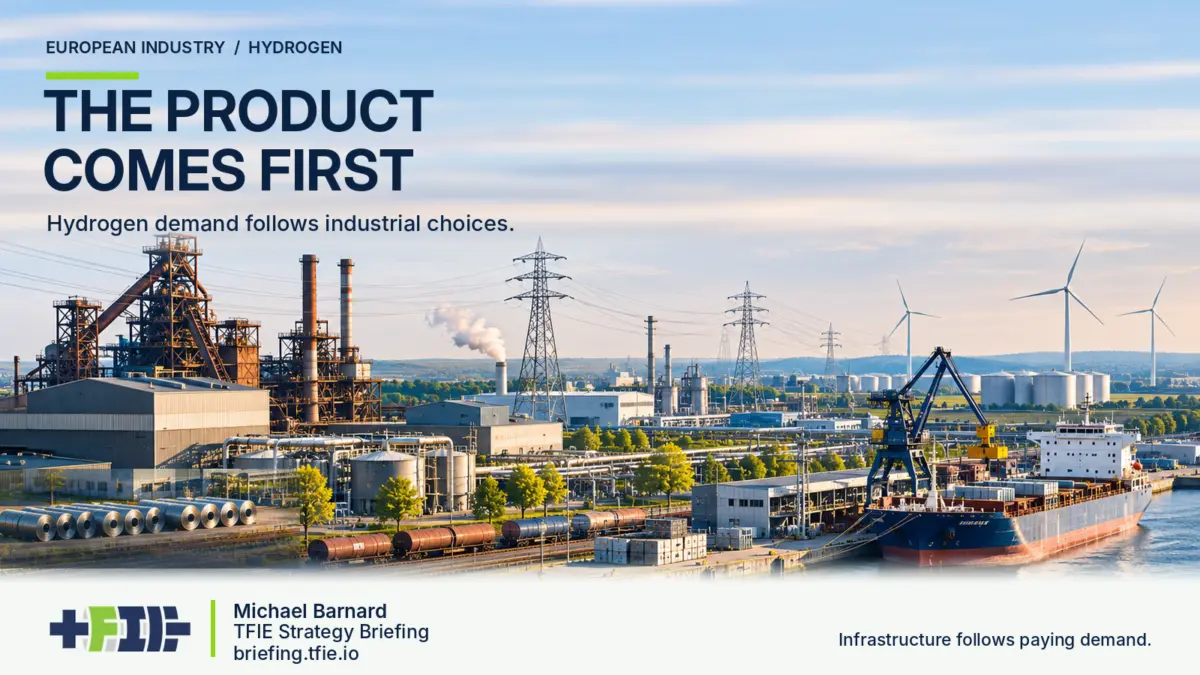
The European Commission has officially reopened its hydrogen strategy for consultation, marking a pivotal moment for the continent’s industrial future as policymakers grapple with the widening gap between ambitious decarbonization targets and the economic realities of energy-intensive production. While the initial roadmap for a European hydrogen economy was built on aggressive supply-side volume targets, a growing body of evidence suggests that the next phase of the strategy must be driven by a more nuanced, demand-led assessment of industrial requirements. This shift is prompted by the realization that renewable and low-carbon hydrogen production has scaled more slowly than anticipated, leading to a necessary re-examination of how public funds are allocated and how infrastructure is planned across the European Union.
The Context of the European Hydrogen Strategy Review
The original European Hydrogen Strategy, adopted in 2020 and later accelerated by the REPowerEU plan in 2022, set a target of producing 10 million tonnes and importing 10 million tonnes of renewable hydrogen by 2030. These figures were designed to signal a massive shift away from fossil fuels, particularly in the wake of the geopolitical shifts following the invasion of Ukraine. However, as the 2026 deadline for the renewed strategy approaches, the European Commission has acknowledged that the actual uptake of green hydrogen has been sluggish.
High capital costs, fluctuating electricity prices, and the slow deployment of electrolyzers have created a bottleneck. In response, the Commission opened a targeted consultation, with submissions due by late 2024, to refine the strategy. This review process is not merely a technical update but a fundamental rethink of Europe’s industrial competitiveness. The central question facing the EU is whether it should prioritize the domestic production of hydrogen at any cost or allow industrial players to source the most competitive decarbonized inputs, even if that means importing finished products like green ammonia from abroad.
The Economic Disconnect: Domestic Production vs. Global Imports
At the heart of the debate is a stark economic reality regarding the cost of electrolysis. To produce green hydrogen, an electrolyzer typically consumes approximately 55 kWh of electricity per kilogram of hydrogen. At a wholesale electricity price of €60/MWh, the energy cost alone amounts to €3.30 per kilogram. If electricity prices rise to €100/MWh, that cost jumps to €5.50 per kilogram. These figures exclude the significant capital expenditures (CAPEX) for the electrolyzer itself, financing costs, maintenance, and the secondary expenses of compression and transport.
In contrast, the global market for hydrogen derivatives, such as green ammonia, offers a different financial outlook. Recent modeling suggests that qualifying green ammonia could be imported into Europe by 2050 at a delivered cost of between €755 and €839 per tonne. In comparison, ammonia produced within Europe using on-site hydrogen is projected to cost approximately €1,222 per tonne. This creates a price gap of nearly €400 to €467 per tonne.
For a European fertilizer manufacturer, the choice is existential. If they are forced to use domestic hydrogen through quotas or mandates, their final product may become uncompetitive on the global market. Conversely, if they import green ammonia produced in regions with cheaper renewable energy (such as North Africa, Chile, or Australia), they preserve their downstream industrial operations—such as processing and distribution—but create zero demand for new hydrogen pipelines or electrolyzers within Europe.
Sectoral Analysis: Where Hydrogen is Truly Needed
The demand for hydrogen is not uniform across industries, and the strategy review must account for the specific technological pathways available to different sectors.

The Chemical and Fertilizer Industry
Currently, the European hydrogen market is essentially a market for industrial chemicals. In 2024, EU consumption was estimated at approximately 7.4 million tonnes. Refining accounted for 4.2 million tonnes, while ammonia production for fertilizers used 1.9 million tonnes. Unlike the transport or heating sectors, where electrification is often more efficient, the chemical industry requires hydrogen as a feedstock. However, as noted, the industry can survive by importing hydrogen-rich precursors rather than the gas itself.
The Steel Industry
Steelmaking represents one of the most significant potential growth areas for hydrogen, yet it faces multiple strategic choices. Producers can transition to green steel by using hydrogen-based direct reduction of iron (DRI). However, they can also opt to increase the use of recycled scrap in electric arc furnaces or purchase "hot briquetted iron" (HBI) made in regions where green hydrogen is cheaper. The actual hydrogen requirement in Europe will depend entirely on which of these paths the industry takes, rather than a top-down mandate.
The Refining Sector
The petroleum refining sector is facing a structural decline as Europe transitions toward electric mobility. As the demand for liquid fossil fuels drops, the hydrogen required for desulfurization and other refining processes will naturally decrease. This suggests that a portion of the current "established" hydrogen market will disappear regardless of the green hydrogen supply.
Infrastructure Risks and the Pipeline Paradox
One of the most contentious aspects of the current strategy is the planning of the "European Hydrogen Backbone"—a massive proposed network of pipelines designed to transport hydrogen across the continent. Infrastructure planners often work under the assumption that if the supply is built, the demand will follow. However, recent assessments suggest this may be a risky and expensive gamble for taxpayers.
A pipeline requires industrial customers who can afford the delivered product. If industrial players in Germany or the Netherlands opt for electrification or imported derivatives instead of gaseous hydrogen, these pipelines risk becoming "stranded assets." For example, Germany has made significant network reservations based on high-demand scenarios, while the Netherlands has recently produced more conservative demand projections.
To mitigate this risk, experts are calling for a "competition-led" appraisal of infrastructure. This involves testing proposed pipeline projects against two scenarios:
- A Policy-Aligned Case: Where demand is driven by existing mandates and subsidies.
- An Economic-Competition Case: Where industrial buyers are free to select the most cost-effective emissions-qualified production route, including imports.
If a pipeline project cannot show high utilization rates under the economic-competition case, it suggests that the project may require permanent public subsidies to remain viable, or that a smaller, more localized network would be more appropriate.
Chronology of the European Hydrogen Evolution
The journey toward a hydrogen-based economy in Europe has been marked by several key milestones that have led to the current state of re-evaluation:
- July 2020: The European Commission launches the "A Hydrogen Strategy for a Climate-Neutral Europe," focusing on the 2024 and 2030 production goals.
- December 2021: The Hydrogen and Decarbonized Gas Market Package is proposed to create a regulatory framework for hydrogen infrastructure.
- May 2022: REPowerEU is introduced, doubling the 2030 hydrogen targets to 20 million tonnes (10m domestic, 10m imports) to reduce reliance on Russian gas.
- February 2023: The Commission adopts the "Delegated Acts" defining what constitutes renewable hydrogen (the "additionality" rules), providing clarity for investors.
- November 2023: The European Hydrogen Bank holds its first auction, offering subsidies to bridge the price gap between grey and green hydrogen.
- November 2024: The targeted consultation for the renewed strategy concludes, with new modeling from organizations like TFIE (The Field Institute for Economics) highlighting the need for a demand-led approach.
- 2026: The revised Hydrogen Strategy is expected to be finalized, likely incorporating more realistic industrial demand projections.
Strategic Implications and the "Who Pays?" Question
The shift toward a demand-led strategy forces a difficult conversation about industrial policy and sovereignty. There are legitimate reasons for Europe to support domestic hydrogen production that go beyond the lowest immediate price. Maintaining domestic facilities ensures employment, fosters technical expertise in electrolysis, and provides a level of energy security that imports cannot match.
However, the current model of using volume targets and production quotas risks burying the true cost of these benefits. If domestic green hydrogen makes European steel or fertilizer significantly more expensive than global alternatives, the "green premium" must be paid by someone—either the consumer, the taxpayer through subsidies, or the industry itself through lost competitiveness.
The renewed strategy must be transparent about these costs. Instead of assuming a fixed volume of hydrogen demand, the Commission is being urged to identify the strategic benefits of domestic production, calculate the extra cost compared to imports, and clearly state the mechanism by which that cost will be covered.
Data-Driven Decision Making
The use of advanced modeling is becoming central to this policy debate. Recent research utilizing reproducible Python models and interactive dashboards allows stakeholders to visualize how different assumptions—such as the cost of electricity or the capacity for industrial imports—affect the total hydrogen requirement.
In a "Strong" pathway model with central costs, it is estimated that selected European industrial markets and transport services will require 1.887 million tonnes of physical hydrogen in 2050. However, if the capacity to import industrial products like ammonia is halved, that requirement jumps to 3.206 million tonnes. These figures are significantly lower than the early, more optimistic projections, suggesting that the "hydrogen economy" may be more of a specialized industrial tool than a universal energy carrier.
Conclusion
Europe’s industrial future depends on a delicate balance between production processes, electricity costs, and international trade. As the European Commission moves toward finalizing its renewed hydrogen strategy, the focus is shifting away from the sheer volume of hydrogen produced and toward the value of the industrial products and services that hydrogen enables.
By grounding infrastructure investment in the reality of what industrial customers can actually afford, Europe can avoid the pitfalls of over-building and ensure that its transition to a net-zero economy is both environmentally sustainable and economically viable. The coming months of consultation will determine whether the EU builds a hydrogen system based on policy aspirations or one sized for the customers who will actually use it.
