

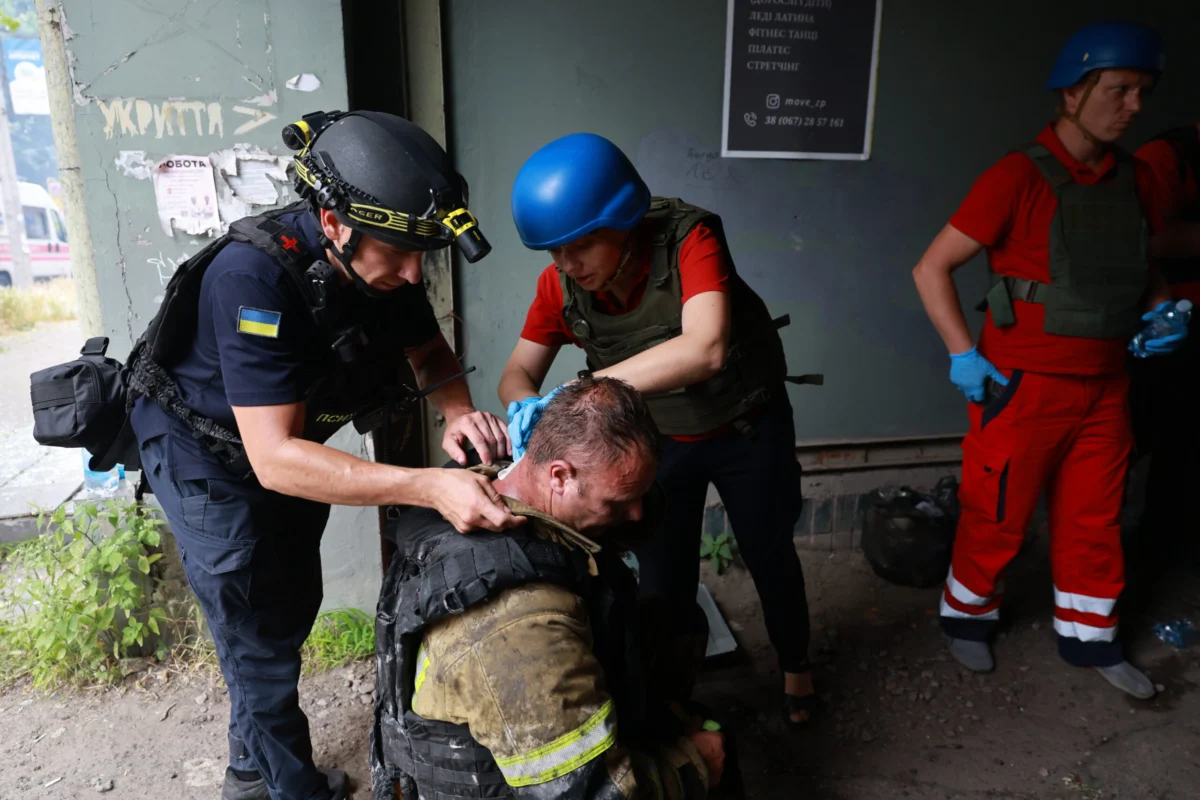
Overnight attacks have left a trail of destruction and casualties across Ukraine and within Russian territory, marking a significant escalation in the ongoing conflict. Russian forces launched a barrage of drones and aerial bombs across multiple Ukrainian regions, resulting in the deaths of two civilians and injuring more than 20 others. Simultaneously, Ukrainian strikes on Russian-controlled areas and within Russia itself claimed one life and wounded ten, while causing substantial damage to industrial infrastructure. These reciprocal assaults underscore the relentless nature of the conflict and the increasing readiness of both sides to target deeper into enemy territory, impacting civilian lives and critical strategic assets.
Intensified Russian Assaults Batter Ukrainian Regions
The latest wave of Russian aggression against Ukraine unfolded overnight into Saturday, employing a combination of drones and aerial bombs in what Ukrainian officials described as widespread and intensive attacks. The assaults primarily targeted the northern, central, and southeastern regions of Ukraine, leaving a grim tally of human suffering and material damage.
In the northern Sumy district, a 66-year-old man tragically lost his life when a Russian drone struck his home. Regional military Governor Oleh Hryhorov confirmed the fatality, highlighting the indiscriminate nature of the drone attacks that continue to plague civilian areas. A separate statement from the Sumy regional administration also referenced a "massive attack" elsewhere in the same region, which borders Russia, resulting in injuries to ten additional individuals. The sheer scale and frequency of these attacks on Sumy region have been a recurring challenge for Ukrainian defenses, often involving multiple unmanned aerial vehicles (UAVs) designed to overwhelm air defense systems.
Further south, the Dnipropetrovsk region bore the brunt of an exceptionally heavy assault. Oleksandr Ganja, head of the Dnipropetrovsk regional military administration, reported via Telegram that Russia attacked two districts within the region more than 30 times using drones and aerial bombs. This concentrated bombardment resulted in one civilian fatality, bringing the total reported deaths in Ukraine from these overnight attacks to two. The extensive nature of these strikes points to a concerted effort by Russian forces to inflict damage across a broad front, potentially aiming to disrupt logistics, degrade infrastructure, or simply terrorize the civilian population.
The southeastern city of Zaporizhzhia, a frequent target throughout the conflict, also sustained significant damage and casualties. Ukraine’s State Emergency Service confirmed that nine people, including two children, were injured in attacks on the city. The service provided harrowing details of the destruction, stating that "The enemy attack caused extensive destruction to the city’s civilian infrastructure." Specifically, a residential high-rise building suffered partial destruction, necessitating urgent rescue operations. Emergency workers were able to pull two individuals from under the rubble, a testament to their swift response amidst the chaos. Photos shared on Telegram by local authorities painted a stark picture of the devastation: the roof of a block of flats obliterated, windows shattered across multiple floors, a devastated stairwell, and the interior of a ravaged flat – all stark reminders of the human cost of the conflict.
Broader Context of Russian Attack Patterns
These recent attacks align with Russia’s established pattern of employing drones, cruise missiles, and aerial bombs against Ukrainian targets. The Shahed-136 "Geran-2" suicide drones, often supplied by Iran, have become a staple of Russian overnight assaults, frequently launched in waves to test and exhaust Ukrainian air defenses. These drones, while slower than missiles, are cost-effective and can be difficult to detect, especially when flown at low altitudes. Aerial bombs, particularly glide bombs launched from tactical aircraft, have also seen increased use, allowing Russian aircraft to strike targets from a distance while minimizing exposure to Ukrainian air defenses.
The strategic intent behind these widespread attacks is multi-faceted. They aim to degrade Ukraine’s energy infrastructure, disrupt military logistics, and pressure the civilian population, hoping to undermine morale and support for the war effort. Targeting residential areas, while consistently condemned by international bodies as potential war crimes, also serves a psychological purpose, sowing fear and uncertainty. The continued focus on cities like Zaporizhzhia, Sumy, and Dnipropetrovsk, which are vital industrial and logistical hubs, highlights Russia’s objective to cripple Ukraine’s ability to sustain its defense.
Ukraine’s Retaliatory Strikes Penetrate Russian Territory
In a clear demonstration of its evolving offensive capabilities and strategic objectives, Ukraine has intensified its attacks on Russian territory and Russian-occupied areas in recent months. These strikes aim to disrupt Russian military logistics, target key industrial facilities supporting the war effort, and exert pressure on the Russian populace and leadership.
One such strike occurred in Horlivka, a town located in Ukraine’s Russian-controlled Donetsk region. The attack resulted in the death of one woman, as reported by Moscow-installed mayor Ivan Prikhodko via Telegram. While details of the specific weapon used were not immediately available, such incidents underscore the constant danger faced by civilians in occupied territories, caught between the warring factions.
More significantly, Ukrainian forces launched an attack deep within Russia, targeting the Volgograd region in the southwest. Regional authorities confirmed that ten people were injured in this assault, and crucially, industrial facilities sustained damage. Ukrainian President Volodymyr Zelenskyy promptly claimed responsibility for the strike, providing specific details of the target and its strategic importance. In a social media post, Zelenskyy stated, "Last night, FP-5 Flamingo missiles successfully struck the Titan-Barrikady facility in Volgograd." He further elaborated on the significance of the target, explaining, "It is a major industrial complex where the enemy produces artillery systems and specialised military equipment, including components for missile launch systems used in attacks against our people."
Strategic Rationale Behind Ukrainian Strikes
Ukraine’s decision to target facilities like Titan-Barrikady reflects a deliberate and strategic shift. By striking deep within Russia’s military-industrial complex, Kyiv aims to directly impede Moscow’s ability to produce and replenish the weapons systems used against Ukraine. This strategy seeks to reduce the flow of artillery shells, missiles, and other critical military hardware to the front lines, thereby diminishing Russia’s combat effectiveness.
This approach is part of a broader strategy to severely disrupt Russian battlefield logistics, a goal Ukraine has pursued with increasing vigor in recent weeks. Previous dramatic attacks on Russian-occupied Crimea, which serves as a crucial logistical hub for Russian forces in southern Ukraine, and strikes on satellite communications centers near Moscow, illustrate this expanding operational reach. These actions demonstrate Ukraine’s growing capacity to conduct long-range precision strikes, utilizing both domestically produced drones and, potentially, long-range missile systems provided by international partners.
The implications of these Ukrainian strikes are substantial. They force Russia to divert valuable resources, including air defense systems, to protect targets far from the front lines. As Zelenskyy himself noted, Russia has been compelled to relocate air defense systems from other regions to bolster the defenses of Moscow and the strategically vital Kerch Bridge, which connects Crimea to the Russian mainland. This redeployment potentially weakens Russian air defenses in other critical areas, creating opportunities for further Ukrainian offensive operations. Moreover, these attacks carry a significant psychological impact within Russia, bringing the reality of the war closer to home for its citizens and challenging the Kremlin’s narrative of invulnerability.
A Timeline of Escalation and Adaptation
The ongoing conflict, which began with Russia’s full-scale invasion in February 2022, has seen several phases of escalation and adaptation by both sides. Initially, Russia focused on a rapid conquest of key Ukrainian cities, including Kyiv. However, after failing to achieve these objectives, the conflict evolved into a brutal war of attrition, primarily concentrated in eastern and southern Ukraine.
February 2022 – Early 2023: Initial invasion and widespread missile strikes on Ukrainian cities. Ukraine’s successful defense of Kyiv and subsequent counteroffensives in Kharkiv and Kherson regions.
Mid-2023 – Early 2024: Ukraine’s counteroffensive in the south, while limited in territorial gains, forced Russia to establish extensive defensive lines. Russia intensifies long-range missile and drone attacks, particularly targeting energy infrastructure during winter months.
Late 2023 – Present: Ukraine increasingly develops and deploys long-range drones and potentially other strike capabilities, expanding its targeting envelope to include Russian territory, the Black Sea Fleet, and military-industrial facilities deep within Russia. This period marks a clear shift in Ukraine’s strategy to degrade Russia’s war-making capacity directly. The recent overnight attacks from both sides fit squarely into this pattern of reciprocal escalation, where each side seeks to gain an advantage by striking critical targets, irrespective of geographical boundaries or the immediate proximity to the front lines.
Official Reactions and International Concern
In the wake of these attacks, official statements from both sides have largely adhered to established narratives. Ukrainian officials, while condemning the attacks on civilian infrastructure and casualties, have also highlighted the necessity of their own strikes as defensive measures aimed at degrading Russia’s ability to continue its aggression. President Zelenskyy’s direct claim of responsibility for the Volgograd strike signals a growing confidence in Ukraine’s ability to project power and a willingness to publicly acknowledge these operations. Ukrainian calls for increased international military aid, particularly advanced air defense systems, are expected to intensify given the ongoing barrage of Russian missiles and drones.
Russian officials, including local administrators in occupied territories, have condemned Ukrainian attacks as "terrorist acts" targeting civilian areas and infrastructure. While often downplaying the extent of damage or casualties from Ukrainian strikes, Moscow typically vows retaliation and claims to have successfully intercepted a majority of incoming threats. The Kremlin maintains that its "special military operation" is aimed at "demilitarizing" Ukraine and protecting Russian security interests, a narrative largely rejected by the international community.
International bodies and governments have consistently expressed grave concern over the escalating violence and the continued toll on civilian lives. The United Nations has repeatedly called for an end to hostilities and adherence to international humanitarian law, emphasizing the protection of civilians and civilian infrastructure. Humanitarian organizations are continually working to provide aid to affected populations, while Western allies of Ukraine are closely monitoring the situation, often reiterating their commitment to supporting Ukraine’s defense and condemning Russia’s aggression. The strikes on civilian targets further complicate diplomatic efforts to find a peaceful resolution and underscore the urgent need for de-escalation.
Broader Impact and Implications
The recent wave of cross-border strikes carries significant implications for the future trajectory of the conflict:
- Humanitarian Crisis: The immediate and most tragic impact is the continued loss of civilian lives and the exacerbation of the humanitarian crisis in Ukraine. Damage to residential buildings and essential infrastructure further displaces populations and hinders reconstruction efforts, placing immense strain on public services.
- Evolving Military Strategy: These attacks highlight a crucial evolution in military strategy. Russia continues its war of attrition, using massed drone and missile strikes to overwhelm defenses and inflict widespread damage. Ukraine, in turn, is demonstrating an increasingly sophisticated asymmetric strategy, leveraging long-range capabilities to target Russia’s military-industrial complex and logistical networks, seeking to diminish its capacity to wage war.
- Escalation Risks: Strikes deep within Russian territory inherently carry a higher risk of escalation. While Ukraine frames these as legitimate defensive actions, Russia may interpret them as provocations warranting further, potentially more severe, retaliatory measures. The constant tit-for-tat dynamic creates a perilous cycle of escalation.
- Economic Impact: The damage to industrial facilities, such as the Titan-Barrikady plant, has direct economic consequences for Russia’s war effort, potentially slowing down arms production. For Ukraine, the destruction of civilian infrastructure imposes massive long-term reconstruction costs, estimated to be hundreds of billions of dollars.
- Psychological Warfare: Both sides utilize these attacks as tools of psychological warfare. Russia aims to demoralize the Ukrainian populace and break their will to resist. Ukraine’s strikes on Russian soil aim to bring the reality of the war home to Russian citizens, potentially eroding public support for the conflict and putting pressure on the Kremlin.
- International Support and Sanctions: The continued attacks on Ukrainian civilians will likely reinforce international resolve to support Ukraine, potentially leading to further military aid packages and tighter sanctions against Russia. Conversely, any perception of Ukraine crossing "red lines" with attacks deep inside Russia could, theoretically, complicate the narrative for some international partners, though strong support for Ukraine’s right to self-defense generally prevails.
As the conflict grinds on, the intensification of these cross-border strikes signals a new phase of intense and geographically expanded warfare. The human cost remains tragically high, and the strategic implications continue to reshape the dynamics of one of Europe’s most devastating conflicts in decades. The immediate future suggests a continuation of these reciprocal attacks as both sides seek to gain the upper hand and impose costs on their adversary.
