

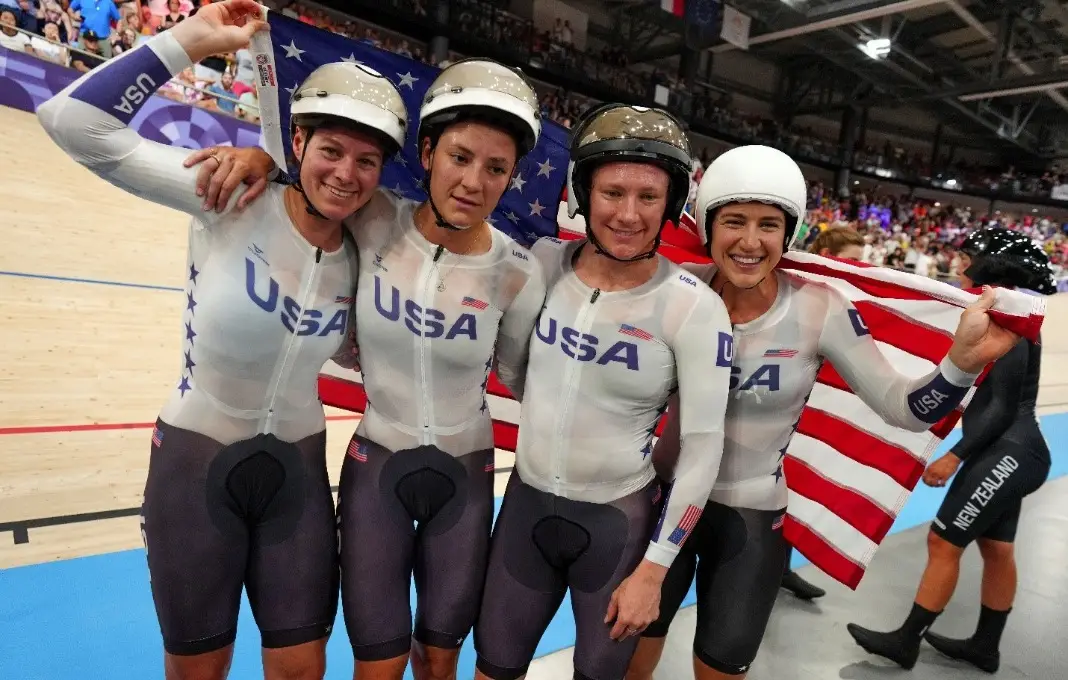
Kristen Faulkner, a two-time Olympic gold medalist in road and track cycling, a Harvard graduate, and a venture capital professional, offers a compelling perspective on high-performing teams. Her unconventional path to athletic and professional success, marked by a late start in cycling and rapid ascent to the pinnacle of the sport, underscores a philosophy of teamwork that holds profound implications for the business world. Faulkner’s insights, gained from the intense crucible of Olympic competition, reveal that sustained success is not the product of individual brilliance but rather the result of deliberate, collective action built on radical transparency, selfless contribution, and continuous adaptation.
Faulkner’s journey is a testament to a different kind of ambition. Having not begun cycling until her mid-twenties, she achieved Olympic glory at the 2024 Paris Games, securing gold medals in both the individual road race and the team pursuit. This extraordinary trajectory is not accidental but the outcome of intentional choices, a deep well of resilience, and a distinct approach to team dynamics. As she articulated her experiences, it became evident that the lessons learned on the velodrome and the open road are directly transferable to the boardroom and the operational floor. The core of her philosophy lies in the understanding that true team strength is forged through shared responsibility, unfiltered communication, and the willingness to subordinate personal accolades to the collective objective.
The Unfiltered Dialogue of High-Stakes Competition
One of the most striking takeaways from Faulkner’s discussion centers on the critical role of communication, particularly under duress. She emphasized the necessity of "over-communicating with the entire time," stating, "You cannot sit there and feel something is wrong and not say it out loud." This stands in stark contrast to many professional environments where hesitation or a reluctance to voice concerns can lead to missed opportunities and critical failures. In the high-octane world of team pursuit cycling, where riders are separated by mere inches and milliseconds dictate outcomes, silence is not an option. Faulkner described the behind-the-scenes communication as "constant, raw communication. No filters. No hesitation."
This directness is essential for real-time adjustments. Faulkner elaborated on the principle: "If the person in front of you is starting to slow down, you have to tell them to get off the front. You can’t hold anything back in the moment." This level of transparency, while demanding, is foundational to building trust. It eliminates ambiguity when precision is paramount and fosters an environment where issues are addressed proactively rather than allowed to fester. Simon Sinek, a noted author and speaker on leadership, aptly describes communication as the "lubricant" of teamwork, essential for breaking down silos, minimizing assumptions, and creating a safe space for admitting errors, seeking assistance, and ultimately, performing optimally under pressure.
Eliminating Ego for Collective Gain
Beyond communication, Faulkner highlighted the absolute imperative of shedding ego. "There can be no ego at all," she asserted. In team cycling, this translates into pragmatic decision-making driven by the team’s overall performance. If a rider feels strong, they extend their effort, not to outshine others, but to benefit the team’s momentum. Conversely, if a rider is struggling, they signal their limitations to allow others to compensate. The primary objective is not individual glory but collective output. This philosophy sharply contrasts with many business cultures that often incentivize and reward individual heroism, even when it strains the organizational system. Cycling, in this regard, champions self-awareness and sacrifice for the common good.
The business implication is clear: leaders must cultivate environments where employees are encouraged to speak up in real-time and where stepping back to allow others to lead is viewed as a strategic strength, not a personal failing. This fosters a shared sense of responsibility that transcends hierarchical structures.
Trust Forged Through Consistent Action, Not Titles
Faulkner articulated a tangible understanding of trust, asserting, "If someone is always going to the point where they’re slowing down in a race it can erode trust." In her experience, trust is not an abstract concept bestowed by rank or good intentions; it is meticulously built through consistent, observable behavior. When a teammate reliably performs within their capabilities, demonstrating self-awareness, it builds confidence. "If someone always hits their numbers I start to feel like, wow, this person is really self-aware," she noted.
High-performing teams are not composed of flawless individuals but of those who possess a keen understanding of their limitations and act accordingly. Faulkner recounted an instance: "I have a teammate who goes so hard that the people behind her actually get dropped, and I don’t always trust that she doesn’t want to show how strong she is." This scenario, all too familiar in business, illustrates how individual excellence, if misaligned with team objectives, can inadvertently create obstacles for others. The issue is not the pursuit of excellence itself, but the lack of synergy.
James Clear, author of Atomic Habits, echoes this sentiment, suggesting that sustained high performance is less about sheer willpower and more about establishing routines and systems that enable consistent contribution without disrupting the broader team. This concept of "mutual accountability," as described by Positive Intelligence, emphasizes that team members are responsible for both their results and the manner in which those results are achieved. In optimal teams, this accountability is not solely vested in leadership but is a shared commitment.
The business lesson derived from this is that trust is cultivated when individuals consistently prioritize the team’s best interests over personal performance metrics. This requires a culture that values collaborative effort and shared success.
The Power of Direct, Objective, and Constant Feedback
Faulkner’s perspective on feedback is equally direct. She advocates for feedback that is "never [based on] assumptions about intent." Instead, the focus should be on observable facts: what occurred, what was experienced, and what adjustments are needed. This objective approach, as highlighted by Fearless Culture, transforms raw observations into actionable insights by posing clarifying questions. Faulkner stressed the importance of clarity: "I think if you beat around the bush, then things can get a little confusing… the clearest ‘this is what happened’ is the best."
Furthermore, feedback in elite cycling is a continuous process. After every training session, a review takes place, often augmented by data and video analysis. This immediate, specific, and actionable feedback loop is crucial for rapid learning and improvement. An article on Medium discussing the role of feedback in team building notes that constructive criticism, when delivered effectively and frequently, not only corrects errors but also enhances performance, engagement, growth, and trust.
Faulkner explained the impact of this constant feedback: "There’s a lot of accountability for the decisions that we make in real time and there’s a constant feedback loop." Over time, this frequency desensitizes individuals to the emotional sting of feedback, normalizing it as a tool for collective advancement. The objective becomes learning speed, not the avoidance of critique.
The business lesson here is to establish rapid feedback loops that are objective, frequent, and psychologically safe. This cultivates a culture of continuous improvement and learning.
Micro-Awareness: The Unseen Engine of High Performance
In the absence of dashboards and real-time metrics on the cycling course, athletes rely on a heightened sense of "micro-awareness." This involves interpreting subtle cues like cadence, body movement, and shifts in pace. Faulkner illustrated this: "If the cadence is starting to slow down, it means the person on the front is going too slow." Or, "If the person in front of you is wobbling, maybe they need to get off sooner." This is a perpetual process of sensing and adjusting.
This principle is highly relevant in business. Subtle signals—a change in posture, a delayed response, a fleeting expression of doubt—can often reveal unspoken concerns before they escalate. Mindful Insights refers to these cues as "unspoken truths" that can surface frustration, hesitation, or disengagement before they become significant problems. In business, reliance on formal reports, metrics, or escalations can mean that critical issues are identified too late. Faulkner’s approach represents a form of situational awareness that allows teams to course-correct proactively.
The business lesson is to train teams to recognize and interpret subtle signals early, fostering a culture of observation and proactive problem-solving rather than passive analysis.
Applying Olympic Principles to Business Leadership
Reflecting on Faulkner’s insights, it becomes clear that elite athletes build teams around six fundamental elements: radical transparency in communication, ego dissolution for collective gain, trust earned through consistent self-awareness and action, direct and objective feedback, and acute micro-awareness of team dynamics. These are not abstract theories for Faulkner; they are daily practices honed under immense pressure where every millisecond counts.
While the stakes in business may appear different, the underlying principles are remarkably consistent. The most effective teams do not merely coexist; they understand the rhythm of collaboration—knowing when to take the lead, when to yield, and when to support a teammate. They function as an integrated system, adapting in real-time, holding each other accountable, and relentlessly pursuing improvement. Ultimately, high performance is not a solitary achievement but the collective power generated by a team that understands and effectively shares the load. The strength of the pull, and how equitably it is shared, defines true team success.
