

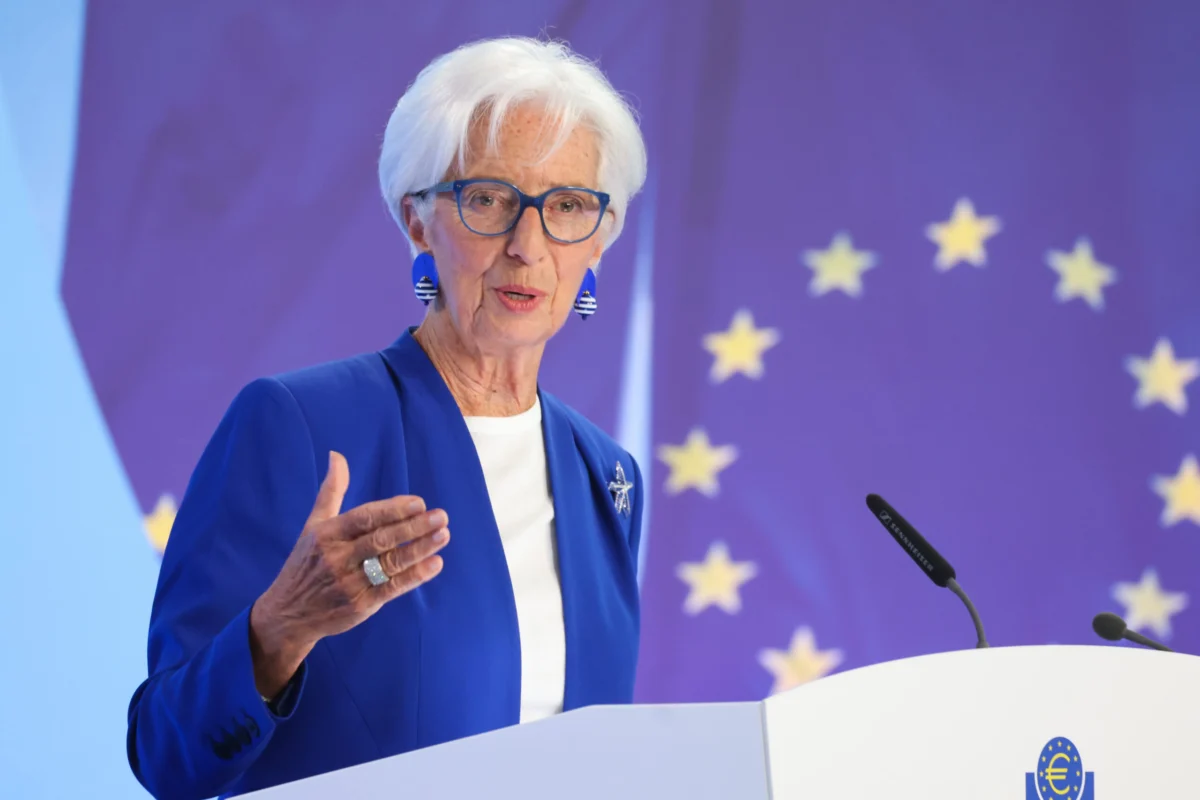
European Central Bank President Christine Lagarde has strategically positioned herself to potentially influence French politics, a move that has already sent ripples through financial markets. In a candid interview with the French business newspaper Les Echos, Lagarde declared that an early departure from her ECB presidency, which is slated to conclude in October 2027, is "possible." This revelation comes as France approaches its presidential elections in the same year, a period where, according to Lagarde, "a European voice must be heard in the French presidential debate."
Lagarde, a former Managing Director of the International Monetary Fund and French Finance Minister, expressed her concern that certain political narratives emerging in France could diminish the nation’s standing within the European Union. She stated, "If this debate were to present a perspective that diminishes France’s place within Europe, I think it would be necessary to explain why this would be a painful path for our country and our citizens." When directly questioned about the possibility of her personal involvement in the French Presidential campaign, either in support of a candidate or by running herself, Lagarde offered a contemplative response: "I’m going to ask myself some questions."
This potential shift in focus by Lagarde arrives at a critical juncture for both the European Central Bank and France. The ECB is currently navigating a complex economic landscape, working to tame inflation while avoiding a recession, a delicate balancing act that requires steady leadership. Simultaneously, France is grappling with significant fiscal challenges, attempting to rein in its public debt and deficit under the watchful eye of the European Union.
Lagarde’s Ambitions and the French Political Landscape
The current political climate in France is marked by the anticipated departure of President Emmanuel Macron, who is constitutionally barred from seeking a third term. Opinion polls indicate Jordan Bardella, the leader of the far-right National Rally party, as the leading contender to succeed Macron. Bardella’s platform includes a significant re-evaluation of France’s role within the European Union, advocating for a reversal of what he perceives as the European Commission’s overreach, aiming to place "the European Commission and the EU ‘back at the service of nations and no longer the other way around.’"
The French presidential election process is structured with a first round of voting scheduled for April, followed by a runoff if no candidate secures an outright majority. Macron himself faced the National Rally, then known as the Front National, in the runoff stages of both the 2017 and 2022 presidential elections, highlighting the party’s significant electoral presence.
Lagarde’s expressed desire to inject a "European voice" into the French presidential discourse suggests a deep-seated concern about the direction of French European policy under potential future leadership. Her experience as a high-ranking European official provides her with a unique perspective on the interconnectedness of national economic policies and their impact on the broader European Union.
Market Reactions and ECB’s Stance
Lagarde’s tentative remarks have already elicited market responses. In February, the euro experienced a decline following a report by the Financial Times suggesting Lagarde was contemplating an early departure from the ECB. At that time, the ECB issued a statement clarifying that no such decision had been made. The ECB has declined to offer further comment on Lagarde’s latest statements when approached by CNBC.
Despite the speculation and the potential for future political engagement, Lagarde has reaffirmed her commitment to her current role at the ECB, at least in the short term. She stated in the Les Echos interview, "My term ends in October 2027. And I believe my mission is to maintain price stability. As we are once again in a period of turbulence, I believe the captain of the ECB ship must remain on board." This assertion underscores the gravity of the ECB’s mandate during a period of economic uncertainty.
France’s Fiscal Tightrope Walk
The French government is currently engaged in a challenging effort to pass a budget that includes at least €4 billion ($4.6 billion) in spending cuts. This fiscal recalibration is driven by the imperative to manage national debt and reduce the public deficit to the 3% of GDP benchmark mandated by the European Union, with a target deadline of 2029. French Finance Minister Roland Lescure has reiterated the government’s commitment to achieving a 5% deficit target in the near term as a stepping stone towards this goal.
In recent public statements, Lescure has emphasized the importance of separating the immediate budgetary concerns from the broader political debates surrounding the 2027 presidential election. He articulated this sentiment to CNBC’s Charlotte Reed, stating, "There’s a win-win one in which we focus on the budget, they let us pass it, we find a compromise that…[not all parties will be happy with], but at least that’s going to make sure we have a budget. And on the other hand, the big debates about 2027 and beyond take place. We can decorrelate both, [but] if we don’t, and if one becomes the hostage of the other – the budget hostage to the campaign – it’s not going to work." Lescure expressed hope that "reason will prevail, we manage to decorrelate both. We’ll see."
The political landscape in France has become increasingly fragmented since President Macron’s re-election in 2022, with the nation experiencing five changes in prime minister. This political volatility has presented significant obstacles to the passage of crucial economic reforms, underscoring the complexity of France’s domestic policy environment.

The Stakes for France and Europe
Lagarde’s potential foray into French politics, whether as an influential voice or a direct participant, carries substantial implications. Her deep understanding of European economic integration and her experience at the highest levels of international finance could offer a distinct perspective on the challenges facing France. She articulated this by saying, "I would have a French and a European voice because I am deeply committed to both. I would tell them that, in terms of the economic future of our continent, France must play a decisive role. And that without this European environment and these European roots, the economic outlook is, at the very least, clouded."
Her assessment of the French public’s awareness of the nation’s economic realities is also noteworthy. Lagarde believes that "contrary to what I often hear from politicians, the French people are perfectly aware of the situation and they expect a discourse of truth and solutions." This suggests a conviction that a more pragmatic and forward-looking approach to economic policy is both necessary and desired by the electorate.
The timing of Lagarde’s considerations is particularly significant given the ongoing efforts to stabilize inflation across the Eurozone. The ECB’s credibility and effectiveness are paramount during this period, and any perception of leadership instability or distraction could undermine market confidence. Furthermore, France’s fiscal health is a key pillar of the broader European economic architecture. A stable and fiscally responsible France is essential for the overall stability of the Eurozone.
Background and Context
The European Central Bank (ECB): Established in 1998, the ECB is the central bank for the Eurozone, comprising 20 EU member states that have adopted the euro. Its primary mandate is to maintain price stability, which it defines as inflation below, but close to, 2% over the medium term. The ECB also supervises significant financial institutions in the Eurozone and oversees the implementation of monetary policy. The current term for the ECB President is eight years, non-renewable.
French Presidential Elections: The President of France is the head of state, elected for a five-year term. The election involves a two-round system. If no candidate secures an absolute majority in the first round, a runoff election is held between the two candidates with the highest number of votes. The upcoming election in 2027 marks the end of President Macron’s second term.
France’s Fiscal Situation: France has historically faced challenges in meeting EU fiscal deficit targets. The COVID-19 pandemic and subsequent energy crisis led to increased public spending, further exacerbating the deficit. The current government’s efforts to implement budget cuts reflect a renewed focus on fiscal consolidation in line with EU fiscal rules, which are set to be revised.
The National Rally: This political party, formerly known as the National Front, is a prominent far-right political force in France. Led by Jordan Bardella, its platform often emphasizes national sovereignty, immigration control, and a critical stance on certain aspects of European integration.
Broader Implications and Analysis
Lagarde’s contemplation of a political future in France raises several key questions about the interplay between European institutions and national politics. Her dual identity as a European leader and a French citizen positions her as a potentially potent force in shaping the national discourse on Europe.
If Lagarde were to enter the French political arena, her considerable experience and international standing could lend significant weight to her pronouncements. This could be particularly impactful in a political climate where the role and direction of France within the EU are subjects of intense debate. Her supporters might see her as a pragmatic voice capable of steering France towards a more balanced and constructive engagement with its European partners. Conversely, her critics might argue that her departure from the ECB, especially if it were perceived as politically motivated, could destabilize the institution during a critical economic period.
The market’s reaction to the initial reports of her potential early exit underscores the sensitivity surrounding leadership at the ECB. Maintaining market confidence requires a perception of stability and continuity. Lagarde’s current commitment to her role at the ECB, coupled with her expressed concerns about France’s European trajectory, suggests a strategic approach to her potential future involvement. She appears to be signaling a willingness to act if she perceives a significant threat to France’s European integration, rather than an outright pursuit of a political career for its own sake.
The French government’s push for budgetary reform, against a backdrop of political fragmentation, highlights the domestic pressures that influence its European policy. The success of these fiscal measures is not only crucial for France’s own economic health but also for its credibility within the EU framework. Lagarde’s insights, if shared publicly or privately with political actors, could offer valuable perspective on the economic consequences of various policy choices.
Ultimately, Christine Lagarde’s statements reveal a complex calculus of her personal ambitions, her commitment to European stability, and her deep-seated concern for France’s future. The coming months will likely see further developments as the French political landscape evolves and as Lagarde herself grapples with the profound decisions she has indicated are on her horizon. Her potential involvement in French politics could represent a significant moment in the ongoing dialogue about the future of Europe and France’s place within it.
