

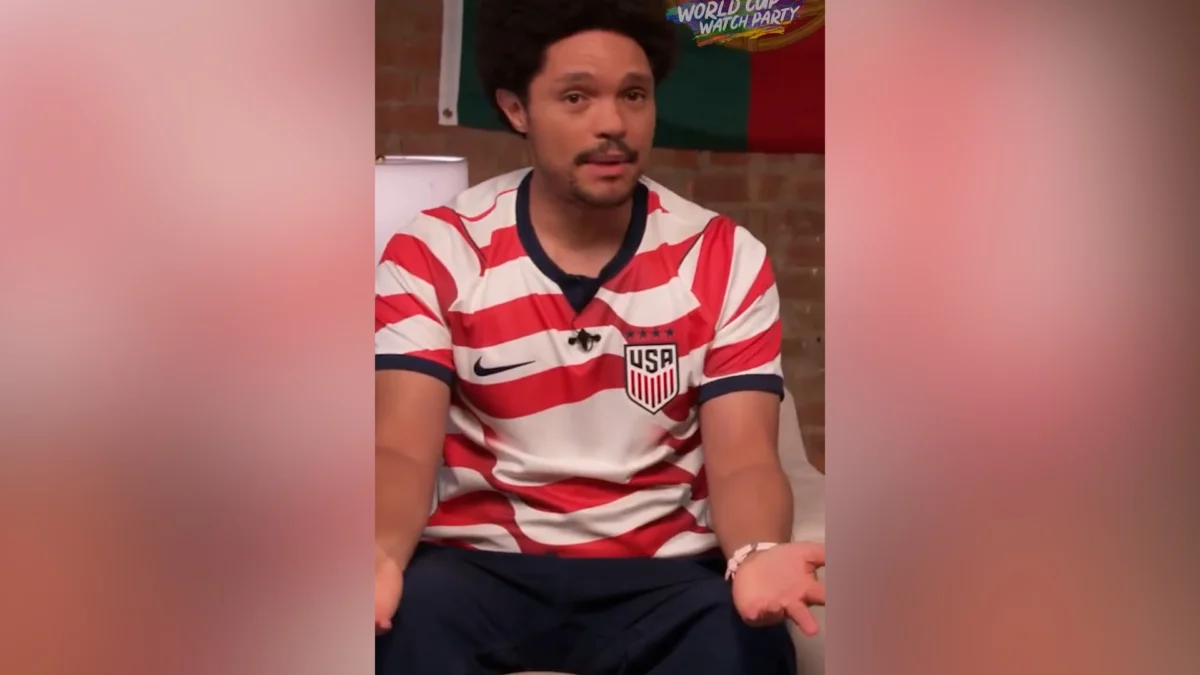
Comedian Trevor Noah sparked widespread discussion and laughter during his livestreamed "Trevor Noah’s World Cup Watch Party" on July 7, 2026, when he satirically suggested that former U.S. President Donald Trump’s purported intervention in Folarin Balogun’s controversial red card saga amounted to “government interference.” The comments, made ahead of the highly anticipated USA-Belgium World Cup quarter-final match, quickly resonated across social media and news outlets, drawing attention to the delicate balance between sports, politics, and international governance. Noah’s remarks tapped into a broader conversation regarding the sanctity of sporting regulations and the boundaries of political influence, particularly concerning FIFA’s stringent rules against external interference in national football federations.
The Alleged Intervention and Its Genesis
The genesis of Noah’s comedic commentary lies in an alleged, albeit unconfirmed, series of actions attributed to former President Trump following a contentious match during the ongoing FIFA World Cup 2026. The incident in question occurred on July 2, 2026, during a high-stakes Group C decider between the United States and Ghana. In the 78th minute of the match, with the score tied at 1-1, U.S. striker Folarin Balogun, a pivotal figure for the American squad, was issued a straight red card by Brazilian referee Ricardo Silva for what was deemed a dangerous tackle on Ghanaian midfielder Thomas Partey. Replays showed Balogun’s studs-up challenge, though contact appeared minimal to some, while others argued it was reckless. The Video Assistant Referee (VAR) system upheld the on-field decision after a lengthy review, much to the dismay of U.S. players, coaching staff, and millions of American fans. The U.S. ultimately lost the match 2-1 after conceding a penalty in stoppage time, which, combined with other group results, initially threatened their progression to the knockout stages. While the U.S. eventually advanced as one of the best third-placed teams, the red card and the subsequent defeat left a bitter taste.
According to unsubstantiated reports circulating primarily on right-leaning news outlets and social media, former President Trump, known for his vocal support of American athletes and his frequent commentary on perceived injustices, reportedly made several public and private statements questioning the impartiality of the refereeing decision. These reports suggested that Trump, during a rally in Arizona on July 3rd, alluded to the red card as "a rigged call by a globalist referee," and that his office had been "looking into" the situation. Further rumors, unverified by mainstream media, hinted at informal communications between individuals close to Trump and representatives of the U.S. Soccer Federation, allegedly urging them to challenge the decision more aggressively or even to appeal directly to FIFA with political backing. While no official channels confirmed these allegations, the narrative of Trump’s involvement gained traction in certain segments of the public, setting the stage for Noah’s satirical take.
FIFA’s Strict Stance on Government Interference
FIFA, the international governing body of association football, maintains a notoriously strict policy against government interference in the affairs of its member associations. Article 19 of the FIFA Statutes explicitly states that "each member must manage its affairs independently and with no influence from third parties." This principle is fundamental to FIFA’s structure, designed to protect the sport from political manipulation and to ensure that football federations operate autonomously. Breaches of this article can lead to severe sanctions, including the suspension of a national federation from all international competitions, a ban on its clubs participating in continental tournaments, and even the freezing of development funds.
There are numerous historical precedents where FIFA has acted decisively to enforce this rule. In 2004, FIFA suspended the Iraqi Football Association due to government interference. More recently, in 2017, the Football Federation of Pakistan was suspended for third-party interference, and in 2022, the Football Association of India faced a temporary ban due to undue influence from a third-party committee. These examples underscore FIFA’s unwavering commitment to its statutes, making any alleged political intervention, even informal or symbolic, a sensitive matter. The prospect of the U.S. Soccer Federation facing potential scrutiny or sanctions due to perceived external political pressure, however indirect, adds a layer of seriousness to Noah’s humorous observations.
Trevor Noah’s "World Cup Watch Party" and Its Impact
Trevor Noah, leveraging his considerable platform and comedic acumen, used his "World Cup Watch Party" as a forum to dissect the alleged controversy. The livestream, a popular segment offering Noah’s unique brand of global political and cultural commentary intertwined with sports analysis, typically attracts millions of viewers across various digital platforms. During the broadcast, Noah, with his characteristic blend of wit and critical observation, presented the situation as an absurd, yet potentially serious, overreach.
"You know, FIFA has very clear rules about government interference," Noah qui quipped, a wry smile playing on his lips. "If a government steps in, a country can be banned from the World Cup. So, when I hear reports about President Trump supposedly ‘looking into’ a red card decision, all I can think is: ‘Is this how America gets suspended from the World Cup? Not by losing, but by… let’s call it, election interference in the referee’s booth?’" The audience, both live and online, erupted in laughter and comments, appreciating the pointed satire. Noah further elaborated, imagining a scenario where FIFA President Gianni Infantino would have to issue a stern warning to the White House, or perhaps even sanction the U.S. Soccer Federation for what he jokingly termed "diplomatic fouls." His commentary skillfully highlighted the potential absurdity of a former head of state attempting to influence a sporting decision, juxtaposing it with the very real and severe consequences FIFA imposes for such actions. The segment quickly went viral, generating hundreds of thousands of shares and discussions across Twitter, TikTok, and other social media platforms, amplifying the debate beyond his immediate viewership.
Official Reactions and Denials
In the wake of the burgeoning online narrative and Trevor Noah’s high-profile commentary, various parties issued statements, largely aimed at clarifying their positions and reiterating adherence to established protocols.
A spokesperson for FIFA, speaking on background, firmly stated that "FIFA operates under strict principles of independence for all its member associations and refereeing decisions are final, subject only to established appeal processes within the football framework. Any suggestion of external political influence on these processes is entirely unfounded and would be treated with the utmost seriousness." This statement, while not directly addressing the alleged Trump intervention, served as a clear reaffirmation of FIFA’s governance principles.
The U.S. Soccer Federation, through its President, Cindy Parlow Cone, issued a formal statement on July 5, 2026, confirming that "U.S. Soccer adheres strictly to FIFA regulations and has followed all established procedures regarding the appeal of Folarin Balogun’s red card. Our focus remains solely on supporting our players and coaches within the established sporting framework. We have not engaged, nor would we engage, in any communication or action that would compromise the integrity of the sport or our standing with FIFA." This statement implicitly distanced the Federation from any alleged external political pressure. Balogun’s red card appeal was ultimately rejected by FIFA’s Disciplinary Committee, meaning he would serve a one-match suspension, which he did during the USA’s Round of 16 victory against Senegal.
A representative from former President Trump’s political action committee, when approached for comment on the allegations, dismissed them as "media sensationalism" and "fake news." The representative stated, "President Trump is a proud American who supports all our athletes. His comments are always about fairness and American excellence, not about interfering in international sports bodies. The idea that he would somehow ‘intervene’ in a red card is a ridiculous attempt by the radical left and their media allies to distract from real issues." This response, characteristic of Trump’s political messaging, neither explicitly confirmed nor denied the specific allegations of informal intervention but framed any commentary as patriotic support rather than official action.
Broader Implications and the Role of Satire
The "Trump-FIFA Red Card Controversy," however much it originated from unverified reports and amplified by satire, touches upon several significant implications. Firstly, it underscores the persistent tension between the world of international sports and the realm of national politics. While sports organizations like FIFA strive for autonomy, their immense global reach and cultural significance often make them targets or subjects of political discourse, especially during major events like the World Cup. The alleged intervention, even if purely rhetorical, highlights the ongoing challenge for sports bodies to maintain their independence in an increasingly politicized global landscape.
Secondly, the incident serves as a poignant reminder of the power and responsibility of political figures, even former ones, to shape public perception. Whether Trump’s alleged comments were serious attempts at influence or merely expressions of frustration, they contributed to a narrative that tested the boundaries of FIFA’s governance and potentially put the U.S. Soccer Federation in an awkward position. This episode could also be viewed through the lens of political strategy, where associating with popular national causes, even sporting ones, can serve to rally a political base.
Thirdly, Trevor Noah’s role in this saga exemplifies the critical function of satire in modern media. By taking an alleged, potentially hyperbolic scenario and pushing it to its logical, comedic extreme, Noah effectively highlighted the absurdity and potential dangers of blurring the lines between political power and sporting integrity. His commentary, far from being mere entertainment, served as a form of social critique, forcing audiences to consider the real-world implications of such hypothetical interventions. In an era often characterized by the rapid spread of misinformation, satirical takes can sometimes offer a clarifying perspective, inviting audiences to critically evaluate information and the motivations behind it.
Looking Ahead to USA-Belgium
As the U.S. national team prepared to face a formidable Belgium squad in the World Cup quarter-finals, the "red card controversy" and the ensuing political and satirical commentary provided an unexpected backdrop. While the immediate focus for the team remained on their on-field performance, the external noise served as a testament to the World Cup’s unparalleled ability to transcend sport and seep into wider cultural and political conversations. The incident, fueled by a blend of genuine fan frustration, unconfirmed political maneuvers, and incisive comedic commentary, underscored the complex, often unpredictable, interplay of forces that define major global events in the 21st century. The USA’s journey in the tournament, now under intense scrutiny, continued with the hope that sporting excellence, rather than political intrigue, would ultimately define their legacy in the 2026 FIFA World Cup.
