

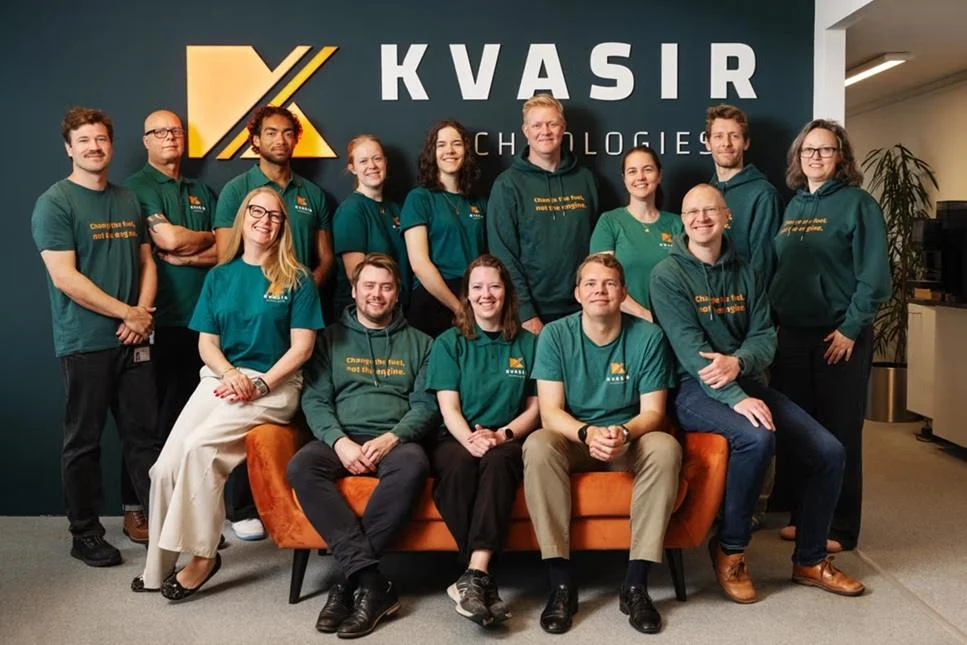
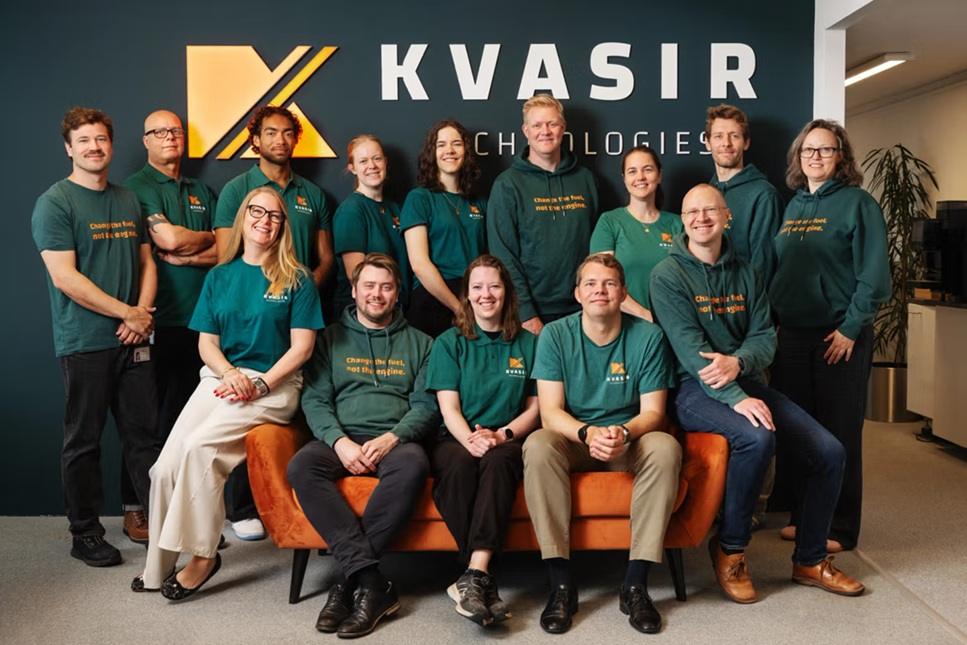
The Danish biofuel innovator Kvasir Technologies has successfully secured €10 million (approximately USD $11.1 million) in a Series A funding round designed to propel the commercialization of its proprietary climate-neutral marine fuel. This capital injection marks a pivotal moment for the maritime industry, which is currently grappling with the immense pressure of meeting international decarbonization targets. The financing round was led by new investor European Energy and saw continued participation from existing backers, including the Export and Investment Fund of Denmark (EIFO), Mærsk Growth, and the Footprint Fund.
Beyond the immediate financial boost, Kvasir Technologies has entered into a strategic joint venture with European Energy to establish KVEEN Biofuels. This new entity is tasked with the development and operation of a commercial-scale production facility that will utilize Kvasir’s patented technology to transform agricultural and forestry waste into high-quality marine fuel. The move signifies a shift from laboratory-scale proof of concept to industrial-grade infrastructure, a transition critical for the "hard-to-abate" shipping sector.
The Technological Breakthrough: Solvothermal Liquefaction
At the heart of Kvasir’s value proposition is a sophisticated process known as solvothermal liquefaction. While the concept of biomass conversion is not new, Kvasir’s specific application is engineered to overcome the historical limitations of lignocellulosic biomass—the non-edible, woody parts of plants that represent the most abundant organic material on Earth.
Traditional biofuel methods often struggle to process lignin, a complex organic polymer that provides structural support to plants. Lignin is notoriously difficult to break down into usable liquid fuel, often resulting in low yields or high processing costs. Kvasir’s technology, however, is designed to fully convert these lignin-based residues into a refined bio-oil. According to data provided by the company, the process retains more than 80% of the combustible energy originally found in the biomass.
Furthermore, the technology offers a unique environmental advantage: the potential for carbon-negative operations. During the conversion process, a byproduct known as biochar is produced. Biochar is a stable form of carbon that can be sequestered in soil for centuries, effectively removing CO2 from the atmospheric cycle. When combined with the use of waste feedstocks that would otherwise decompose and release methane or CO2, Kvasir’s fuel can achieve a lifecycle reduction in carbon emissions exceeding 100%.
Strategic Implications for the Maritime Sector
The shipping industry is responsible for nearly 3% of global greenhouse gas emissions. The International Maritime Organization (IMO) has set ambitious targets to reach net-zero emissions by or around 2050, with intermediate "checkpoints" in 2030 and 2040. However, the long operational lifespan of cargo vessels—often 20 to 30 years—means that the global fleet cannot be replaced overnight with ships running on hydrogen or ammonia.
This reality makes "drop-in" fuels particularly valuable. Kvasir’s biofuel is chemically similar to the heavy fuel oil (HFO) currently used by the global merchant fleet. Crucially, it can serve as a direct replacement without requiring modifications to existing internal combustion engines or the global bunkering infrastructure. This compatibility allows shipowners to decarbonize their current assets immediately, bypassing the massive capital expenditures associated with retrofitting or purchasing new dual-fuel vessels.
A Chronology of Innovation and Growth
Kvasir Technologies’ journey began in 2018 as a spinout from the Technical University of Denmark (DTU), a prestigious institution known for its focus on engineering and sustainability. Founded by CEO Joachim Bachmann Nielsen and COO Anders Bak Kristoffersen, the startup was born from a decade of academic research into thermochemical conversion.
- 2018: Kvasir Technologies is officially incorporated following successful laboratory trials at DTU.
- 2020–2022: The company secures seed funding and begins construction on a test facility in Fredericia, Denmark. During this period, Mærsk Growth—the venture arm of the global shipping giant A.P. Moller – Maersk—identifies the technology as a key component of the future fuel mix.
- 2023: The Fredericia plant reaches a production capacity of up to two tonnes of biofuel per day, providing samples for engine testing and validation by industry partners.
- 2024 (June): The Series A round is finalized, bringing in European Energy and paving the way for the Aabenraa commercial plant.
The newly raised funds are earmarked for two primary objectives. First, the company will expand operations at its Fredericia test site to refine the fuel’s chemical properties for various marine engine specifications. Second, the capital will fund the front-end engineering and design (FEED) for the first industrial-scale plant in Aabenraa, southern Jutland. This facility will serve as a global flagship, demonstrating that lignin-to-fuel conversion is economically viable at scale.

Investor Perspectives and Market Confidence
The participation of European Energy as a lead investor and strategic partner reflects a growing trend of "sector coupling" in the green transition. European Energy, traditionally focused on wind and solar power, is increasingly moving into Power-to-X and biomass-based solutions to provide holistic energy services.
Joachim Bachmann Nielsen, CEO of Kvasir Technologies, emphasized that the investment is a testament to the maturity of their solution. “This investment round enables us to take the next crucial steps in developing and scaling our technology,” Nielsen stated. “At the same time, it underlines that there is still strong support for solutions that can deliver real climate impact in the maritime sector.”
The Export and Investment Fund of Denmark (EIFO) also highlighted the strategic importance of the deal. Sara Sande, Partner and Head of Thematic Venture Investments at EIFO, noted that Kvasir’s "feedstock agnostic" nature—meaning it can use a variety of waste inputs from different geographies—makes it a highly scalable business model. “The combination of scalable technology, a biofuel that can be used in existing fleets, and strong partnerships makes the case particularly attractive,” Sande added.
Analysis: The Economic and Environmental Context
The success of Kvasir’s Series A comes at a time when the venture capital landscape for climate tech is becoming more discerning. Investors are moving away from purely theoretical concepts and toward "hard tech" solutions that have physical assets and clear paths to revenue.
From an economic perspective, Kvasir’s reliance on non-edible residues is a significant advantage. Unlike first-generation biofuels made from corn or sugarcane, Kvasir does not compete with the global food supply. By utilizing waste from forestry and agriculture, the company taps into a low-cost, high-volume feedstock. As carbon taxes like the EU Emissions Trading System (ETS) begin to apply to the shipping industry, the cost-competitiveness of Kvasir’s biofuel relative to taxed fossil fuels is expected to improve dramatically.
Furthermore, the creation of KVEEN Biofuels in partnership with European Energy suggests a decentralized production model. If the Aabenraa plant proves successful, the model can be replicated in other regions rich in biomass residues, such as Southeast Asia (rice husks), North America (forestry waste), or South America (agricultural stalks). This could potentially localize fuel production, reducing the carbon footprint associated with transporting fuel across oceans.
Future Outlook and Challenges
While the €10 million funding is a significant milestone, the path to total industry transformation remains steep. The maritime sector consumes roughly 300 million tonnes of fuel annually. To make a meaningful dent in this demand, Kvasir and its competitors will need to scale production by several orders of magnitude.
The next 24 months will be critical for Kvasir. The industry will be watching the Aabenraa facility closely to see if the high energy retention and carbon-negative claims hold up under the rigors of industrial-scale operation. Additionally, the company will need to navigate the complex regulatory landscape of fuel certification and safety standards required by international maritime law.
However, with the backing of Mærsk—one of the world’s largest fuel buyers—and the technical expertise of European Energy, Kvasir Technologies is well-positioned to lead the charge. The transition from a university spinout to a key player in the global energy transition serves as a blueprint for how academic innovation can be harnessed to solve the most pressing environmental challenges of the 21st century.
As the Fredericia facility ramps up and the Aabenraa plant takes shape, Kvasir Technologies is not just selling a fuel; it is offering a bridge between the fossil-fueled past of the shipping industry and a sustainable, climate-neutral future.
