

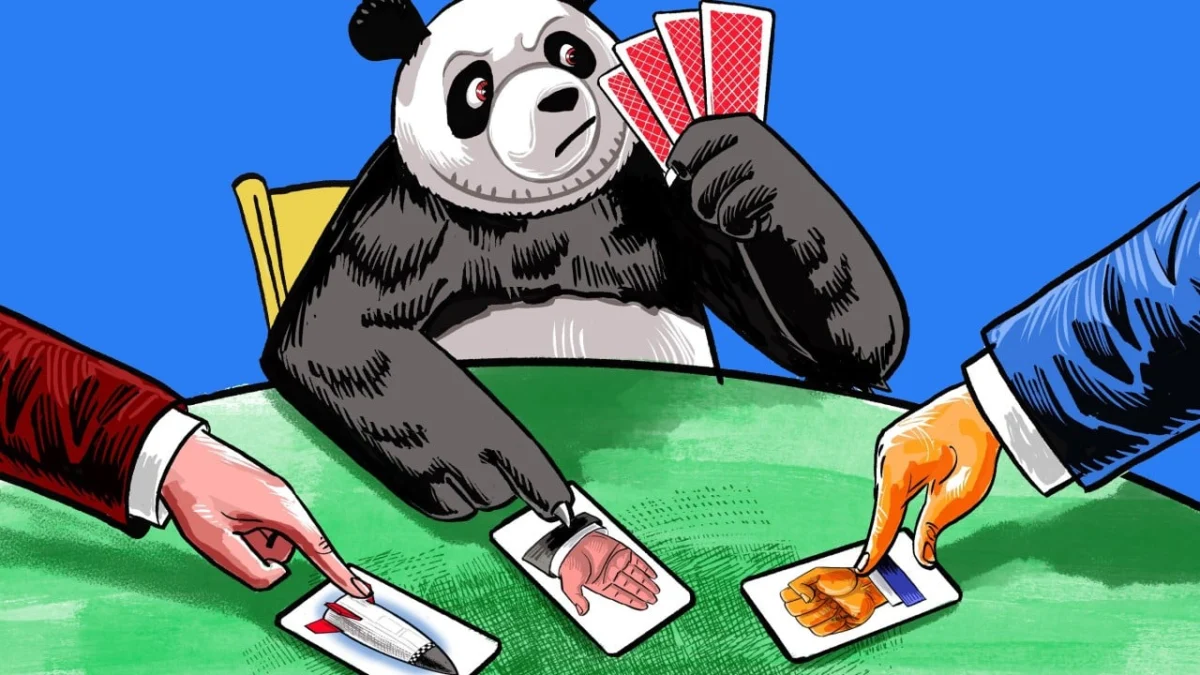
The spectacle of United States President Donald Trump publicly thanking China for its "neutrality" regarding the recent military hostilities between the US-Israeli coalition and Iran marks a seismic shift in the geopolitical landscape of the 21st century. Only a year ago, the prospect of a Republican administration in Washington offering accolades to Beijing for its role in a Middle Eastern conflict would have been dismissed as an impossibility. However, at the Group of Seven (G7) summit held in Evian-les-Bains, France, on June 17, this transformation was laid bare. President Trump credited both Beijing and Moscow with preventing a regional escalation from descending into a global catastrophe. His observation that China possessed the capability to "send in an oil ship with six destroyers alongside of it, on each side" but instead chose a path of calculated restraint, captured the essence of Beijing’s current strategic posture: a sophisticated demonstration of power that relied on influence rather than overt military intervention.
This diplomatic breakthrough did not emerge in a vacuum. It was the culmination of months of intense, behind-the-scenes maneuvering, economic leverage, and a multi-vector foreign policy that positioned China as an indispensable mediator. The resulting 14-point memorandum of understanding, signed this week, represents the first tangible framework for de-escalation in a conflict that had threatened to upend global energy markets and spark a broader confrontation in the Persian Gulf.
The Genesis of the Crisis and the Escalation of Hostilities
To understand the significance of the June 17 summit, it is necessary to examine the timeline of the conflict that brought the world to the brink. The hostilities between the US-Israeli alliance and Iran reached a critical flashpoint in early 2024, following a series of maritime incidents and drone strikes that disrupted shipping in the Strait of Hormuz. By February, the situation had evolved from a "shadow war" into a direct military confrontation, with US and Israeli forces conducting targeted strikes against Iranian military infrastructure.
As the conflict intensified, the international community braced for a protracted war. Oil prices surged past $120 a barrel, and global supply chains, already fragile from previous geopolitical tensions, faced a renewed crisis. It was during this period that Beijing’s role began to shift from passive observer to active stabilizer. While the United States focused on military deterrence and the "maximum pressure" of sanctions, China utilized its unique position as a major economic partner to both sides to open channels of communication that were otherwise closed to Western diplomats.
A Chronology of Chinese Shuttle Diplomacy
The road to the Evian-les-Bains summit was paved with what diplomats describe as "unglamorous but essential" groundwork. The chronology of China’s intervention reveals a systematic approach to regional de-escalation:
- February 2024: Foreign Minister Wang Yi initiated a series of high-level telephone consultations with his counterparts in Tehran, Islamabad, and several Persian Gulf capitals. The objective was to establish a baseline for "red lines" that would prevent a full-scale ground invasion of Iranian territory.
- March 2024: Special Envoy Zhai Jun was dispatched on a regional shuttle mission. Unlike Western envoys, Zhai’s mission was characterized by discretion. He visited Riyadh, Abu Dhabi, and Doha before concluding his trip in Tehran. His message was consistent: China would provide a "diplomatic shield" at the United Nations, but only if Iran demonstrated "flexibility" regarding its retaliatory measures.
- April–May 2024: Beijing coordinated closely with Pakistan, supporting Islamabad’s efforts to act as a bridge between the Sunni Arab world and Shia-majority Iran. This period saw the drafting of the initial points of what would eventually become the 14-point memorandum.
- June 2024: Following a series of secret meetings in neutral locations, the framework for a ceasefire was presented to the US administration. The "neutrality" praised by President Trump was, in fact, a period of active restraint where China discouraged its partners in the Global South from forming a military bloc to oppose US actions, while simultaneously ensuring Iran remained economically viable enough to negotiate from a position of relative stability.
The Mechanics of Economic Leverage
China’s influence in the Middle East is fundamentally rooted in its economic interdependence with the region. As Iran’s largest oil customer and a primary financial lifeline, Beijing holds a level of leverage that no other global power can match. In the months leading up to the ceasefire, China continued to purchase Iranian crude, albeit through complex financial mechanisms that bypassed traditional banking systems. This provided Tehran with the necessary liquidity to maintain its domestic economy, preventing a total collapse that could have led to more desperate and unpredictable military actions by the Iranian leadership.
According to data from energy tracking firms, China’s imports of Iranian oil averaged approximately 1.2 million to 1.5 million barrels per day during the height of the conflict. This economic relationship was not merely a matter of trade; it was a strategic tool. Behind closed doors, Chinese officials reportedly signaled to Tehran that continued economic support was contingent upon Iran’s willingness to engage in the multilateral management of the crisis. This was not coercion in the traditional sense, but a pragmatic application of "soft power" backed by the reality of the global energy market.
The 14-Point Memorandum: A Framework for Peace
The 14-point memorandum of understanding, published this week by the US and Iranian governments, is the centerpiece of this diplomatic effort. While the full details remain confidential, several key components have been confirmed by officials close to the negotiations:
- A phased withdrawal of naval assets from contested waters in the Persian Gulf.
- The establishment of a "hotline" between the US Central Command and the Iranian Revolutionary Guard Corps to prevent accidental escalations.
- A commitment from Iran to limit its uranium enrichment levels in exchange for targeted sanctions relief.
- The creation of a regional security forum, chaired by a rotating committee of neutral nations, including China and Russia.
- Provisions for the protection of international shipping lanes, with guarantees of non-interference from all signatories.
The memorandum represents a departure from the binary "win-lose" outcomes of previous conflicts. Instead, it frames the situation as a crisis requiring multilateral management—a concept that Beijing has championed at the United Nations for years.
Official Responses and Regional Reactions
The reaction to President Trump’s statements and the subsequent memorandum has been a mixture of relief and cautious skepticism. In Tehran, the gratitude toward China was palpable. Iranian Foreign Ministry spokespersons publicly thanked the "Chinese public and leadership" for their role in preventing further bloodshed. This sentiment was echoed by the Iranian embassy in Beijing, which highlighted the "enduring bond" between the two nations.
In Israel, the response was more nuanced. While the government of Prime Minister Benjamin Netanyahu remains wary of any deal that leaves Iran’s nuclear infrastructure intact, there is a recognition that a full-scale war would have been devastating for the region. Israeli analysts have noted that the "Chinese factor" introduced a level of predictability into the conflict that allowed for a strategic pause.
Meanwhile, in Europe, the G7 leaders expressed support for the de-escalation. French President Emmanuel Macron, the host of the summit, praised the "spirit of cooperation" that characterized the discussions in Evian-les-Bains. European diplomats, who had struggled to maintain the 2015 nuclear deal (JCPOA), viewed the 14-point memorandum as a viable successor that addresses contemporary security concerns.
Broader Implications and Strategic Analysis
The events of June 2024 signify a turning point in global governance. For decades, the United States was the sole arbiter of Middle Eastern security. The emergence of China as a "neutral" but decisive power broker suggests that the era of unipolarity has officially transitioned into a multipolar reality.
China’s success in this instance was predicated on its ability to offer what the US could not: a relationship with Iran built on decades of non-interventionist trade and diplomatic support. By framing the conflict as a "multilateral crisis" rather than a "binary struggle," Beijing allowed all parties to save face—a crucial element in Middle Eastern diplomacy.
However, this new role for China also brings significant risks. By becoming a guarantor of regional stability, Beijing has moved beyond its traditional role as a purely economic actor. It now bears a degree of responsibility for the maintenance of the ceasefire. Should the 14-point memorandum fail, China’s reputation as a reliable mediator will be at stake.
Furthermore, the "neutrality" praised by President Trump may be short-lived. As the US and China continue to compete for influence in the Indo-Pacific and in the realm of high technology, the cooperation seen in the Middle East may remain an exception rather than the rule. Nevertheless, for the moment, the world breathes a sigh of relief. The restraint shown by Beijing, and the subsequent diplomatic breakthrough, has averted a conflict that many feared would be the definitive crisis of the decade. The 14-point memorandum stands not just as a ceasefire agreement, but as a testament to the power of discreet, leverage-based diplomacy in an increasingly complex world.
