


In the early 1990s, a radio-collared grey wolf known as Pluie became a living testament to the indifference of the natural world toward man-made boundaries. Over the course of two years, researchers tracked Pluie as she traversed an astonishing 100,000 square kilometers across the Rocky Mountains. Her journey was a logistical nightmare for human bureaucracy but a biological necessity for her species; she crossed 30 distinct political jurisdictions, including three U.S. states, two Canadian provinces, and the ancestral territories of several First Nations. Pluie’s trek highlighted a fundamental ecological truth: wildlife does not recognize the lines drawn on maps. Today, however, the collaborative systems designed to protect such wide-ranging species are facing unprecedented strain due to shifting political priorities and significant budgetary contractions within the United States federal government.
The nearly 9,000-kilometer border between Canada and the United States is the longest undefended border in the world, but for the more than 500 migratory species that cross it annually, it is increasingly becoming a zone of regulatory uncertainty. From the delicate monarch butterfly to the massive grey whale, and including terrestrial residents like grizzly bears, woodland caribou, and grey wolves, these species rely on a seamless web of protection that spans the 49th parallel. For decades, this protection was maintained through a robust partnership involving federal agencies, local municipalities, non-profit organizations, field scientists, private landowners, and Indigenous groups. This cooperative framework is now being tested as the administration of U.S. President Donald Trump implements sweeping cuts to conservation funding, research initiatives, and the federal workforce tasked with land management.
The Erosion of Federal Capacity and Scientific Infrastructure
The backbone of transboundary conservation is the sharing of data and the synchronization of management strategies. Laurel Angell, the director of government relations and policy at the Yellowstone to Yukon Conservation Initiative (Y2Y), emphasizes that the "protection systems have to catch up to the reality" of nature’s borderless movement. Y2Y, a joint U.S.-Canada-Indigenous non-profit, has spent years fostering these relationships. However, the current trajectory of U.S. policy suggests a retreat from these collaborative commitments.
In 2025, a series of aggressive workforce reductions began to hollow out U.S. public land agencies. The U.S. Fish and Wildlife Service (FWS), the primary agency responsible for enforcing the Endangered Species Act (ESA), has seen an 18% reduction in its total workforce. This equates to the loss of approximately 1,800 positions, including 500 specialized biologists whose expertise is critical for species recovery programs. Brian Nesvik, the director of the FWS, recently informed the U.S. Secretary of the Interior that nearly 60% of the nation’s wildlife refuges are now operating without the resources or staff required to fulfill their statutory missions.
The impact extends beyond staffing to the very foundations of conservation science. Sixteen of the 22 land research cooperatives—essential government-funded centers that provide the science-based data used to inform conservation policy—have been placed on indefinite hiatus. These centers are responsible for tracking how climate change and habitat loss alter the movement patterns of migratory species. Without up-to-date data, conservationists are essentially "flying blind," unable to predict where wildlife corridors need to be established or how to mitigate emerging threats.
A Chronology of Transboundary Cooperation and Conflict
To understand the gravity of the current situation, one must look at the history of North American conservation efforts, which have historically been a model of international cooperation.
- 1916: The Migratory Birds Treaty is signed between the U.S. and Great Britain (on behalf of Canada), establishing one of the first international frameworks for wildlife protection.
- 1973: The U.S. passes the Endangered Species Act (ESA), providing a legal mechanism for protecting species across their entire range, often necessitating cooperation with Canadian authorities.
- 1993-1995: The journey of Pluie the wolf provides empirical evidence of the massive scale required for carnivore conservation, leading to the formation of the Yellowstone to Yukon (Y2Y) initiative.
- 2002: Canada passes the Species at Risk Act (SARA), further aligning the two nations’ legal approaches to biodiversity.
- 2017-2021: The first Trump administration proposes rollbacks to the ESA to facilitate energy and resource development, signaling a shift toward deregulation.
- 2025-Present: Substantial cuts to the FWS and the suspension of research cooperatives create a "data vacuum" that hampers current transboundary projects.
This timeline illustrates a move from foundational treaties to sophisticated, data-driven landscape management, which is now being disrupted by a return to isolationist and pro-development policies.
The High Stakes of Habitat Connectivity
The primary casualty of these policy shifts is the concept of "connectivity." In conservation biology, connectivity refers to the ability of wildlife to move freely between different protected areas. When habitats become fragmented by roads, fences, or industrial development, animal populations become isolated. This isolation leads to genetic bottlenecks, making species more vulnerable to disease, climate fluctuations, and eventual extinction.
The Y2Y initiative has spent over 30 years working to repair the fragmentation of grizzly bear habitats in the Rocky Mountains. In the late 20th century, the two largest grizzly populations in Montana and Canada were separated by a 240-kilometer gap of unprotected and often hostile territory. Through strategic land acquisitions, the construction of wildlife overpasses, and the establishment of corridors on private lands, that gap has been reduced to less than 50 kilometers.
"That last stretch to achieve real, full connectivity would be a landmark conservation success story," says Angell. "It requires sustained investment and rigorous science, not less of both." The concern is that if the U.S. side of the mapping and connectivity work is abandoned mid-stream due to budget cuts, the decades of progress made on the Canadian side and by private partners could be rendered moot.
Broader Implications for Migratory Species
The disruption of conservation efforts has immediate consequences for several high-profile species:
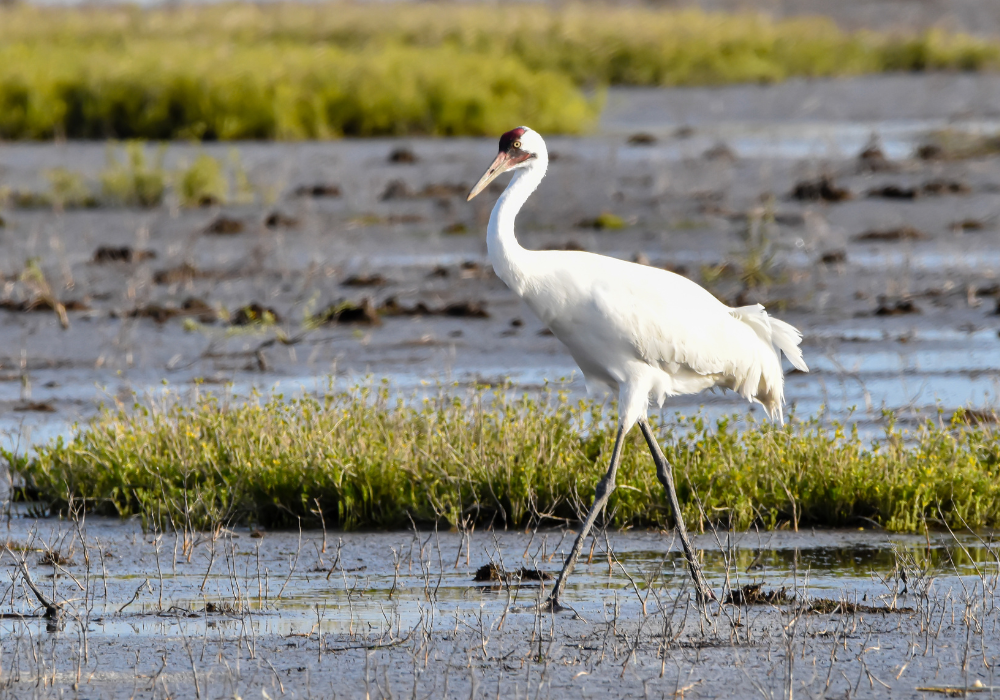
- Whooping Cranes: These iconic birds migrate from their wintering grounds in Texas to their breeding grounds in Alberta and the Northwest Territories. Their survival depends on the integrity of "stopover" habitats across multiple U.S. states. A lack of federal oversight on the U.S. side could lead to the degradation of these vital rest areas.
- Monarch Butterflies: The monarch’s multi-generational migration from Mexico through the U.S. to Canada is one of nature’s most complex feats. The loss of biologists who monitor milkweed populations and pesticide impacts in the U.S. Midwest directly threatens the viability of the Canadian population.
- Woodland Caribou: In the Pacific Northwest, caribou herds frequently cross the border between British Columbia, Washington, and Idaho. These herds are already on the brink of localized extinction; the loss of coordinated transboundary management could be the final blow for these "grey ghosts" of the forest.
Economic and Political Analysis
The administration’s push to weaken the ESA and cut conservation funding is largely framed as a move to ease the path for energy production and resource extraction. By reducing the "bureaucratic hurdles" of environmental impact assessments and species protection protocols, the administration aims to stimulate economic growth in the mining, logging, and oil sectors.
However, this approach overlooks the significant economic value of the "conservation economy." National parks and wildlife-related recreation contribute billions of dollars to the GDP of both the U.S. and Canada. In the U.S. alone, the outdoor recreation economy accounts for approximately 2.2% of the national GDP. Furthermore, the loss of ecosystem services—such as natural water filtration by healthy forests or pollination by migratory insects—carries a heavy, albeit often hidden, price tag.
Collin O’Mara, president and CEO of the National Wildlife Federation, notes that while the current rate of staff cuts is worrying, there is a silver lining in the form of legislative resilience. "So far, the U.S. Congress has pushed back on most of the proposed budget cuts in a bipartisan way," O’Mara states. Conservation remains one of the few areas where Republican and Democratic interests often align, particularly regarding the preservation of hunting grounds, fishing waters, and local tourism hubs.
Conclusion: A Precarious Future for North American Biodiversity
The situation at the U.S.-Canada border serves as a microcosm for the global challenge of biodiversity loss. As climate change forces species to shift their ranges northward, the need for international cooperation will only intensify. The biological reality of species like Pluie the wolf cannot be ignored without consequence.
If the scientific infrastructure continues to erode and the federal agencies tasked with stewardship are further diminished, the "incomplete picture" of the landscape described by Laurel Angell will become the new norm. For the 500 species that rely on a clear path across the 49th parallel, the stakes are nothing less than survival. The hope for the future lies in the continued advocacy of non-profits, the leadership of Indigenous communities, and a potential return to the bipartisan recognition that nature, in all its borderless complexity, is a shared heritage that requires a shared defense.
