

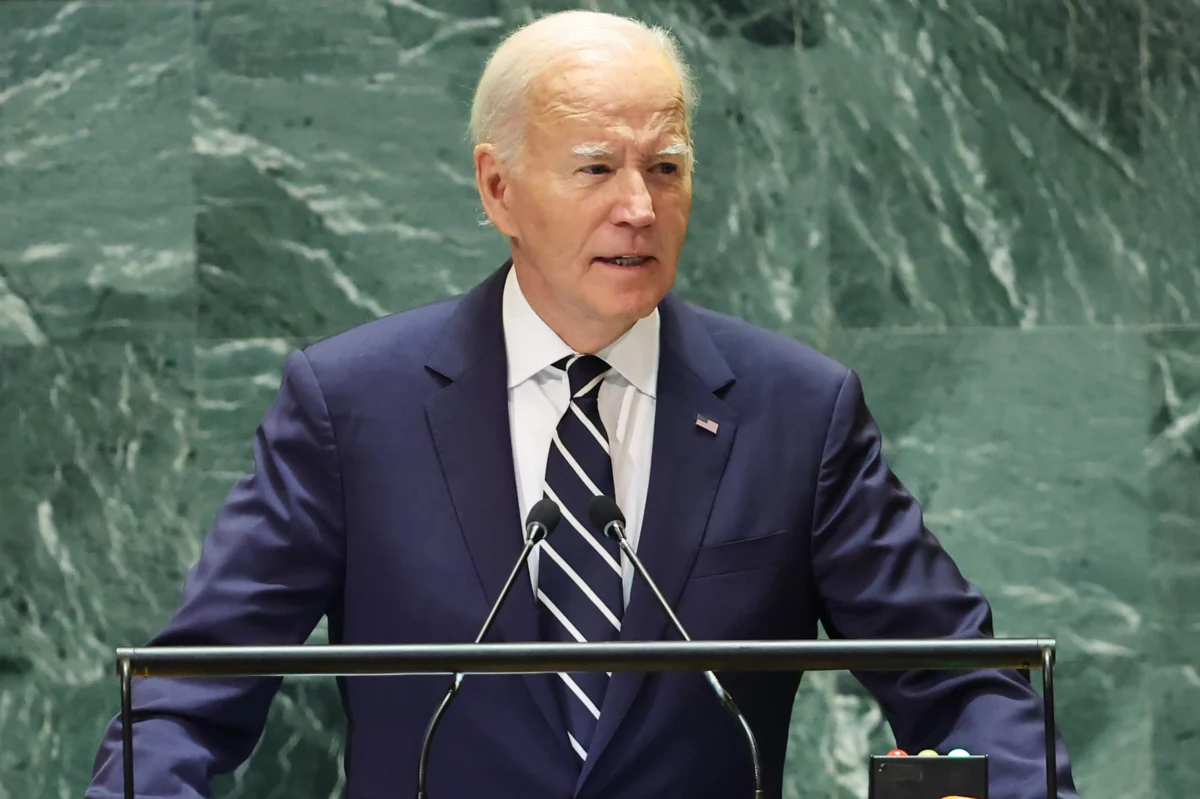
President Joe Biden stood before the United Nations General Assembly on Tuesday for the final time of his presidency, attempting to reconcile his career-long commitment to international diplomacy with a global landscape increasingly defined by brutal warfare and fractured alliances. Speaking to an audience of world leaders in New York, Biden sought to frame his foreign policy legacy as one of resilience and cooperation, even as the "rules-based international order" he has championed faces its most severe tests since the end of the Cold War.
"I know many look at the world today and see difficulties and react with despair," Biden told the assembly, acknowledging the pervasive sense of crisis. "But maybe because of all I’ve seen and all we have done together over the decades, I have hope." This duality—acknowledging the grim reality of the present while insisting on the possibility of progress—served as the cornerstone of a speech that was as much a farewell address as it was a call to action.
A Presidency Defined by Global Upheaval
When Joe Biden assumed the presidency in January 2021, he famously declared that "America is back" on the world stage. However, the four years that followed have been marked by a series of cascading geopolitical shocks. His final address served as a summary of how his administration navigated these challenges, from the withdrawal from Afghanistan to the revitalization of the NATO alliance.
The President used the platform to highlight what the White House considers its premier achievements. Chief among these was the mobilization of a global coalition to support Ukraine following Russia’s full-scale invasion in February 2022. Biden also pointed to his administration’s efforts in managing the complex competitive relationship with China, establishing ethical guardrails for artificial intelligence, and reinforcing the foundational principles of the U.N. Charter.
However, the speech was delivered against a backdrop that allowed for little celebration. Since Biden’s last appearance at the General Assembly in September 2023, the world has become significantly more volatile. The conflict in Ukraine has entered a grueling war of attrition, Sudan has descended into one of the world’s worst humanitarian disasters, and the Middle East has been set ablaze by the October 7 attacks and the subsequent war in Gaza.
The Middle East: A Region on the Brink
The most pressing concern for many leaders in the room was the escalating violence in the Middle East. Biden addressed the conflict with a sense of urgency, particularly as tensions between Israel and Hezbollah in Lebanon threaten to expand into a broader regional conflagration.
"Now is the time for the parties to finalize its terms," Biden said, referring to the long-sought ceasefire and hostage deal between Israel and Hamas. He emphasized that the goal remains a "Gaza free from Hamas’ grip" and a return of the hostages taken during the October 7 massacre. Yet, he also spoke directly to the plight of Palestinians, noting that tens of thousands of civilians have been killed and that the humanitarian crisis in the enclave is untenable.
Biden’s rhetoric on the Middle East has shifted over the past year, becoming increasingly critical of the humanitarian toll of Israel’s military operations while maintaining steadfast security support for the Jewish state. On Tuesday, he went further, condemning the "rise in violence against innocent Palestinians on the West Bank" and reiterating that a two-state solution remains the only viable path toward long-term peace. "A state where Israel enjoys security and peace, full recognition and normalized relations with all its neighbors, and where Palestinians live in security, dignity, and self-determination," he declared.
Ukraine and the Defense of Sovereignty
Turning to Europe, Biden revisited the conflict that has defined much of his foreign policy tenure: the Russian invasion of Ukraine. With the war now in its third year, Biden sought to remind the international community of why the defense of Kyiv remains central to global security.
"We could have stood by and merely protested," Biden said, reflecting on the start of the invasion. "But Vice President Harris and I understood that that was an assault on everything this institution was supposed to stand for."
The President took credit for the expansion of NATO, which saw the inclusion of Finland and Sweden during his term, a move that fundamentally altered the security architecture of Europe. However, he also issued a stern warning against "fatigue." As some members of the U.S. Congress, particularly within the Republican party, voice increasing opposition to continued military aid, Biden’s message was directed as much at Washington as it was at the world.
"You cannot grow weary. You cannot look away," he urged the assembly. "We will not let up on our support for Ukraine, not until Ukraine wins a just and durable peace." This commitment will be put to an immediate test on Thursday, when Biden is scheduled to host Ukrainian President Volodymyr Zelenskyy at the White House to discuss a "victory plan" aimed at ending the war.

The Humanitarian Crisis in Sudan
While Ukraine and Gaza have dominated the headlines, Biden also made a point to address the civil war in Sudan, a conflict often described by aid organizations as the "forgotten war." Since fighting broke out in April 2023 between the Sudanese Armed Forces (SAF) and the Rapid Support Forces (RSF), more than 10 million people have been displaced, and the country is facing a man-made famine.
Biden’s inclusion of Sudan in his address was an attempt to elevate the crisis on the global agenda. The administration has been pushing for increased humanitarian access and a cessation of hostilities, though diplomatic efforts have so far yielded little success on the ground.
A Lesson in Power: Stepping Aside for a New Generation
Perhaps the most personal moment of the speech came when Biden addressed his decision to withdraw from the 2024 presidential race. In July, following a period of intense domestic political pressure, Biden announced he would not seek re-election, effectively passing the torch to Vice President Kamala Harris.
"As much as I love the job, I love my country more," Biden said, a line that drew significant attention from the gathered diplomats. He framed his decision as a lesson in democratic values, contrasting it with the actions of autocrats who cling to power at any cost. "My fellow leaders, let us never forget: Some things are more important than staying in power. It’s your people that matter the most."
This statement was viewed by analysts as a subtle critique of leaders like Vladimir Putin and Xi Jinping, as well as a reflection on the domestic stability of the United States. By voluntarily stepping down, Biden argued that he was prioritizing the health of the American republic over personal ambition.
The Diplomatic Marathon: A Packed Final Schedule
The General Assembly address was just one part of a high-stakes week of diplomacy for the President. The White House has curated a schedule intended to solidify Biden’s "Atlantic-Pacific" strategy—the idea that security in Europe and the Indo-Pacific are inextricably linked.
- The Quad Summit: On September 21, Biden hosted the leaders of Australia, India, and Japan in Wilmington, Delaware, focusing on maritime security and counter-acting China’s influence in the South China Sea.
- The UAE Meeting: On Monday, Biden met with United Arab Emirates President Mohamed bin Zayed Al Nahyan to discuss trade and the escalating tensions in Lebanon.
- Vietnam and Southeast Asia: On Wednesday, Biden will meet with Vietnamese President Tô Lâm, continuing the administration’s efforts to upgrade ties with Hanoi as a hedge against Beijing.
- The Fight Against Fentanyl: Following his speech on Tuesday, Biden hosted a summit dedicated to addressing the global trafficking of synthetic drugs, a key domestic and foreign policy priority.
The Shadow of the 2024 Election
Despite Biden’s efforts to project a sense of continuity and American leadership, the shadow of the upcoming U.S. election loomed large over the U.S. headquarters. Foreign leaders are acutely aware that the foreign policy of a Harris administration would likely differ significantly from that of a second Trump administration.
As a result, many visiting dignitaries are hedging their bets. While Biden and Harris meet with President Zelenskyy and the UAE leadership this week, Donald Trump is also expected to hold his own meetings. Campaign sources confirmed that Trump plans to meet with Zelenskyy, Indian Prime Minister Narendra Modi, and Polish President Andrzej Duda.
This "dual-track" diplomacy underscores the uncertainty many nations feel regarding the future of U.S. commitments. For Biden, the challenge of his final four months in office will be to institutionalize his policies—such as the AUKUS submarine deal and the revitalization of NATO—in a way that makes them difficult to reverse, regardless of who occupies the Oval Office in 2025.
Analysis: The Biden Legacy and the Future of the UN
President Biden’s final UNGA address marks the end of an era for a man who has spent half a century in public service, much of it focused on foreign affairs. His legacy will likely be viewed as an attempt to restore traditional American leadership in an age of populism and multipolarity.
However, the effectiveness of the United Nations itself remains a point of contention. Biden has consistently called for reforms to the U.N. Security Council, including the addition of permanent seats for nations in Africa and Latin America, to make the body more representative of the 21st century. Yet, the gridlock caused by the veto power of permanent members like Russia and China has often left the U.N. sidelined during the very crises Biden discussed on Tuesday.
As Biden concludes his final major international appearance, the "hope" he spoke of will be tested by the reality of the coming months. Whether the ceasefire in Gaza can be achieved, whether Ukraine can sustain its defense, and whether the U.S. can navigate a peaceful transition of power are questions that will ultimately determine how history judges the 46th president’s impact on the world stage. For now, Biden’s message to the world was clear: the strength of a nation is measured not just by its military might, but by its willingness to work within a community of nations for the common good.
