

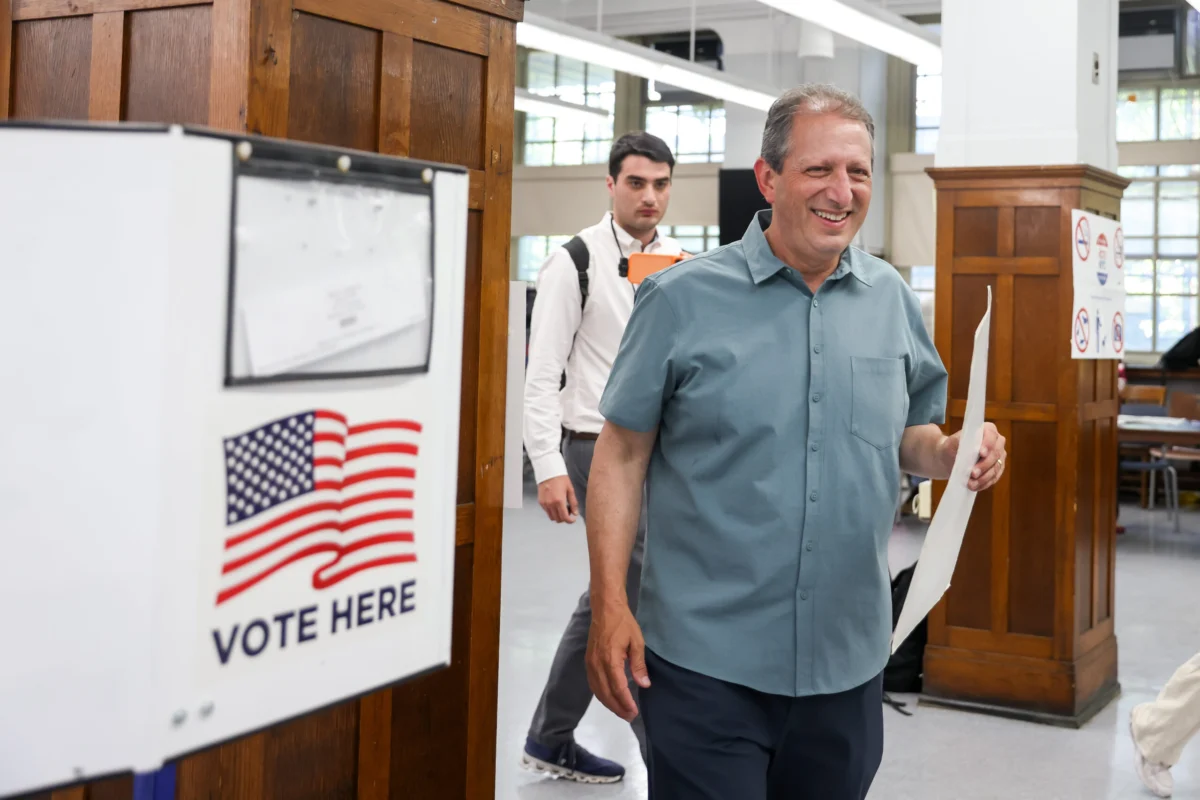
New York’s 10th congressional district, a vibrant tapestry of Brooklyn and Manhattan neighborhoods, is bracing for a fiercely contested Democratic primary on Tuesday, June 23, 2026. Conventional wisdom, which typically favors scandal-free, two-term incumbents who maintain a strong community presence and vote largely in line with their party, might suggest a smooth path to re-nomination for Congressman Dan Goldman. Yet, Goldman, a prominent figure known for his role as lead counsel in the first impeachment inquiry against former President Donald Trump, finds himself embroiled in an unexpectedly bitter and high-stakes battle for his political survival against former New York City Comptroller Brad Lander. This race has evolved into a pivotal test for the burgeoning influence of progressive politics in New York City, the enduring power of organized labor, and the deep divisions within the Democratic Party over issues ranging from economic populism to foreign policy.
The contest culminates amidst a backdrop of increasing anti-establishment sentiment sweeping through Democratic primaries nationwide, echoing calls for a more assertive progressive agenda. Lander, a seasoned progressive politician with a long history in New York City government, aims to harness this energy. He has strategically positioned himself to Goldman’s left, garnering significant endorsements from influential progressive figures, including US Senator Bernie Sanders (I-Vt.) and New York City Mayor Zohran Mamdani, along with the powerful New York Working Families Party.
A Progressive Challenger Emerges: Brad Lander’s Bid
Brad Lander’s political career has been characterized by a consistent progressive stance and a deep engagement with local policy. Prior to his current challenge, Lander served as the New York City Comptroller, a powerful oversight role responsible for auditing city agencies, managing pension funds, and ensuring fiscal accountability. Before that, he represented parts of Brooklyn on the City Council for over a decade, where he championed legislation on workers’ rights, affordable housing, and good governance. His 2025 mayoral primary campaign, though ultimately unsuccessful in securing the nomination, saw him consolidate a significant portion of the progressive vote through a strategic cross-endorsement with then-candidate Zohran Mamdani, who ultimately triumphed in the general election.
Lander officially launched his congressional campaign in December, even before Mayor Mamdani was sworn into office, signaling the importance of the mayor’s endorsement to his strategy. Mayor Mamdani, a rising star in the progressive movement, offered his unequivocal support early, stating, "[Brad] has been a trusted ally and partner of mine, and I’m proud to support him. I know he’ll keep delivering for those who need government to show up for them the most." This early backing from a popular progressive mayor, especially in a district that supported Mamdani by nearly 25 percentage points in the previous mayoral election, has been a cornerstone of Lander’s campaign narrative, framing him as the true progressive champion aligned with the city’s political trajectory.
The 10th congressional district, encompassing diverse and largely liberal areas like Park Slope, Gowanus, Lower Manhattan, and parts of Sunset Park, is indeed one of the most leftward-leaning districts in the country, according to the Cook Political Report’s Partisan Voting Index. Its demographics skew younger, more educated, and notably progressive, making it fertile ground for a challenger like Lander. The district’s deep blue hue means the Democratic primary is effectively the general election, intensifying the internal party struggle.
The Incumbent’s Stance: Dan Goldman’s Fight for Re-nomination
Congressman Dan Goldman, a scion of the Levi Strauss fortune, entered Congress with a distinct profile. A former federal prosecutor, Goldman gained national prominence as the lead counsel for House Democrats during the first impeachment inquiry into former President Donald Trump. His background in law and his role on the national stage positioned him as a pragmatic Democrat, focused on legislative work and national issues. In his two terms, Goldman has maintained a relatively low national profile, concentrating on constituent services and aligning with mainstream Democratic policy.
Despite his initial advantages, the race quickly tightened, prompting Goldman to respond forcefully. Acknowledging the financial demands of a competitive primary, Goldman pledged to match up to $1 million in campaign donations, leveraging his personal wealth to counter Lander’s grassroots momentum and progressive endorsements. This move underscored the high stakes and the incumbent’s determination to retain his seat.
Beyond financial outlays, Goldman has sought to anchor his campaign in an issue historically central to American progressivism: a strong alliance with organized labor. New York City boasts a union density rate of approximately 20%, double the national average, making labor unions indispensable electoral allies. In a city where unions wield significant influence, candidates often compete fiercely to demonstrate their commitment to workers’ rights and priorities. Goldman has actively courted union support, presenting himself as the reliable advocate for working families in Washington.
The 485-x Controversy: A Flashpoint for Labor
A central point of contention that has galvanized the race is Lander’s outspoken opposition to Section 485-x of the New York State Real Property Tax Law. This statute, enacted in April 2024, replaced the long-standing 421-a program and was designed to incentivize developers to construct affordable housing while also establishing robust wage floors and mandatory annual wage increases for construction workers on eligible projects. Specifically, projects with at least 100 units must pay construction workers a minimum of $40 an hour, while those over 150 units mandate wages of $63 or $72.45 an hour, depending on the zone, or a percentage of the greatest prevailing wage, with annual 2.5% increases.
However, a critical "loophole" within 485-x exempts projects with fewer than 100 units from these wage and affordability requirements. This exemption has created an incentive for developers to build smaller, market-rate projects, undermining the law’s stated goals of increasing affordable housing and ensuring fair wages for a broader segment of construction workers.
Lander has been an ardent critic of this aspect of 485-x. In a forum last month with New York Law School, he lambasted the law, stating, "I think that the governor gave in to the building trades, and, as a result, no new housing is being produced under that program." He further elaborated, "[With] the cockamamie approach they put in [485-x], with different zones and a made-up wage level, they created a whole new bureaucracy in order for the governor to satisfy the building trades, and now no new housing is being built."
Goldman seized upon Lander’s critique as a strategic opening, framing it as an attack on organized labor. In a late May Facebook post, Goldman asserted, "My opponent says he’s the true progressive in this race, which is interesting, because he clearly has a problem with our city’s labor unions." He continued, "Last week in a forum, he blamed the building trades for… our housing crisis in New York City. That doesn’t seem very much like pro-labor to me; that doesn’t seem very progressive."
Lander’s campaign, in turn, has defended his position, arguing that his criticism targets the flawed design of the law, not the unions themselves. A Lander spokesperson told Spectrum News 1, "Brad has criticized the 485x program because it’s just not working to build affordable housing or to protect workers and everyone knows it. It’s strange for elected officials or labor union officials to be defending a program in which 99% of the developments have taken advantage of a loophole that requires zero affordable housing or good jobs." They contend that the loophole undermines both affordability and labor standards, leading to a proliferation of smaller, non-union, market-rate developments.
The Labor Divide: Building Trades vs. Progressive Unions
Lander’s stance on 485-x has drawn the ire of some powerful building trades unions, who view the law as a hard-won victory for their members. Kevin Elkins, director of political action for the NYC District Council of Carpenters (NYCDCC), publicly dubbed Lander "Scab Lander" in a May X post – a potent and highly derogatory term in labor circles, equating Lander’s criticism to strike-breaking. Later that month, NYCDCC members protested outside Lander’s Brooklyn office, chanting "Who’s the rat? Lander!" These actions underscore the depth of the building trades’ commitment to 485-x and their perceived defense of the program against what they see as anti-worker rhetoric.
Goldman has actively embraced the support of the NYCDCC and other building trades, frequently touting their endorsements. In a statement shared with CNBC, Goldman affirmed, "New York’s working families and organized labor have been my North Star throughout my time in office, and I’m deeply honored that the overwhelming majority of unions representing the hard-working men and women who keep New York City running are supporting me in this race. I will always fight for organized labor – the heart and soul of our city." Mario Cilento, president of the New York State AFL-CIO, echoed this sentiment, praising Goldman for fighting "to create thousands of family-sustaining construction jobs in Brooklyn and put workers first." Janella Hinds, vice president for academic high schools at the United Federation of Teachers, reiterated the need for Goldman to ensure "that the voices of working people are always heard, that unionized workers have a voice in Congress and in our government."
However, Goldman’s narrative as the sole champion of labor is complicated by a significant split within the broader labor movement. While twenty New York City-based labor unions, predominantly building trades, have endorsed Goldman, a powerful coalition of progressive-leaning unions has thrown its weight behind Lander. These include the United Auto Workers (UAW), the New York State Nurses Association (NYSNA), the Communications Workers of America (CWA), and 32BJ SEIU.
These unions articulate a different vision for labor advocacy. A CWA spokesperson told CNBC, "There really is no legislator who has been a greater friend to CWA than Brad Lander. He’s devoted his entire career to public service, and in every elected office he’s held, he’s used his position to advocate for working people and has really walked the walk in terms of prioritizing working families and the middle class." The CWA specifically cited Lander’s commitment to national pro-labor legislation, such as the Protecting the Right to Organize (PRO) Act, as a key factor in their endorsement. This perspective reflects a broader national frustration among labor leaders over the stalled progress of major federal labor reforms, leading many to prioritize candidates who will aggressively push for new legislation.
Manny Pastriech, President of 32BJ SEIU, highlighted Lander’s extensive record of local accomplishments. "As NYC Comptroller, he worked furiously to enforce our city’s worker protection laws and helped win justice and overdue wages for thousands of wronged workers, including in industries 32BJ organizes in," Pastriech said. He added, "In the City Council, he passed new labor standards like the Fair Workweek Law to help bring stability to working peoples’ lives, legislation that was a 32BJ top-priority." This demonstrates that for many unions, a candidate’s legislative track record at the local level and their commitment to enforcement of existing labor protections are equally, if not more, important than their stance on specific development tax laws.
Historical Context and Broader Implications
The fractured labor support in NY-10 stands in contrast to past progressive insurgencies in New York City. In cases like Alexandria Ocasio-Cortez’s upset victory in the 2018 NY-14 Democratic primary or Jamaal Bowman’s 2020 win in NY-16, most NYC unions largely united behind the incumbent representatives. Even in the current cycle, Representative Adriano Espaillat, facing a challenge from his left in NY-13, has seen near-unanimous labor backing, despite his opponent being a current union member. The split in NY-10 suggests a deepening ideological chasm within the labor movement itself, between those prioritizing established relationships and specific project-based benefits, and those seeking broader systemic reforms and an alignment with the progressive movement’s overall agenda.
This race serves as a crucial benchmark for Mayor Mamdani’s political influence. His early and strong endorsement of Lander is a significant investment of his political capital. A Lander victory would solidify Mamdani’s position as a kingmaker within the city’s progressive landscape, empowering him to further shape the Democratic Party’s direction. Conversely, a Goldman victory would represent a setback for the mayor’s endorsement power and the broader progressive movement’s ability to unseat incumbents.
The debate over Israel, alluded to in the original reporting, also plays a subtle yet significant role in this primary. While not as overtly central as the labor issue, the ongoing conflict and the Biden administration’s stance have created palpable tensions within the Democratic Party, particularly among younger and more progressive voters. Lander’s alignment with the progressive wing often translates to a more critical stance on Israeli policy, which resonates with segments of the NY-10 electorate, further differentiating him from Goldman, who generally aligns with the Democratic Party’s mainstream foreign policy positions.
The Polling Picture and the Road Ahead
The limited public polling for the NY-10 race has shown conflicting results, highlighting the fluidity and competitiveness of the contest. However, a recent Emerson College poll indicated a surprising 34-point lead for Lander over Goldman, suggesting a significant shift in voter sentiment. This dramatic lead, if accurate, would represent a monumental upset. Prediction markets, which often reflect aggregated informed opinion and financial stakes, appear to align with this sentiment, with Lander’s odds on platforms like Kalshi nearing 100%. While not definitive, prediction markets are often seen as strong indicators of likely outcomes, suggesting that many observers believe the race has already been decided in Lander’s favor.
As Tuesday’s primary approaches, the outcome of the NY-10 race will offer critical insights into several evolving dynamics within the Democratic Party. It will test the true extent of anti-establishment sentiment, the durability of progressive coalition-building, the influence of local policy debates on federal elections, and the future alignment of organized labor. For the Democratic Party, the question is whether to preserve institutional power by backing a labor-friendly incumbent or to fully embrace an upstart who promises more aggressive legislative action. The voters of New York’s 10th congressional district will provide a definitive answer to this question, potentially reshaping the political landscape of New York City and offering a potent lesson for national progressive movements.
