

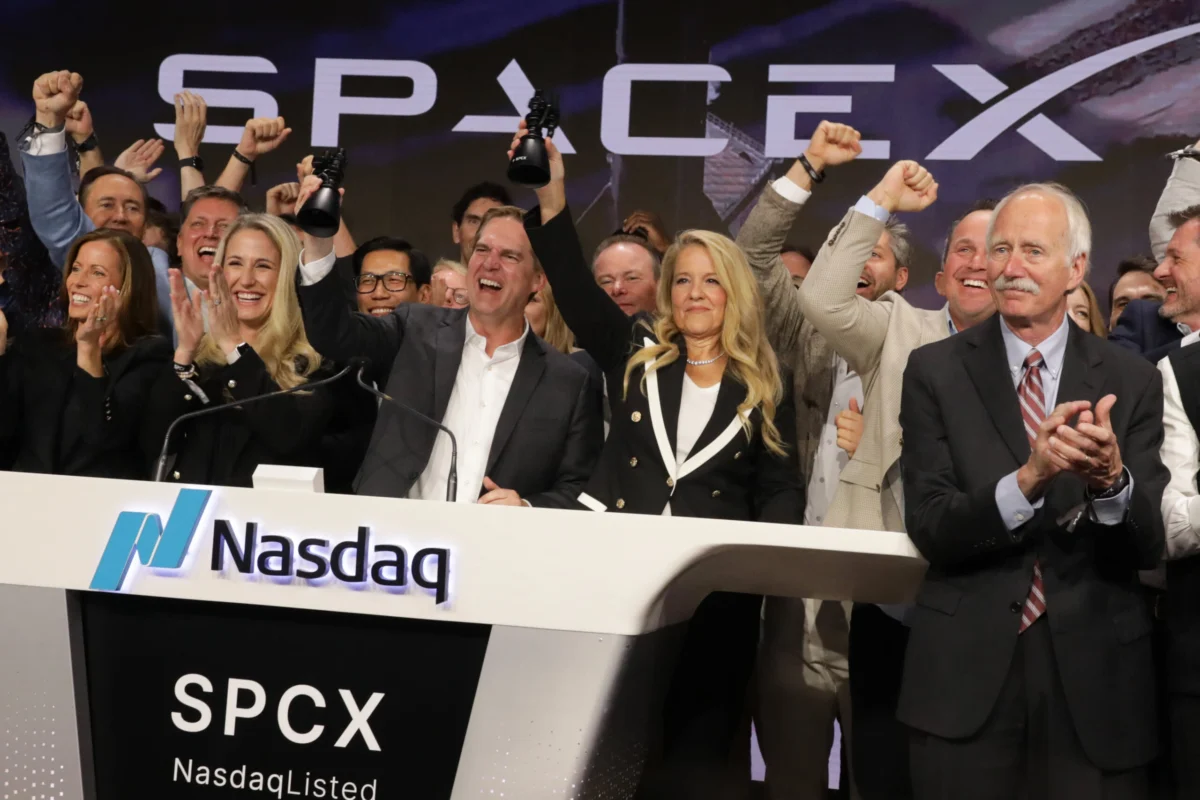
The highly anticipated public debut of SpaceX, the aerospace manufacturer and space transportation services company founded by Elon Musk, on Friday, June 12, 2026, marked a pivotal moment for the burgeoning commercial space industry and the broader equity markets. While the initial surge in its stock price captured significant attention, financial analysts, particularly Peter Haynes, head of index and market structure at TD Securities, emphasize that the true financial gravitational pull for SpaceX will come not from its initial public offering (IPO) but from its eventual inclusion in key market indexes. This strategic integration into benchmarks like the Nasdaq 100, S&P Total Market Index, MCI Global Index, and Russell Indexes is poised to exert a far more profound and enduring impact on its valuation and investor base.
SpaceX’s monumental entry onto the Nasdaq exchange at 11:46 a.m. ET on Friday was met with robust investor enthusiasm. The stock, trading under the ticker SPCX, immediately signaled strong demand, closing the day with a remarkable surge of over 19% to $160.95 per share. This impressive performance propelled the company’s market capitalization to exceed an astonishing $2 trillion, a valuation that immediately positioned it among the world’s most valuable publicly traded entities. The successful IPO underscored the market’s profound confidence in SpaceX’s ambitious vision, its technological prowess, and its diverse revenue streams ranging from satellite internet services to human spaceflight and interplanetary exploration.
The Unfolding Space Economy and SpaceX’s Dominance
SpaceX’s journey to becoming a publicly traded behemoth is rooted in its revolutionary impact on the space industry. Founded in 2002 with the audacious goal of making life multi-planetary, the company has systematically disrupted traditional aerospace by pioneering reusable rocket technology, drastically reducing launch costs, and accelerating the pace of space exploration. Its Falcon 9 and Falcon Heavy rockets have become the workhorses for commercial and government satellite launches, including critical missions for NASA.
Beyond launch services, SpaceX’s Starlink constellation, a rapidly expanding network of thousands of low-Earth orbit satellites, provides high-speed, low-latency internet access globally, a service that has proven invaluable in underserved areas and during humanitarian crises. The development of Starship, SpaceX’s fully reusable super heavy-lift launch system, represents another quantum leap, designed to transport both cargo and humans to the Moon, Mars, and beyond. This ambitious project, coupled with lucrative contracts from NASA for lunar landers as part of the Artemis program, paints a picture of a company with unparalleled growth potential and a diversified portfolio of groundbreaking technologies. The commercial space industry, once the domain of government agencies, has transformed into a vibrant economic sector projected to reach over a trillion dollars in value within the next decade, with SpaceX undeniably at its forefront. The company’s unique blend of innovation, proven execution, and visionary leadership under Elon Musk has cultivated a dedicated investor following, eagerly anticipating its long-awaited public offering.
Beyond the IPO Hype: The Criticality of Index Inclusion
While the IPO’s initial price action generates significant headlines, experienced market strategists like Peter Haynes correctly pivot the conversation towards index inclusion. For a company of SpaceX’s magnitude, being added to major stock market indexes is not merely a symbolic gesture; it is a fundamental driver of long-term capital inflow, liquidity, and stability.
The mechanics are straightforward: a vast and ever-growing portion of global investment capital is managed passively through index funds, exchange-traded funds (ETFs), and institutional mandates that are designed to track specific benchmarks. When a stock is added to an index, these passive funds are obligated to purchase shares of that company to maintain their tracking accuracy. This creates guaranteed demand, often in the billions of dollars, for the newly included stock. Conversely, exclusion or delayed inclusion can mean missing out on this significant, consistent buying pressure.
For a company like SpaceX, which has commanded considerable private market valuation and investor anticipation, index inclusion acts as a crucial bridge, integrating it deeply into the broader financial ecosystem. It transitions the stock from being a speculative growth play, primarily attractive to active fund managers and retail investors, to a core holding for a much wider array of institutional capital. This process typically leads to increased trading volume, reduced price volatility (as passive buying offsets active selling), and enhanced long-term price appreciation as the company becomes a staple in diversified portfolios.
Navigating the Index Landscape: Key Dates and Benchmarks
According to TD Securities’ Peter Haynes, investors should mark specific dates on their calendars, as these will dictate the flow of institutional capital into SpaceX. Haynes specifically highlighted July 6, 2026, as a crucial milestone: "Day 15 [after SpaceX goes public], which should be July 6… will be the day that Nasdaq rebalances the 100 Index to reflect SpaceX’s IPO shares," he told CNBC’s "ETF Edge" ahead of the IPO.
The Nasdaq 100 Index, known for tracking 100 of the largest non-financial companies listed on the Nasdaq exchange, is a particularly significant benchmark for growth-oriented technology and innovation companies. Its inclusion criteria typically focus on market capitalization and liquidity, making SpaceX a natural fit given its massive valuation. The rebalancing process involves recalculating the index’s composition and weightings to incorporate new entrants and adjust for market changes. This event will trigger substantial buying from funds that mirror the Nasdaq 100, providing an immediate and significant boost to SpaceX’s institutional ownership.
Beyond the Nasdaq 100, Haynes indicated that other major benchmarks, including the S&P Total Market Index, MCI Global Index, and Russell Indexes, would likely adjust their compositions "early this summer." The S&P Total Market Index, as its name suggests, aims to capture the entire investable U.S. equity market, offering a broad-based inclusion path. The MCI Global Index (likely referring to MSCI Global Indexes) represents a suite of international equity benchmarks widely used by global investors. Russell Indexes, particularly the Russell 1000 and Russell 2000 (which combine to form the Russell 3000, representing the vast majority of the U.S. market), are also crucial for institutional investment. Annual rebalances for these indexes, typically occurring in late spring or early summer, will ensure SpaceX’s shares are proportionally represented, further solidifying its position within diverse investment portfolios.

Haynes also pointed to the longer-term consideration of "when do indexes adjust for the additional shares that will be freely tradable down the road." This refers to the common practice of IPO lock-up periods, where initial investors and company insiders are restricted from selling shares for a certain period (typically 90 to 180 days) after the IPO. Once these lock-ups expire, a new tranche of shares becomes available for trading, which indexes then need to incorporate into their calculations. These subsequent adjustments can create additional waves of institutional buying as passive funds rebalance their holdings to reflect the increased float.
The S&P 500’s Stance: A Controversial Exclusion
Perhaps the most talked-about aspect of SpaceX’s index journey, however, has been its initial exclusion from the prestigious S&P 500 Index. Earlier in June 2026, the S&P 500 Index Committee announced what Peter Haynes termed a "controversial decision": SpaceX would not be fast-tracked into the index. This means the aerospace giant must adhere to the standard eligibility criteria, which mandates that a company must have traded on the market for at least one full year before it becomes eligible for inclusion.
The S&P 500 is considered the benchmark of large-cap U.S. equities, representing approximately 80% of the total market capitalization of publicly traded American companies. Its inclusion criteria are stringent, requiring companies to meet specific thresholds for market capitalization, liquidity, U.S. domicile, and, crucially, consistent profitability over the preceding four quarters. While SpaceX undoubtedly satisfies the market cap and liquidity requirements, and its U.S. domicile is clear, the one-year trading history rule proved to be the immediate barrier.
The decision was "controversial" because of SpaceX’s unprecedented size and impact. With a market capitalization exceeding $2 trillion on its debut, it instantly dwarfed many existing S&P 500 constituents. Many market participants and analysts had speculated that S&P Dow Jones Indices might make an exception or expedite its inclusion, given the company’s significant weight and influence on the broader market. Tesla, Elon Musk’s other major venture, faced a similar waiting period, eventually being included in the S&P 500 in December 2020 after demonstrating a consistent track record of profitability and meeting the one-year trading requirement.
The S&P 500’s steadfast adherence to its established rules, despite the immense scale of SpaceX, reinforces the index committee’s commitment to maintaining the integrity and methodological consistency of its benchmarks. This delay means that institutional investors who strictly track the S&P 500 will not be able to hold SpaceX shares directly within those portfolios for at least another year. This could potentially lead to a bifurcated market, where some large-cap growth funds might buy actively, while core large-cap passive funds remain on the sidelines, at least for now. "That leaves us with the other benchmarks and their rebalancing schedule," Haynes observed, underscoring the heightened importance of other index inclusions in the interim.
Broader Implications for Investors and the Space Sector
The implications of SpaceX’s public debut and its subsequent index integration are far-reaching. For investors, particularly those in passive funds, it means exposure to one of the most innovative and rapidly growing companies in the world will gradually become unavoidable as indexes adjust. For active managers, the initial IPO surge and upcoming index rebalances present distinct trading opportunities and portfolio re-evaluations. The delayed S&P 500 inclusion, while initially disappointing to some, might also present a longer window for active investors to establish positions before the inevitable wave of passive buying.
For the broader space sector, SpaceX’s successful IPO and its integration into major indexes could serve as a powerful catalyst. It validates the immense commercial potential of space ventures and could attract significantly more institutional capital into the nascent "space economy" theme. This influx of capital could fuel further innovation, accelerate technological advancements, and encourage other private space companies to consider public listings, thereby expanding the investment landscape within this exciting sector.
Peter Haynes’ observation post-IPO, "We take for granted that the infrastructure that supports the equity trading business always works. Today was a test of that infrastructure and in my opinion the industry passed the test," speaks volumes about the technical challenges involved in bringing a company of SpaceX’s scale to market. The seamless execution of its Nasdaq debut, handling immense trading volumes and price discovery, underscores the robustness of modern financial markets, even under extraordinary circumstances.
A Chronology of Key Events and Future Milestones
The journey of SpaceX to full market integration is a multi-stage process:
- Early June 2026: S&P 500 Index Committee announces its decision not to fast-track SpaceX, reaffirming the one-year trading history requirement. This sets the earliest eligibility date for S&P 500 inclusion to June 2027.
- Friday, June 12, 2026: SpaceX debuts on the Nasdaq exchange, with its stock surging over 19% and market capitalization exceeding $2 trillion.
- July 6, 2026: Scheduled date for the Nasdaq 100 Index rebalance, incorporating SpaceX’s IPO shares and triggering significant passive investment buying.
- Early Summer 2026: Anticipated rebalancing dates for other major indexes, including the S&P Total Market Index, MCI Global Index, and Russell Indexes, which will integrate SpaceX into their compositions.
- Late 2026 / Early 2027: Potential expiry of IPO lock-up periods, leading to additional shares becoming freely tradable and subsequent index adjustments.
- June 2027 onwards: SpaceX becomes eligible for consideration for inclusion in the S&P 500 Index, provided it meets all other criteria, including sustained profitability.
In conclusion, while SpaceX’s IPO was a spectacular event, validating its gargantuan valuation and market excitement, the ongoing narrative revolves around its strategic assimilation into the global financial fabric through major stock market indexes. The meticulous process of index rebalancing, led by insights from firms like TD Securities, highlights that for a company of SpaceX’s stature, the real and lasting impact on its investor base and long-term valuation will stem from the systematic, often passive, capital flows dictated by these crucial benchmarks. The initial market frenzy has subsided, giving way to a more measured, yet equally significant, journey towards becoming a permanent fixture in institutional portfolios worldwide.
